Elevate your local knowledge
Sign up for the iNFOnews newsletter today!
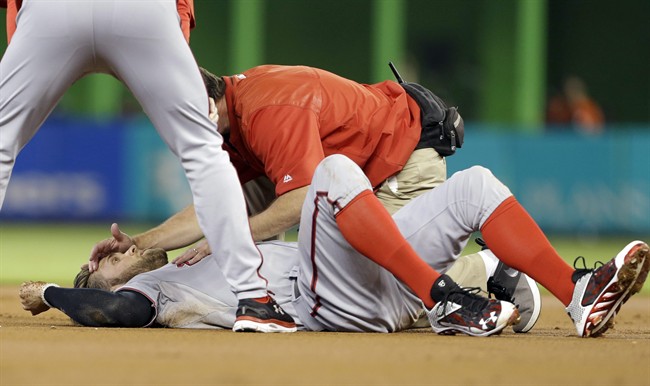
MIAMI – Bryce Harper left the Washington Nationals’ game against Miami on Sunday with dizziness but passed postgame concussion tests after colliding with Marlins second baseman Derek Dietrich in the first inning.
“I tried to get up on my own, but I felt pretty dizzy,” Harper said. “Once I rolled I just said that I didn’t feel right. I was looking up into the stadium and I just didn’t feel good at all.
“I told them I was fine to play, but once I said I was dizzy they were just like, ‘There’s no point’ and just got me out there.”
Harper reached base on a fielder’s choice and was attempting to run to third on Jayson Werth’s grounder to shortstop Miguel Rojas with third baseman Martin Prado out of position. Dietrich was going to second to cover the base when the two collided as Rojas’ throw went to first base for the final out.
“It felt like a helicopter or something,” Harper said.

Harper stayed down for several moments, then walked off on his own after trainers tended to him. He was tested for a concussion and put some ice on his left hip, which has been ailing him.
“All tests now and since have been really good,” Nationals manager Matt Williams said. “No signs of a concussion, so we’ll keep evaluating him through the night and see how he is tomorrow.”
Harper said: “I’m good now, I’m totally fine.”
Harper is hitting .333 with 36 homers and 85 RBIs. He was replaced by Matt den Dekker, who homered in his place.
The Nationals begin a three-game series at Philadelphia on Monday.
News from © The Associated Press, . All rights reserved.
This material may not be published, broadcast, rewritten or redistributed.

This site is protected by reCAPTCHA and the Google Privacy Policy and Terms of Service apply.
Want to share your thoughts, add context, or connect with others in your community?
You must be logged in to post a comment.