Elevate your local knowledge
Sign up for the iNFOnews newsletter today!
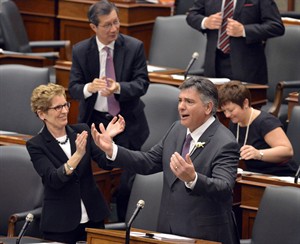
TORONTO, ONTARIO, – Ontario’s minority Liberals used Thursday’s budget to clearly signal their dedication to bolstering the province’s infrastructure by allocating $35 billion in spending over three years, one of the largest commitments to a single element in their fiscal plan.
The province aims to spend nearly $13.5 billion in 2013-2014 on building transit, highways, hospitals, post-secondary institutions and hospitals.
“We will continue to make investments in modern infrastructure,” Finance Minister Charles Sousa said in the legislature.
“Because we know that growth in Ontario’s economy is supported by the movement of goods and people.”
The government said the planned investments would support over 100,000 jobs on average across the province each year.
One of the biggest chunks of the planned spending will go to transit — earmarked at $3.4 billion for the next fiscal year — and provincial highways, which will receive $2.2 billion over the same period.
The spending falls in line with Premier Kathleen Wynne’s insistence that she’s not afraid to make transit and road infrastructure a major part of her platform should a lack of opposition support for the budget trigger an election.
While it wasn’t entirely clear where all the funds for infrastructure would come from, one source of revenue detailed by the government was a new plan to allow drivers the option to pay a toll to use high-occupancy vehicle lanes even if they don’t have passengers.
The province stressed that the so called high-occupancy toll or HOT lanes would be voluntary and planned to introduce the plan at the end of the year. The province also plans to increase the number of Ontario’s HOV lanes.
Sousa estimated the measures will bring in $250 million to $300 million in “additional revenue” which will be used to pay for public transit in the congested Greater Toronto and Hamilton Area.
The emphasis on giving drivers a choice was a nod to the New Democrats, who have insisted that no tolls be used to pay for expanding public transit and repairing roads and bridges. The minority Liberals used many of the highlights in their budget to target the NDP, whose support for the fiscal plan is needed to avoid an election.
The budget also included a boost for municipalities who get a share of the provincial gas tax to fund public transit with the government promising to permanently transfer two cents per litre of gas to them.
One reason the budget was slim on details of how the province would fund much of its transit spending was because the Liberals are waiting for a report due in June from Metrolinx, the transit planning agency.
The report will recommend a combination of tolls, taxes or levies that could be used to raise the $2 billion a year for 25 years needed to help ease gridlock in the Toronto-Hamilton area.
Metrolinx has already said it will consider highway tolls, raising the sales tax and a half-cent-a-litre tax on gasoline to help fund transit, in addition to a per kilometre charge or congestion fees.
Wynne has already suggested she has no plans to hike property taxes, saying it would not raise enough money to pay for all the transit infrastructure that’s needed in the region.
Municipal politicians outside Toronto are concerned about having to pay for improvements to services their residents don’t use, while Toronto Mayor Rob Ford has said he’ll oppose any tax hike to fund transit.
The government said Thursday that new investments in transportation will reflect the needs of different communities and would not “unfairly impact one type of commute” over another.
It also pledged to be transparent when dedicating new revenue from transportation-related projects so the investment could be “directly tied to measurable results.”
Other transit and highway spending highlights include:
_ Investing in GO Transit to increase capacity to 50,000 more riders per day.
_ Investing up to $416 million towards the renewal of Toronto’s streetcars and up to $600 million towards Ottawa’s light rail transit
_ Widening key sections of Highway 402 in the GTA, Highway 417 in Ottawa and Highway 11/17 in Thunder Bay and Nipigon.
The plan includes a previously announced $100 million fund to help small, rural and northern municipalities improve their roads, bridges and other infrastructure. The funds for the program will be available by October.
The government also pledged to consult on a permanent program for “critical infrastructure investments” in small and rural municipalities for the 2014 budget.
Meanwhile, hospitals stand to receive $2.9 billion in infrastructure spending while schools will get $2 billion. Post-secondary institutions are to get $569 million.
News from © The Canadian Press, . All rights reserved.
This material may not be published, broadcast, rewritten or redistributed.

This site is protected by reCAPTCHA and the Google Privacy Policy and Terms of Service apply.
Want to share your thoughts, add context, or connect with others in your community?
You must be logged in to post a comment.