Elevate your local knowledge
Sign up for the iNFOnews newsletter today!
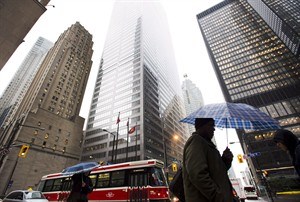
TORONTO – The Toronto stock market appeared set for another negative session Tuesday as economic concerns pressured commodity prices and traders awaited more clarity on what the Federal Reserve may decide to do about cutting back on a key stimulus measure.
The Canadian dollar was down 0.24 of a cent to 96.45 cents US.
New York futures were higher with traders encouraged by better than expected earnings from retailers Best Buy, Home Depot and J.C. Penny.
The Dow Jones industrial futures rose 25 points to 15,027, the Nasdaq gained eight points to 3,078.5 while the S&P 500 futures gained 3.75 points to 1,648.75.
Traders looked ahead to Wednesday and the release of the minutes from the Fed’s most recent meeting at the end of last month. A largely positive run of economic data has persuaded many investors that the central bank will start to taper its monthly bond purchases of US$85 billion, which have kept long term rates low and encouraged a sharp runup on many markets this year. They think the Fed could start winding up its third instalment of quantitative easing as early as September.
Speculation over Fed intentions pushed the September crude contract on the New York Mercantile Exchange down 99 cents to US$106.11 a barrel.
Copper was unchanged at US$3.33 a pound while gold dipped a dime to US$1,365.60 an ounce.
Home Depot beat Wall Street expectations and raised its full-year earnings and revenue expectations. The company earned US$1.8 billion, or $1.24 per share while revenue climbed more than nine per cent to $22.52 billion. Analysts expected earnings of $1.21 per share on revenue of $21.79 billion and its stock was up about two per cent in pre-market trading.
J.C. Penney Co. stock rose three per cent despite another big loss on a nearly 12 per cent drop in revenue for the second quarter. It lost $586 million, or $2.66 per share while revenue reached $2.66 billion. Analysts were expecting a $1.07-per-share loss on revenue of $2.77 billion.

Best Buy shares rocketed 15 per cent as cost-cutting efforts and a benefit from legal settlements led to a quarterly profit of $266 million or 77 cents a share. The biggest specialty electronics store in the U.S. said earnings ex-items were 32 cents per share against the 12 cents that analysts had expected. Revenue fell slightly to $9.3 billion from $9.34 billion last year. Analyst expected $9.13 billion.
In the resource sector, newly-merged commodities and mining group Glencore Xstrata Plc reported a near $9 billion first-half loss as it wrote down the value of its mining assets by $7.66 billion. The company said the write-down reflected “the broader negative mining industry environment” and the heightened risks of taking on some big projects. The charge was more than the $7 billion expected by most analysts and the company’s share price fell two per cent in London trading.
BHP Billiton is investing US$2.6 billion to finish preparing its Jansen Potash project in Saskatchewan. The Australian company says the investment will be spread over a number of years with completion of two mining shafts expected during 2016.
The TSX tumbled almost 150 points Monday, largely wiping out last week’s resource-sector led gain of 1.5 per cent amid economic concerns and uncertainty about what the Fed will do.
Utilities were also a major drag as the prospect of the Fed tapering its massive bond purchases sent U.S. bond yields higher. The benchmark U.S. 10-year Treasury was off 0.05 of a point from late Monday at 2.83 per cent. Bond yields have surged well over a full percentage point since Fed chairman Ben Bernanke first mentioned the possibility of the Fed cutting back in May.
Meanwhile, U.S. stocks have recorded a four-day losing streak for the first time in 2013 as the bond yields have edged up to their highest levels since 2011. At the same time, trading volumes are modest amid a traditional summer lull.
Analysts also suggest that the American market has been looking expensive after a rally that started late last year had boosted the Dow industrials up almost 20 per cent year to date. Recent declines have still left the blue chip barometer up about 15 per cent year to date.
Fed concerns also pressured European bourses and London’s FTSE 100 index lost 0.45 per cent, Frankfurt’s DAX fell 0.84 per cent and the Paris CAC was down 1.2 per cent.
News from © The Canadian Press, . All rights reserved.
This material may not be published, broadcast, rewritten or redistributed.

This site is protected by reCAPTCHA and the Google Privacy Policy and Terms of Service apply.
Want to share your thoughts, add context, or connect with others in your community?
You must be logged in to post a comment.