Elevate your local knowledge
Sign up for the iNFOnews newsletter today!
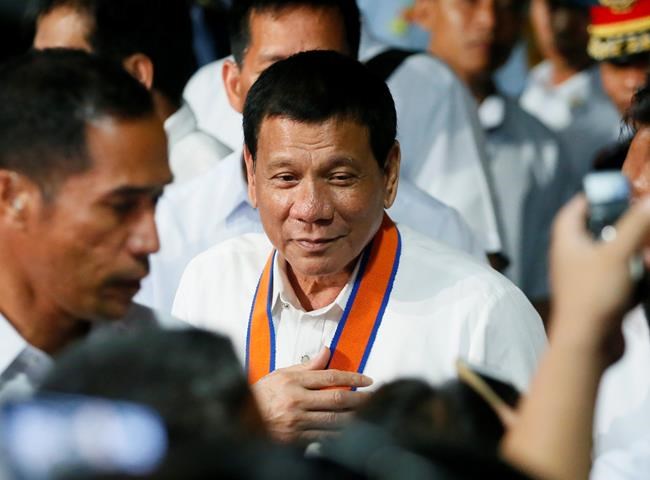
MANILA, Philippines – Philippine President Rodrigo Duterte said Wednesday he has ordered his defence chief not to prepare for joint exercises with the U.S. military next year as he moved to realize his threat to scrap a high-profile symbol of his country’s treaty alliance with Washington.
Duterte, however, reiterated he would not abrogate a 1951 Mutual Defence Treaty with the U.S. that provides a security umbrella for the Philippines. He has said, however, that he’ll chart a foreign policy not dependent on Washington.
“I insist that we realign, that there will be no more exercises next year, ‘Do not prepare,’ I told Defence Secretary Lorenzana,” he said in a speech at the anniversary of the country’s coast guard, referring to his defence chief.
Delfin Lorenzana said in a news conference last week that he has explained to the president the value of the annual military manoeuvrs with the Americans in responding to natural disasters and in potential security crises. The defence chief said he expected a final decision on the Philippines’s participation before the two sides started planning the drills.
Top officials of the U.S. Pacific Command in Hawaii are scheduled to fly to the Philippines later this month to discuss a range of defence issues, including plans for future joint exercises, said a Philippine defence official.
Manila’s defence department, however, has asked them to postpone their trip until after the U.S. presidential elections next month and after Duterte has finalized his decision to change the Philippine military’s engagements with U.S. forces, said the official, who spoke on condition of anonymity because of the delicate nature of the issue.
An eight-day combat exercise between U.S. and Philippine forces ended a day early Tuesday in an air of uncertainty because Duterte wanted to end such drills, saying the manoeuvrs only benefit the U.S. military.
Outgoing U.S. Ambassador to Manila Philip Goldberg said Washington wants to continue its robust alliance with the Philippines, saying both countries benefit mutually from the partnership.
“We have the desire to continue our alliance,” Goldberg told reporters. “Some of the things are beyond my control, beyond the U.S. control, but what I can tell you is the U.S. has a string of commitment to the Philippines, to the people of the Philippines, to the economic well-being of the Philippines.”
Aside from halting at least 28 joint combat exercises with U.S. forces each year, including the Balikatan or shoulder-to-shoulder drills that involve thousands of American and Filipino troops each year, Duterte has opposed joint patrols with the U.S. Navy in the disputed South China Sea. He also wants U.S. counterterrorism troops out of his country’s south, saying they inflame restiveness among minority Muslims, who resent atrocities committed by American colonial forces in the early 1900s.
Under Duterte’s predecessor, Benigno Aquino III, relations with the U.S. blossomed as the Philippines sought help in confronting Beijing over escalating territorial conflicts in the South China Sea and the U.S. reasserted its influence in Asia as a counterweight to China.
Duterte, who took office in June and labels himself as a left-wing politician, however, has taken steps to scale back his country’s military engagements with the U.S., which has criticized his bloody fight against illegal drugs, earning his ire. Contrastingly, Duterte has reached out to China and Russia.
Last week, the foul-mouthed Duterte told Barack Obama to “go to hell.” He issued a new warning to his detractors Wednesday.
“If I don’t respect you anymore, be prepared for the worst because I can give you gallons of gallons of epithets, curses,” Duterte said.
News from © The Associated Press, . All rights reserved.
This material may not be published, broadcast, rewritten or redistributed.

This site is protected by reCAPTCHA and the Google Privacy Policy and Terms of Service apply.
Want to share your thoughts, add context, or connect with others in your community?
You must be logged in to post a comment.