Elevate your local knowledge
Sign up for the iNFOnews newsletter today!
Elevate your local knowledge
Sign up for the iNFOnews newsletter today!
Select Region
Selecting your primary region ensures you get the stories that matter to you first.
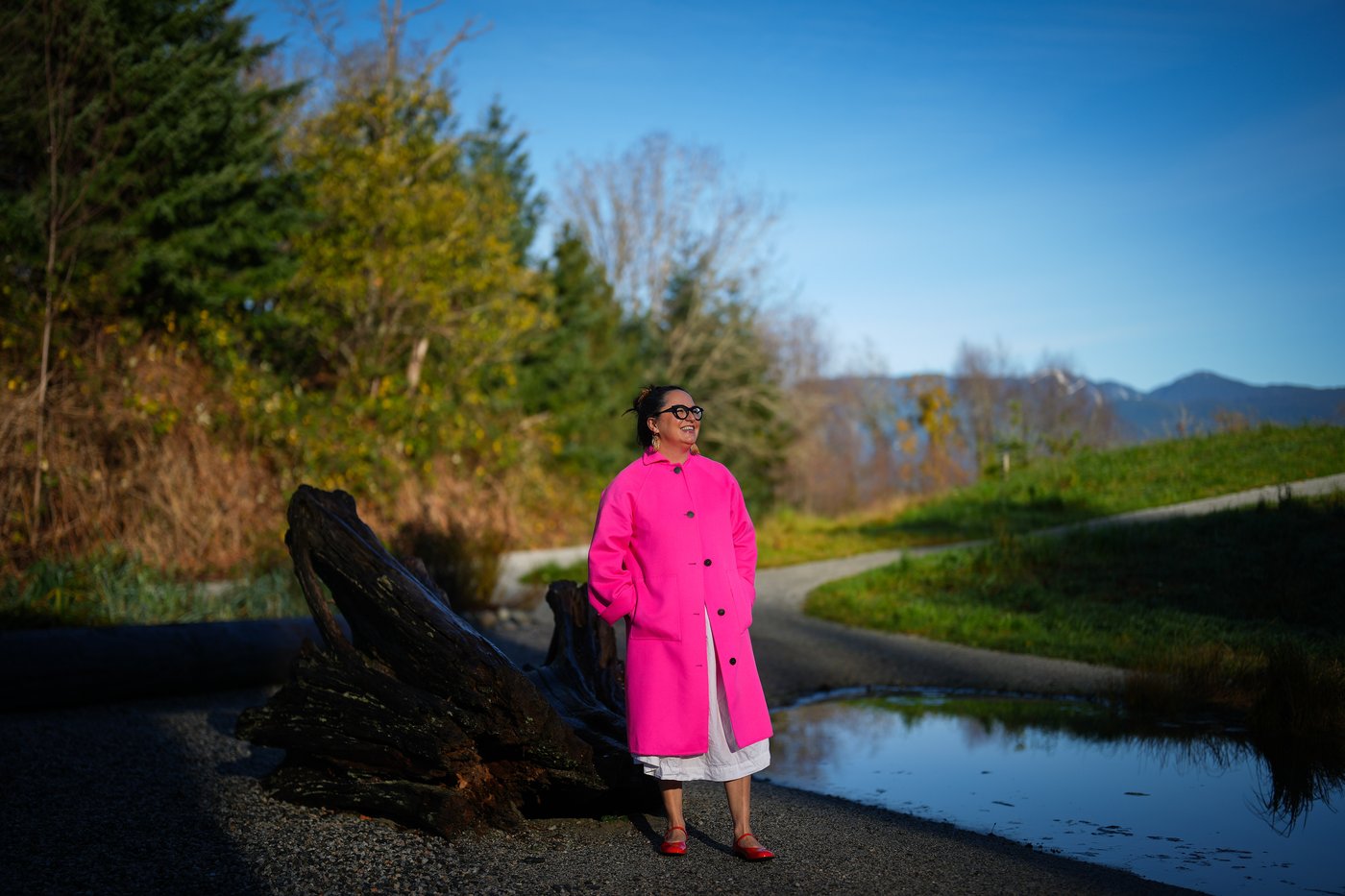
VANCOUVER — Meghann O’Brien used to feel connected to the mountain through her snowboard, but now she finds that link through the wool of a mountain goat used in her weaving for the last 15 years.
O’Brien said she looked for years to find someone who had killed a goat and was also willing to let her use its wool, a material of great importance to many Northwest Coast Indigenous communities, but it isn’t used much anymore.
The artist, who uses the name Jaad Kuujus in her work, has been weaving with the mountain goat wool in projects ever since, but not before the mountains helped her make a name for herself as a professional snowboarder.
“It was the process of working with the mountain goat wool that felt like it brought me back into the mountains, but from a different perspective, and that was unexpected,” she said.
The wool is used in multiple pieces for O’Brien’s solo show at the Museum of Anthropology in Vancouver, “Everyone Says I Look Like my Mother,” where intricately handwoven ceremonial regalia can be seen next to machine-produced reproductions.
O’Brien, who is Haida, Kwakwaka’wakw and Irish, taught herself to weave first basket in 2007. It was made from cedar bark and modelled after baskets that elders wore on their heads so their hands would be free to pick berries.
Without anyone to guide her, she did it backwards.
“I kind of just invented my first baskets, which were actually woven the exact opposite of how you weave a basket. So, I wove the outer sides of it and did a weird braiding technique, and then I spiralled into the centre. Normally you weave from the centre and outward,” she said.
Bad technique or not, she said she felt the pull of weaving right way.
“When I started weaving, it felt like it opened up a place in me that was connected to something really strong. It felt like something totally new. This really profound sense of belonging and community in Alert Bay, where I’d grown up,” she said of the small community on Cormorant Island, off northeastern Vancouver Island.
For several years she tried to weave and snowboard in order to satisfy sponsors while also spending time with accomplished weavers to learn the craft, and even once drove from Salt Lake City to Vancouver to attend a lesson.
“I’m sitting for a month straight weaving in this beautiful long house and fully engaged with this one practice that has so much power, and meaning, and depth to it. And then I would think, who’s that person that thinks it’s important to go and jump off a cliff and get a photograph and try get it published in a magazine?” she said.
“It was such a disconnect of worlds and it would take me a bit to transfer out of that, into valuing what I was doing as a snowboarder.”
Around 2010, she stepped away from snowboarding.
The mountain goat wool is still making various appearances, like in her latest show that runs from Dec. 4 to March 29, including in a T-shirt made from wool and yellow cedar bark.
“I wanted to make a contemporary form with this incredibly sacred, hand-spun, hand-processed material as a question,” she said.
“This very disposable item, can something be sacred based on what it’s made of?”
Some of the show’s pieces come with codes that visitors can scan with their phones, allowing them to have a more immersive experience with the piece.
In one case, a Chilkat apron is blown up to a larger scale, allowing people to see the individual stitches on their phones.
O’Brien said she wanted to invite people to see a woven piece, with its normally flat stitches, in a different way.
“When you’re weaving, it’s such a rich experience and such a multi-dimensional experience. Stitches just lays flat, but when you’re performing the stitch, you’re holding everything and the threads are moving in every direction. There’s so much movement,” she said.
“I’m really interested in how I can invite people into that.”
Her newest piece in the show, entitled the “Burden of Being an Echo” and completed this year, was created on a digital loom that O’Brien visited in the Netherlands.
She used the design of her most well-known, handwoven Chilkat robe “Sky Blanket” and had the machine produce five versions.
Unlike the handcrafted Sky Blanket, which took her years to complete, the machine-produced fabric arrived on a bolt to her Vancouver home relatively quickly, leaving her to unroll the fabric and finish the pieces by hand.
She said the process led her to questions about whether people can find themselves in other cultures and other ways of making things.
“It’s a bolt of fabric. And how do I extract ceremonial regalia out of this bolt of fabric that we’ve designed, you know? And it really felt like an archeological dig, of laying out and cutting and removing. Deconstructing,”
In the end, all five pieces are linked together by strands of the mountain goat’s wool.
“In some way, we’re all copies of the people before us. We’re these new versions that come out, but the fact (is) that we’ve got this unbroken line to wherever, however far back,” she said.
“There’s so much richness, I think, that we carry inside of ourselves that we don’t really connect to. Hopefully, people look toward themselves and a process of discovery of oneself.”
This report by The Canadian Press was first published Dec. 3, 2025.
News from © The Canadian Press, . All rights reserved.
This material may not be published, broadcast, rewritten or redistributed.

This site is protected by reCAPTCHA and the Google Privacy Policy and Terms of Service apply.
Want to share your thoughts, add context, or connect with others in your community?
You must be logged in to post a comment.