Elevate your local knowledge
Sign up for the iNFOnews newsletter today!
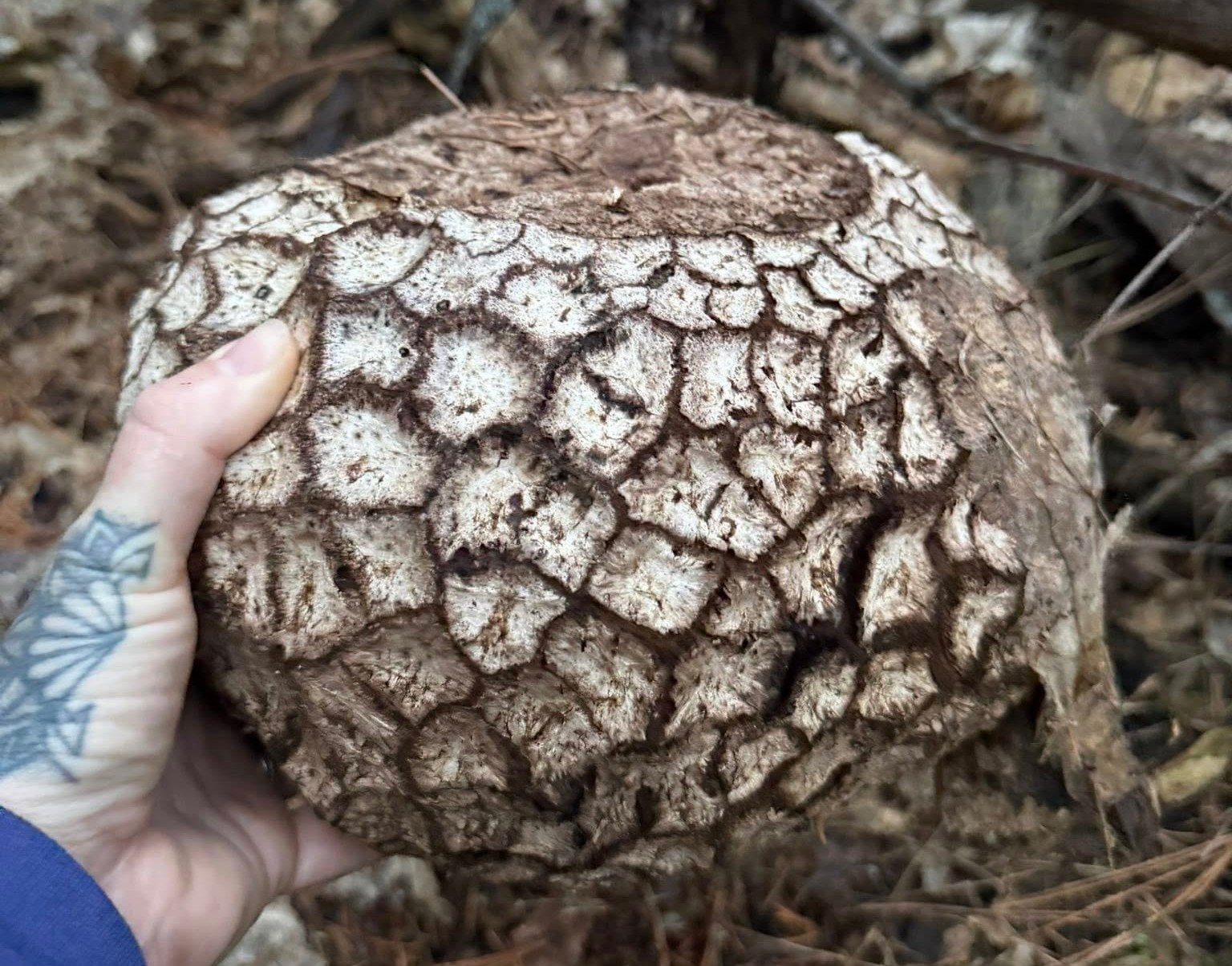
Vernon resident, and lover of the outdoors, Monique Worth was out walking her dog in a forested area in Vernon a few days ago when she spotted a massive mushroom.
“It was a very cool find, I’d never seen anything like it,” she said. “It was getting dusky out but the mosaic pattern on it caught my eye.”
Worth snapped a photo of the supersized specimen which was larger than her hand.
iNFOnews.ca sent the photo to Charles Ruechel, a wild mushroom expert who runs mushroom tours in the Okanagan, who identified the species as a western giant puffball that grew last year and is now old and rotten.
The massive mushrooms grow in western North America solitarily or in clusters in grassy fields or beneath sagebrush in semi-arid regions and are known for their huge fruiting bodies that get up to 60 centimetres in diameter, along with their ability to produce a massive number of spores, according to Healing Mushrooms.
The mushrooms start out looking smooth and white but as they age will develop oddly shaped warts with brownish centres. The spore mass inside turns from white to greenish to brown until it becomes powdery and the mature spores are released.
It’s a good thing Worth made sure to put the rotten specimen back on the ground where she found it, as it holds the potential to grow many more gigantic mushrooms.
“This mushroom has been dead for many months, but it’s still doing its job of spreading spores,” Ruechel said. “If you were to open it up, you would see the entire centre is filled with the green powder or paste, which are the spores that get released and begin new fungus growing.”
He said the spores are similar to seeds in an apple where the apple rots on the ground and the seeds can potentially grow new apple trees.
“Most people mistakenly think that mushrooms are the whole organism itself. Mushrooms are just the fruit born on the fungal organism that lives in the ground, or in trees or dead logs.”
Puffball mushrooms are important for the ecosystem as they decompose dead organic matter and recycle nutrients in the soil. They are also considered edible, however there is always a risk of misidentification and potential toxicity.
“They’re edible up to a point, the inside flesh needs to be firm and white and you must be able to identify it 100 per cent,” Ruechel said. “There are several key identifying features. You don’t want to mistake it for something deadly.”
WARNING: Some wild mushroom varieties can cause serious adverse health effects and even death. Go here for more details.
News from © iNFOnews.ca, . All rights reserved.
This material may not be published, broadcast, rewritten or redistributed.

This site is protected by reCAPTCHA and the Google Privacy Policy and Terms of Service apply.
Want to share your thoughts, add context, or connect with others in your community?
You must be logged in to post a comment.