Elevate your local knowledge
Sign up for the iNFOnews newsletter today!
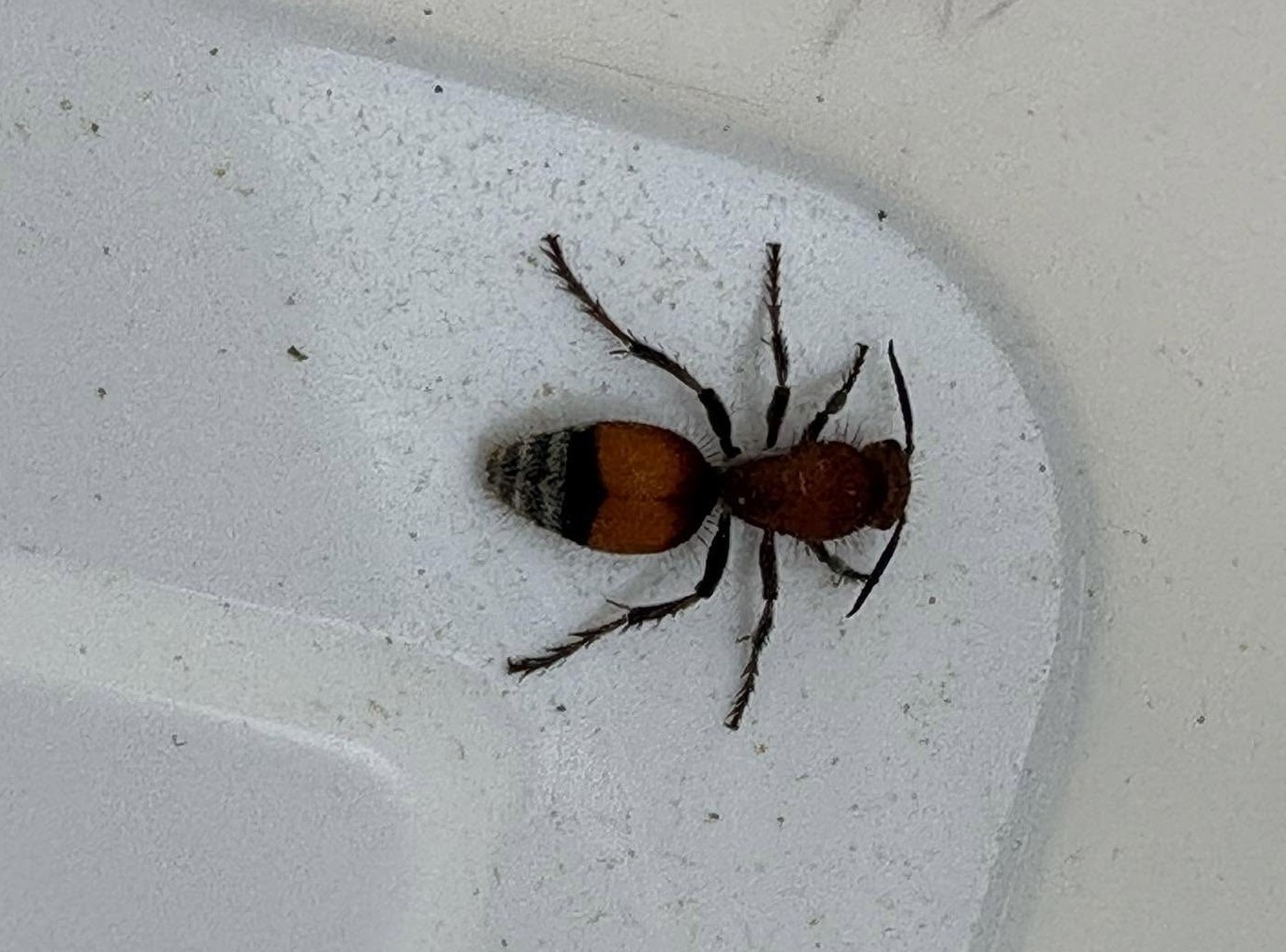
Kamloops bug lover Jenny Lemp spotted a strange looking insect crawling in the lawn while she was sitting on the steps of her patio watching her kids playing earlier this week, and scooped it up to study it more closely.
The red and black insect was a female eastern velvet ant, however, contrary to its name it isn’t an ant, it’s a type of wasp more colloquially known as a “cow killer” due to its powerful sting.
“When I saw it I knew immediately what it was and looked around for something in my reach to scoop it up,” she said. “Finding nothing, not wanting to take my eyes off her because she was moving fast, and knowing they’re actually quite docile, I blocked her path with my hands till she climbed on.
“I didn’t want to grasp her because I didn’t want to risk being a threat and getting stung by accident.”
Lemp called her kids over to see the bug and learn how to identify it and teach them not to touch them because of their painful sting. She kept the bug in a container and after putting the kids to bed called her friend and neighbour Jaenine McFarlen to bring her kids over to see it before releasing it back into the yard.
“My kids knew about the velvet ant and it’s sting, we actually saw one last summer up in Rose Hill but I didn’t get a picture of it,” McFarlen said. “We’re also bee keepers here so anything bee or wasp is a live love for the boys and I. I asked the kids if they wanted to see and they literally ran over to Jenny’s.”
Cow killers are found in parts of Canada, the USA and Mexico. The females are wingless and resemble ants when they walk, while the males have wings and look more like wasps, according to Insect Identification. Unlike the males that don’t have stingers, the females have a sting that is very painful to humans.
The wasps are brightly coloured to warn predators, have a thickened exoskeleton to protect themselves, and make warning sounds and secrete chemicals when threatened. The females are capable of running fast.
These wasps are solitary and most active at dusk or during the night when they feed on nectar. They are parasitic to bumble bees, with the females laying eggs in bee hives which hatch into larvae that feed on bumble bee larvae.
“It’s a fascinating insect,” McFarlen said. “The males have wings but no stinger and the females have no wings, but their stingers are almost the length of their abdomen which is scary to think about. It’s flexible and not barbed so she can sting multiple times. When I find a new critter I do a deep dive into it so I can learn all about it.”
Lemp is always on the lookout for bugs and enjoys learning about them, and she always shares interesting critters she finds with McFarlen.
“I’m a huge bug nerd and lover, especially spiders, but I love and welcome all creepy crawlies,” Lemp said. “My yard is quite wild, if you ask Jeanine and her husband it’s probably unkempt but it’s actually an organized and planned re-wilding chaos, and the insect diversity in my yard has exploded.”
News from © iNFOnews.ca, . All rights reserved.
This material may not be published, broadcast, rewritten or redistributed.

This site is protected by reCAPTCHA and the Google Privacy Policy and Terms of Service apply.
Want to share your thoughts, add context, or connect with others in your community?
You must be logged in to post a comment.