Elevate your local knowledge
Sign up for the iNFOnews newsletter today!

THUNDER BAY — Premier Doug Ford said the province has opened reception centres for people fleeing northern Ontario wildfires as he asked evacuees to not return to their homes, saying going back could jeopardize firefighting efforts.
The warning comes as one First Nation has said residents were taking fire suppression into their own hands over fears the province wasn’t doing enough.
The premier was joined by other government officials at a news conference in Thunder Bay, where many wildfire evacuees have sought shelter.
Ford said there were nearly 200 active wildfires raging across the province on Saturday, seven more than the day prior.
“Do not go to your campsites. Do not go back to your homes,” Ford told people under evacuation orders on Saturday. “We will find you a place, a hotel room, we’ll get you food, we’ll make sure you’re well taken care of.”
Ford said the waterbombers deployed to fight back the flames won’t drop water on areas where pilots spot people on the ground.
An official with an evacuated First Nation community said earlier this week that 26 residents, including people from a neighbouring town, returned to their communities over concerns the province wasn’t committing enough resources to protect their homes.
Whitesand First Nation emergency response manager Devon Wanakamik said the people who returned were helping to dig a firebreak with heavy machinery, as well as laying sprinkler lines, in violation of the evacuation order. Wanakamik also urged residents not to return to the area.
Natural Resources Minister Mike Harris said Saturday that the province has teams to protect infrastructure from wildfires but they’re “spread pretty thin” across the province.
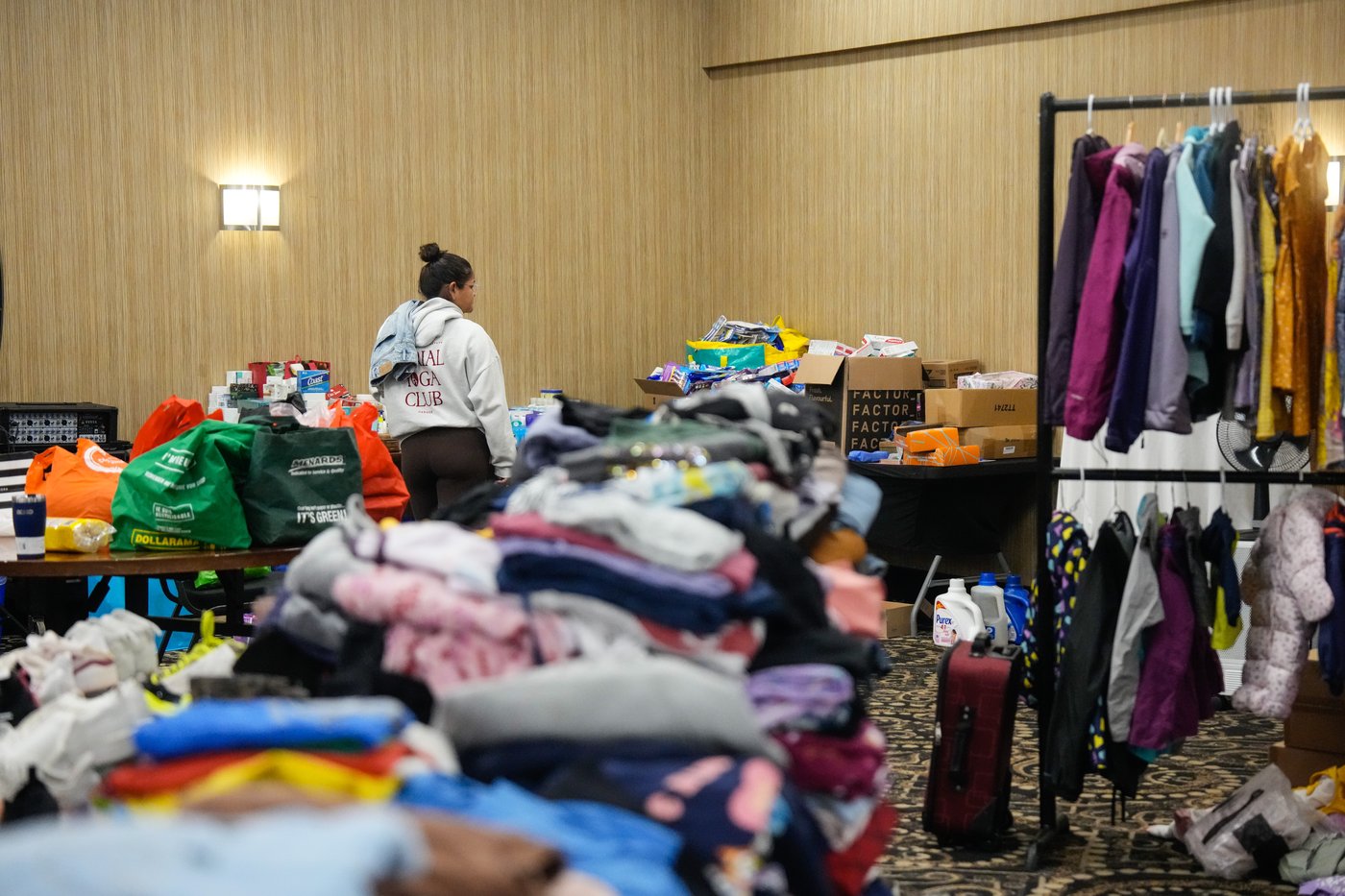
Ford said the province has opened reception centres, including one in Thunder Bay, to help connect people with shelter, food and medical services, as well as transfer evacuees to other cities like Toronto and Niagara Falls.
He said the province is working with Ottawa and the Canadian Armed Forces to establish services to transport, accommodate, feed and register evacuees.
The Ontario wildfires have already scorched more land than all of last year’s fires and sent up plumes of hazardous smoke that have choked the skies across the province and in parts of the United States.
Multiple northern communities have already been evacuated or have evacuations underway, and others are preparing for possible evacuations.
Ford reiterated Saturday that more than 150 fire crews and more than 80 water bombers and helicopters are battling the wildfires and the province would spare no expense in keeping people safe.
Harris said a favourable weather forecast through the weekend and into next week could help further suppress wildfire activity that has slowed in the past day.
The natural resource minister said fires aren’t growing as quickly thanks to recent rain that is also helping to tamp down smoke, allowing waterbombers better access to fight fires.
“What we really need to see is some of those sustained rains but without the lightning strikes because the overwhelming majority of fires that we’re seeing now were actually caused by a storm that came through about a week ago,” Harris said.
At Saturday’s new conference, Ford took aim at American officials who have complained about Canadian wildfire smoke blanketing parts of the U.S.
President Donald Trump threatened Friday to increase tariffs on Canada due to the smoke.
Ford said the detractors have a “very short memory” and spoke about Canada and Ontario’s efforts to support California during the state’s devastating wildfires in January last year.
“That’s what neighbours do. You don’t get on and start threatening and criticizing because guess what? One day, it’s gonna be your turn. And we’re gonna be down there without hesitation to support our neighbours,” Ford said.
Ford has faced backlash over the level of funding and resources the province has allocated for wildfire response, while Harris has fielded criticism for his ministry’s handling of the evacuations of two First Nation communities.
Residents of Whitesand First Nation and Namaygoosisagagun First Nation – also known as Collins First Nation – fled approaching wildfires without help from the province.
Harris said Friday the fire that swallowed Collins First Nation as its residents escaped in boats was only spotted when it was already at the community’s doorstep because it spread so fast.
Members of Collins First Nation and Whitesand First Nation are sheltering in Thunder Bay hotels, which, according to the city’s top fire official, are near or at capacity after evacuees began to flow in on Monday.
Thunder Bay Fire Chief Dave Tarini said at least 500 people fleeing wildfires are sheltering in Thunder Bay, but that’s likely a conservative estimate as it’s hard to gauge an accurate number.
Most evacuees are being hosted by First Nation organizations or found available hotel space themselves, the fire chief says. He adds that Thunder Bay has not been officially asked to be a host community by the province, which would involve the city finding spaces to accommodate evacuees.
Tarini, who started his career fighting wildfires with the Ministry of Natural Resources in 1991, said this fire season is unprecedented in his more than 35 years as a firefighter.
“The amount of fires that are currently burning and the size of the fires is something that I personally haven’t seen in the Thunder Bay district in my career,” he said.
Tarini said he’s alarmed at how fast the fires are moving overnight and he expects the wildfires to continue blazing unless the region sees a period of sustained rainfall.
“This is taxing a lot of the resources that are out there and we’re certainly not out of the woods by a long stretch,” he said.
An expanded evacuation alert has been issued for 29 townships threatened by a 550-square-kilometre fire raging south of Lac des Mille Lacs First Nation.
Residents of towns including Ames, Blackwell, Goldie, Lamport, Michener, Savanne and Upsala are asked to be prepared to evacuate on short notice. A full list of townships under the evacuation alert can be found on Ontario’s forest fires web page.
This report by The Canadian Press was first published July 18, 2026.
–By Sharif Hassan in Thunder Bay, Ont., and Kathryn Mannie in Toronto

News from © The Canadian Press, . All rights reserved.
This material may not be published, broadcast, rewritten or redistributed.

This site is protected by reCAPTCHA and the Google Privacy Policy and Terms of Service apply.
Want to share your thoughts, add context, or connect with others in your community?
You must be logged in to post a comment.