Elevate your local knowledge
Sign up for the iNFOnews newsletter today!
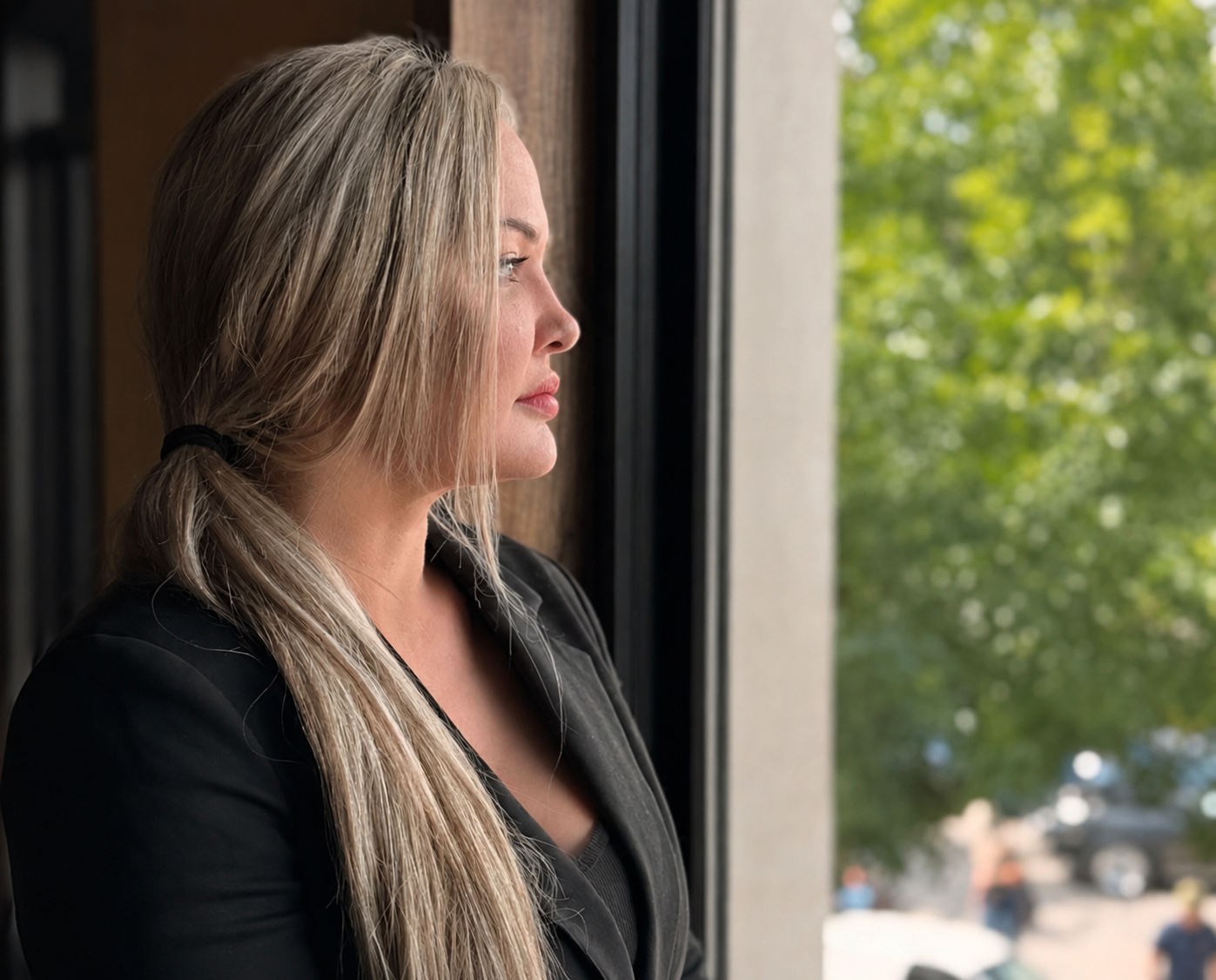
It started off friendly and very professional, but after a year, insurance broker Amber Hedrick realized that her client had begun stalking her.
He made unbelievable excuses as to why he had to come to her office. He turned up randomly in odd places sitting in his truck. She’d be in Starbucks and get a text offering to buy her coffee, but looking around she couldn’t see him anywhere. He found out where she lived, and drove past her house at the end of her dead-end street daily. He followed her on the highway.
It lasted for five years and cost Hedrick her health and eventually her job.
“I lost a huge part of my life,” she told iNFOnews.ca. “I didn’t know a mind could be broken like that.”
Sales is about relationships, and Hedrick’s sales job netted her a salary well above six figures in a cut-throat industry dominated by men. While rounds of golf and charity fundraisers are part and parcel of many sales industries, women face different challenges when it comes to interacting with their clients.
And biases, whether conscious or unconscious, are likely part of the reason Hedrick was allowed to be violated for five years.
“The big thing was being a female in a man’s world and gaining the respect that I had gained for so many of these giant companies and then not… looking weak,” Hedrick said. “I didn’t want to feel like a victim. I didn’t want to feel like I couldn’t handle it.”
Hedrick’s stalker was also the contact person for a very lucrative client.
She thought she could handle it, which she could – in the beginning.
According to Statistics Canada from 2014, almost two million Canadians, about eight per cent of women, have reported having been stalked. Ninety percent of stalkers are men, and 80% of victims are women. In almost 90% of cases, stalkers obsess with someone they know, and about 25% of women who are stalked are stalked by a previous intimate partner.
Hedrick’s stalker started subtly in 2016.
Her brokerage, Johnston Meier Insurance in Mission, spoke to the stalker’s company. The client’s company was sympathetic. It said he was lonely, his wife had MS, but he was harmless, and they were sorry.
It died down for a few months.
“I thought maybe it had worked, but then it started again,” Hedrick said.
“I pulled out of my apartment… and saw him sitting in his truck,” she said. “Then I started seeing him waiting outside my office.”
It started escalating, then stop for a couple of months. Only to start again.
“And then I would start to be mad at myself for letting my guard down,” she said.
In the early days, Hedrick said she felt sorry for him.
“I felt bad, almost like I felt awkward. I didn’t want to hurt someone’s feelings,” she said. “A mixture of emotions and confusion.
“I also didn’t want him to say what he wanted because I was terrified of having to respond to it.”
She hoped it would go away, but it escalated.
Protocols were set up at work so she didn’t have to deal with him.
Hedrick confronted him, he said he was sorry, but it didn’t stop.
She stopped letting her son walk home from school and had nightmares of him slitting her dog’s throat.
She moved house, but he found out where she was living. She had her car checked for a GPS tracker several times and set cameras up around her home.
He waited in her work parking lot, and she confronted him again.
“I rolled down the window and I told him straight up, ‘You have to stop. This is enough,’” she said.
He said he was sorry, but just parked further away.
Hedrick wore sunglasses so she wouldn’t have to make eye contact, noting that he often had a “sinister” smirk on his face.
Hedrick was single in her early forties and it was taking its toll. It began making her sick.
“And then you go through the self-blame,” she said. “I was mad at myself… why wasn’t I stronger?”
Hedrick said she’s not easily scared and jokes that if someone gets aggressive with her, she’s “a little crazy.”
But this situation terrified her.
Over the years, Hedrick changed the way she did things and says in hindsight she normalized the situation.
The stalking came to a head when he showed up at Hedrick’s front door and she inadvertently opened it.
“I thought I was going to like fall, have a seizure or something,” she said.
She called the police.
“They told me that he was crying and that he was apologetic and that he wouldn’t do it anymore,” she said. They also told him he’d be charged with criminal harassment if he went near her again.
But the stalker was still working for a lucrative client, and when Hedrick raised the issue at work, it simply wasn’t dealt with well.
The stress led to eye twitches, and her declining health was exacerbated by her company’s response. She went off sick, WorkSafeBC diagnosed her with PTSD and depression, and she was ultimately fired.
She sued Johnston Meier Insurance, the stalker, and the stalker’s company.
In court documents, the stalker’s company and the stalker denied it all. They were later both removed from the suit.
When reached by phone, the company’s owner said there were two sides to every story, but refused to share their side and hung up. Neither the company nor the stalker responded to iNFOnews.ca‘s request for comment.
Hedrick’s case against Johnston Meier continued and on July 6 the BC Supreme Court ruled in her favour. The court ruled Johnston Meier wrongfully dismissed Hedrick and awarded $116,000 for wrongful dismissal.
In a scathing decision, Justice Lorianna Bennett wrote that Johnston Meier Insurance Agencies was completely aware of the situation but failed to do anything meaningful about it, calling its handling “insensitive, unprofessional, or improper.”
The Justice was highly critical of Hedrick’s manager, David Ebner, who had a moral and legal duty to protect his employees.

“He had the authority and ability to, if necessary, communicate a clear message either to the stalker or to the stalker’s employer about the unwanted and inappropriate behaviour. He also had the authority and managerial expertise to further explore any inclination that Ms. Hedrick may have had to keep the stalker’s employer as a client,” Justice Bennett said.
The Justice said Ebner “did nothing” except say he’d speak to his wife.
But the boss’s wife instead questioned the way she did her hair and makeup and the way she dressed.
She was devastated by the victim shaming.
Hedrick said she felt betrayed by her company and her boss who she’d considered a friend.
Jessika Furbank runs Perk HR Consulting and said the company should have taken the stalking extremely seriously.
“When you have employees you have the legal obligation not only to create a physically safe environment, but a psychologically safe environment as well,” Furbank said. “You need to do everything that you can do to try and protect your employee.”
Furbank advises companies on how to deal with these situations and said there are clear steps the company should have taken in the circumstances.
She also questions whether the company should have kept the client.
“He’s created a situation where one of my team members feels unsafe. That’s not accepted and it’s not accepted by the law either,” she said. “He should no longer be allowed to be a part of the company in any capacity.”
Hedrick’s stalker was the point person for a lucrative client, and she didn’t want the company to lose the client – she feared she’d lose her commission, but still be left with the stalker.
Ultimately, Hedrick said the company cared more about their bottom line than her health.
Furbank said companies choosing profit over employees is something she’d personally experienced herself when she worked as a server during university and a regular customer began harassing and stalking her.
“I told my employer, and they said, ‘oh, but he’s a regular,’” she said.
Nothing was done, and she quit a few months later.
It’s a small reminder of the issues that women face in the workplace that largely don’t affect men.

It’s an issue Shuswap realtor Jessica Klikach knows firsthand.
In the summer of 2024, she began receiving messages from a friend of a client demanding money for recommending her.
She’d never met the person and had no idea who he was, and the messages soon became aggressive.
Over a week, Christopher Mulvagh contacted her almost 200 times– calling, texting, emailing and messaging.
She went to the police, but he continued, before he was charged with criminal harassment. He later pleaded not guilty and was put under a restraining order.
Klikach was left with a considerable amount of stress and anxiety.
“It took a lot to come down out of that fight or flight,” she said.
She already had protocols in place about meeting clients at her office first and sharing her location, but after the harassment she tightened things up.
Sadly, it’s not the first time something like that has happened.
She said when she was in her twenties she went for a drink with a client who drugged and assaulted her. She never reported it because she says she had no evidence.
“I think we need to continue to talk about it. I’m not going to be shamed for it,” she said. “The more women realize that the more the conversation is out and we start talking about it, that’s how we prevent this, it shouldn’t be a secret.”
Klikach also points the finger at women. When she tells women about the man who harassed her, they often reply, “Did you date him?”
Kelowna-based employment lawyer Robert Smithson said he’s been retained by businesses to deal with stalking cases.
“I wouldn’t say these sorts of scenarios are common, but unfortunately I wouldn’t say they are entirely uncommon,” Smithson said.
In one recent case, the stalker was stalking a colleague.
“Ultimately, the objective is the same, to protect the health and safety of the employee who is the target of the unwanted attention,” he said.
So why do people, almost always men, stalk?
Canadian Anti-Stalking Association founder Julie Lalonde said there’s a gendered component and it’s tied to a sense of entitlement.
“There are young men who are socialized to believe that… women say no the first time because they’re being coy, so you have to pursue them,” she said. “You have to be aggressive. You have to be persistent.”
A good woman says no, so you have to convince them.
Lalonde endured her own stalker for a decade and said much of her work is educating Canadians about the realities and communicating to police that criminal harassment is a crime of escalation.
Hedrick did go to the police, but her stalker was only spoken with and never charged. It’s not totally clear, but it appears his behaviour didn’t reach the threshold of criminal harassment. There were no threatening texts or emails — hard proof.
Lalonde said a recent change to the law will remove the threshold that you have to prove that you’re afraid for your safety.
For Hedrick, it’s been a decade since she began to be stalked and five years since she quit her job, a decision she didn’t take lightly.
“I have this big mortgage, I have this beautiful home, I have everything I’ve ever worked so hard for. Clients that I’ve had for 13 years that… took me years to build up and I’m about to lose everything in this one decision to go off work?” She said. “It was not easy.”
Ultimately, her health made the decision for her.
Now, five years since she went off sick, she’d moved out of the Lower Mainland and opened her own business. She has her health back, but not completely.
Her advice to other women in a similar situation is to document everything and speak up.
“Especially in a male-dominated type industry, it doesn’t mean you’re dramatic or difficult… you have to advocate for yourself,” she said.
The BC Supreme Court decision can be found here.
News from © iNFOnews.ca, . All rights reserved.
This material may not be published, broadcast, rewritten or redistributed.

This site is protected by reCAPTCHA and the Google Privacy Policy and Terms of Service apply.
Want to share your thoughts, add context, or connect with others in your community?
You must be logged in to post a comment.