Elevate your local knowledge
Sign up for the iNFOnews newsletter today!
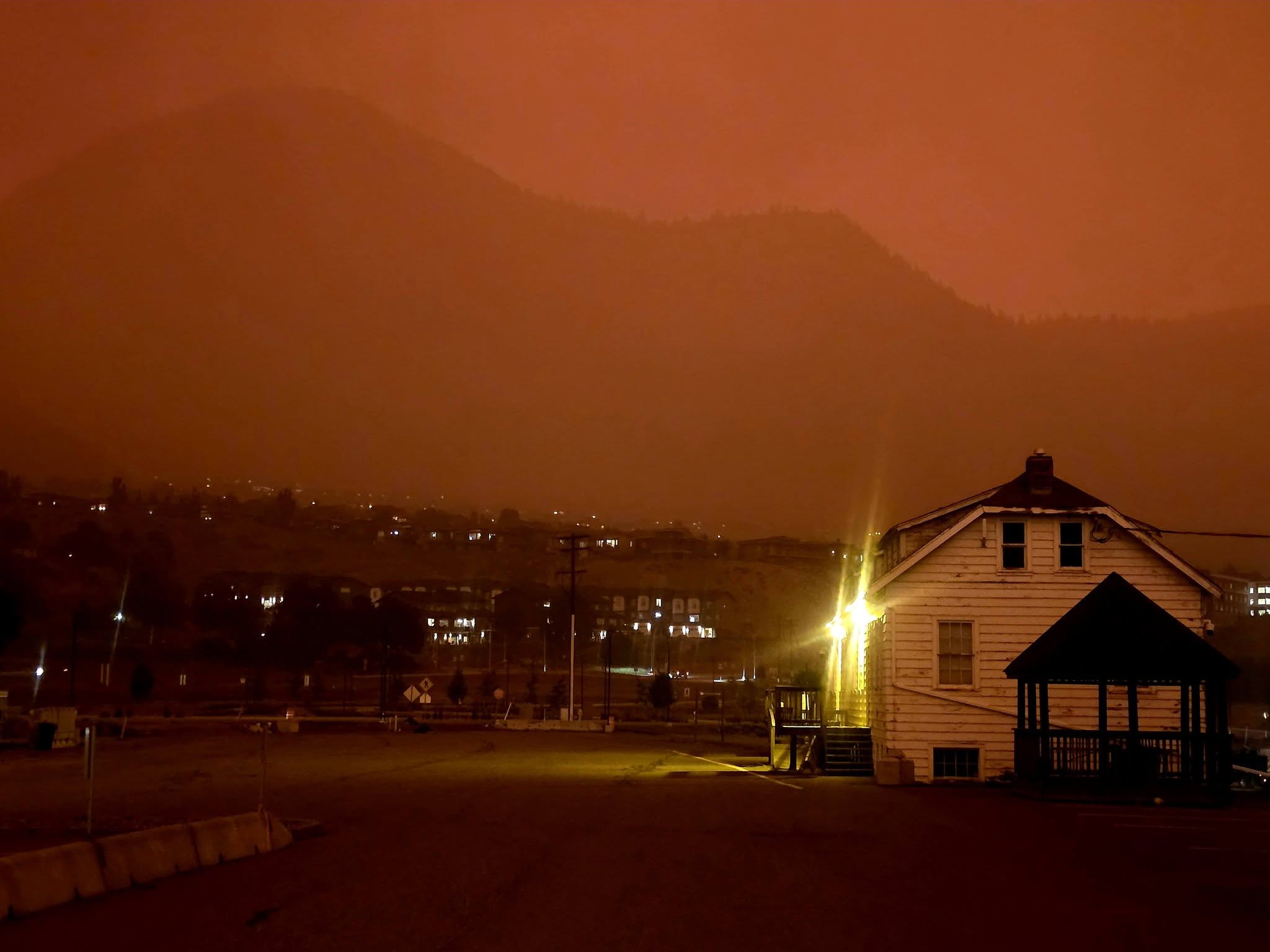
Looking outside in Kamloops and the Okanagan and seeing smoke so thick you can taste it may send people to one of the online trackers and maps to see whether it’s safe to go out. But a lot of the details and metrics can be confusing.
The South Thompson and Okanagan regions are under an orange air quality advisory as of Thursday afternoon, Aug. 6.
There are numerous sites dedicated to tracking air quality and wildfire smoke in more detail than a blanket warning, but it’s hard to understand the risks if you don’t know what you’re looking at.
The BC Air Quality Health Index is the go-to for a lot of people with colour coding to give you a general sense of how potentially harmful the air is at a given moment. It’s an easy scale to read with 10 in red, which means bad, and one in blue which means safe.
The BC Air Quality Health Index also tracks ground level ozone and industrial pollutants like nitrogen oxides, but those are less of a concern when there’s significant wildfire smoke.
The health index keeps it simple with the one to 10 scale, but what most air quality trackers are measuring and displaying is the amount of PM2.5 in the air.
PM2.5 is particulate matter measuring 2.5 microns or less. A micron is a thousand times smaller than a millimetre. It’s typically measured in micrograms per cubic metre of air which is written as μg m-3.
More than 100 micrograms per cubic metre of PM2.5, or 100 μg m-3, is considered hazardous.
PM2.5 is the standard metric for air quality, especially for wildfire smoke, because fine particles in smoke are small enough to get deep into people’s lungs and cause a series of problems from a runny nose to pneumonia.
There are tons of other resources to help gauge air quality like Firesmoke.ca which forecasts smoke conditions and is a “best estimate.” It does show smoke coming up from the U.S. which can be helpful for planning ahead.
IQAir.com measures air quality around the world.
IQAir.com also converts PM2.5 measurements to the U.S. Air Quality Index which is a scale up to 500 where 150 is unhealthy for the general population and more than 300 is considered hazardous.
Cyclone.ca is another popular air quality tracker which simply displays hourly PM2.5 measurements.
There can be differences between the websites because of which air quality monitoring stations they have access to and how often they update, or delays in updates because PM2.5 measurements and conditions can change rapidly.
University of British Columbia’s Dr. Sarah Henderson is an expert in wildfire smoke’s effects on public health.
She said one of the challenges with wildfire smoke and public health is the fact that the human body’s ability to handle pollutants gets tired like anything else the body does.
The fact that there are 100 micrograms of PM2.5 per cubic metre for weeks at a time tires the body out, so by the time conditions worsen to 300 micrograms of PM2.5 per cubic metre the effects are worse.
While most air quality information sites have some scary colour schemes when PM2.5 gets up close to 300 μg m-3, Henderson said it’s actually the buildup over time that has a greater effect than the difference between 100 and 300 μg m-3.
“This is what I call the public health paradox of wildfire smoke,” she told iNFOnews.ca.
“We don’t see that much difference in risk between those two values. So 300 looks way, way worse than 100 does. But they’re about equally as risky from a human health perspective because your body got tapped out at 100.”
Henderson said people should take consistent care and caution to reduce exposure to wildfire smoke throughout the season, rather than only paying attention when conditions get dire.
“I liken this to being chased by a tiger. If you’re being chased by a tiger, and you’re running as fast as you can from the tiger and the tiger speeds up, you don’t have anything else to give,” she said.
News from © iNFOnews.ca, . All rights reserved.
This material may not be published, broadcast, rewritten or redistributed.

This site is protected by reCAPTCHA and the Google Privacy Policy and Terms of Service apply.
Want to share your thoughts, add context, or connect with others in your community?
You must be logged in to post a comment.