Elevate your local knowledge
Sign up for the iNFOnews newsletter today!
Russian strike on a Ukrainian warehouse kills 37 in the war’s deadliest attack this year
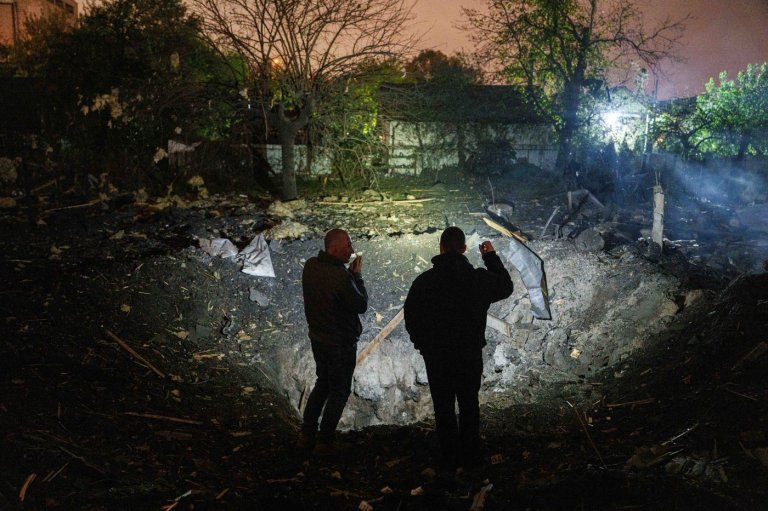
MYLA, Ukraine (AP) — A Russian drone struck a warehouse west of Kyiv that Ukrainian officials say was storing shells, mines and other ammunition, sparking massive explosions and fires that swept through dozens of nearby homes and buildings and killing 37 people.
The Friday night attack on the warehouse in Myla, a village in the Bucha district, was the war’s deadliest attack this year and came on the second of three days of nearly round-the-clock Russian strikes that have severely disrupted life in and around the Ukrainian capital.
Attacks on the capital and, to a lesser extent, the rest of Ukraine have been nearly constant since Thursday. Kyiv officials say Russia builds up missile stocks and launches major attacks every few days, hoping to exhaust Ukrainian defenses through the sheer weight of numbers.
The warehouse strike sparked fires that raced through homes and damaged at least 50 residential buildings, said Tymur Tkachenko, who heads the local regional military administration. He was later cited by local media as saying 34 of the people killed were residents of a care home for elderly and disabled people. More than 370 people were evacuated.
The blasts rocked Myla, causing people to frantically seek cover.
___
An officer is dead and a second was injured in a shooting at South Carolina park, police chief says
A South Carolina police officer died and a second was injured in a “gunfight” Saturday in a park, following a call about a domestic dispute, Columbia police Chief W.H. “Skip” Holbrook said.
The suspect, a 33-year-old man with a lengthy criminal record, also died, Holbrook said at a news conference in the capital city.
The deceased officer, 29-year-old Christopher DeLong, had been with the police department for two years and leaves behind a wife and two young children, Holbrook said.
“Our hearts are broken this evening,” he said, appearing choked up at times.
DeLong’s wife, in a social media post, praised her husband as the “best dad to our babies” and said she was “living a nightmare.”
___
6 months on, Iran’s leaders are defying the US and signaling no tolerance for dissent
DUBAI, United Arab Emirates (AP) — After six months of war, Iran’s leadership has coalesced around a hard core of military generals and clerics long entrenched in the ruling theocracy. They are ready for a potentially long confrontation with the U.S. and determined to prevent any unrest at home.
It’s a far cry from U.S. President Donald Trump’s initial hopes of toppling the Islamic Republic and his subsequent claims that “regime change” had brought more compromising officials to the fore.
Iran’s new leaders evince little faith in any agreement with Trump — after coming under attack twice while holding talks — and they may be bracing for another assault once the U.S. replenishes its supplies of interceptors. They have also threatened to escalate the war as a continuing American blockade and Trump’s plans for new sanctions threaten to suffocate Iran’s already worsening economy.
“If (Trump) wants to do something, we will retaliate in a seismic manner,” the new secretary of Iran’s Supreme National Security Council, Mohsen Rezaei, said last weekend. In a post on X, he said that “if the economic war continues, not a single drop of oil will be exported” from the Persian Gulf.
Rezaei’s appointment came in a recent set of decrees by the supreme leader, Ayatollah Mojtaba Khamenei, that formally set Iran’s new senior leadership, including top military posts. Khamenei’s father and much of the highest echelons were killed in the bombing campaign launched by the U.S. and Israel on Feb. 28.
___
Nepal-China flood survivors reach safe areas as families await news of nearly 3,000 missing
NUWAKOT, Nepal (AP) — As rescue efforts in communities buried by catastrophic flash floods along the Nepal – China border entered their fourth day Saturday, authorities were still finding survivors and transporting them to safety.
At relief centers, families of missing people waited anxiously for news of their loved ones as the death toll and the number of people unaccounted for continued to rise.
The combined toll in Nepal and Tibet rose to 691 dead and over 3,000 people missing after China’s latest update on Sunday. Chinese authorities reported 16 deaths and 546 missing, while Nepal’s disaster agency said late Saturday that the death toll had climbed to 675 with 2,498 people missing.
More than 3,700 people have been rescued in Nepal so far.
In Nuwakot, one of the Nepali districts devastated by the floods, helicopters arrived loaded with boxes and bags of aid, including clothes, instant noodles, crackers and rice. Others returned from the flood-hit areas carrying survivors.
___
Ontario premier answers Trump’s ‘Lake America’ with giant ‘Lake Ontario’ sign
TORONTO (AP) — Ontario Premier Doug Ford answered President Donald Trump’s “Lake America” decree Saturday with a billboard-sized message on the Canadian shoreline — “Lake Ontario. Now and Always” — as Canadian leaders met the move with ridicule rather than outrage.
Wearing a Team Canada soccer jersey, Ford unveiled the sign near Grimsby, Ontario, and posed for photographs. The 24-by-12-foot (7.3-by-3.6 meter) sign stands on 6-foot (1.8-meter) legs, putting its top about 18 feet (5.5 meters) above the ground — roughly two stories high. The message is repeated in French, one
The display followed Trump’s executive order directing U.S. federal agencies to call Lake Ontario “Lake America.” After months of tariffs, threats to make Canada the 51st U.S. state and personal attacks on its leaders, the reaction in Canada has mixed defiance with mockery.
Ford said Trump was trying to rename the lake because Ontario and Canada were “standing up for ourselves” and argued the name would outlast the president.
“Long after President Trump is gone, it will still be called Lake Ontario,” Ford said in a video posted on social media.
___
Colorado River plan to cut water amid drought brings uncertainty for cities and farmers
PHOENIX (AP) — On the outskirts of Phoenix, a small town with a huge reliance on the Colorado River has capped growth, revived old wells and struck water deals.
But Cave Creek Mayor Robert Morris can’t shake the real possibility that it’s not enough to keep the desert community of about 5,000 people afloat well into the future. And a recent federal plan to address a deepening crisis in the river basin won’t help.
Cave Creek gets nearly all of its water from the river, which serves 40 million people across the U.S. West and has been dwindling because of climate change, demand and overuse. The town already was forced to make cuts this year and it stands to lose more under a new federal plan.
Morris likened the situation to planning for a meteor strike.
“You can see it coming, but you can’t get out of the way and you don’t know what the damage is going to be,” he said.
___
As jurors deliberate in the Lindsay Clancy trial, here are key moments they may be considering
PLYMOUTH, Mass. (AP) — Jurors in the closely watched Lindsay Clancy trial began deliberating this week — but had not reached a verdict by the end of the day Friday.
They have a lot to consider.
Over the past five weeks, the jury heard testimony from doctors, first responders, relatives and even Clancy’s former husband. It now weighs the question of whether she should be held criminally responsible for killing her three young children at her Massachusetts home in 2023.
Both sides agree Clancy did it. But her attorneys argue the former labor and delivery nurse was suffering from postpartum psychosis at the time, and that poor mental healthcare exacerbated her condition. Prosecutors argue she intentionally planned the killings.
If Clancy is convicted, her sentence could be as severe as life in prison. If she’s found not guilty, she may be released or remain confined in a mental health facility.
___
Trump cannot deport students for criticizing Israel, judge rules
SAN JOSE, Calif. (AP) — Citing the importance of the First Amendment, a federal judge in California says the U.S. government is unconstitutionally silencing critics of Israel’s war in Gaza and others as part of the Trump administration ‘s quest to deport noncitizens who it says disrupted college campuses while expressing their views.
Judge Noël Wise, in a ruling Friday, delivered a victory for The Stanford Daily, the student newspaper at Stanford University, which has said some international students were afraid to speak out because of the deportation threat.
“Freedom of speech is illusory if we are only ‘free’ to express complementary views about the government and its leaders,” the judge wrote.
The decision largely piggybacks on findings from nearly a year ago by a U.S. district judge in Boston, who ruled that the Trump administration violated the Constitution when it targeted people who are not citizens for deportation solely for supporting Palestinians and criticizing Israel.
Wise wrote that the freedoms of speech and the press are “foundational to America’s enduring democracy.” The judge cited free-speech and vagueness flaws that violate the First Amendment and Fifth Amendment as she struck down portions of the provisions that the federal government follows regarding deportations.
___
Dozens of soldiers killed or arrested after an apparent mutiny in Niger’s capital, state TV reports
NIAMEY, Niger (AP) — Dozens of soldiers were killed or arrested after a group of young troops attempted a mutiny in Niger’s capital in what was seen as a major threat to the country’s ruling junta, according to a state television broadcast and analysts.
It was the culmination of nearly 24 hours of unrest that appeared to be staged by young soldiers aggrieved over the worsening militant violence under the country’s military junta. Russia’s Africa Corps provided aerial and ground support to local forces to resist the rebellion, according to analysts and diplomats.
State broadcaster RTN showed footage of dozens of mostly young soldiers being paraded in public after sustained gunfire and explosions were heard overnight into Saturday at a key military base located within Niamey’s main airport and near the presidential palace.
“The fighting lasted a few hours in several places, which allowed (security forces) to gradually control the situation, arrest and incapacitate these moody soldiers,” state TV reported.
The whereabouts of military leader Abdourahamane Tchiani were unclear.
___
Trump’s Greenland threats cast a shadow on Iceland’s vote on whether to trigger EU membership talks
REYKJAVIK, Iceland (AP) — Voters in Iceland went to the polls Saturday to decide whether the country should resume long-stalled negotiations to become a member of the European Union, in the shadow of U.S. President Donald Trump’s threats to control nearby Greenland.
The yes-or-no referendum question is simple enough for the 265,000 or so eligible voters: Should Iceland resume accession negotiations with the European Union?
A yes vote would trigger negotiations with the EU’s executive branch, the European Commission, covering 35 areas, from the economy to human rights. Some supporters believe the European Union could offer protections if Trump ever made similar threats against Iceland. They also see economic stability in joining the bloc.
If voters reject the proposal, that’s it, for a generation at least. Opponents have rallied around the threat EU membership would pose to Iceland’s rich fishing stocks and the fact that Iceland already reaps benefits from being in the EU’s frictionless single market and the Schengen free-travel zone.
Experts expect a close vote.
News from © The Associated Press, . All rights reserved.
This material may not be published, broadcast, rewritten or redistributed.

This site is protected by reCAPTCHA and the Google Privacy Policy and Terms of Service apply.
Want to share your thoughts, add context, or connect with others in your community?
You must be logged in to post a comment.