Elevate your local knowledge
Sign up for the iNFOnews newsletter today!
MONTREAL — Hours after the office of a Quebec artificial intelligence institute was vandalized Tuesday night, the founder of the organization warned that violence would not resolve public concerns about the rapidly evolving technology.
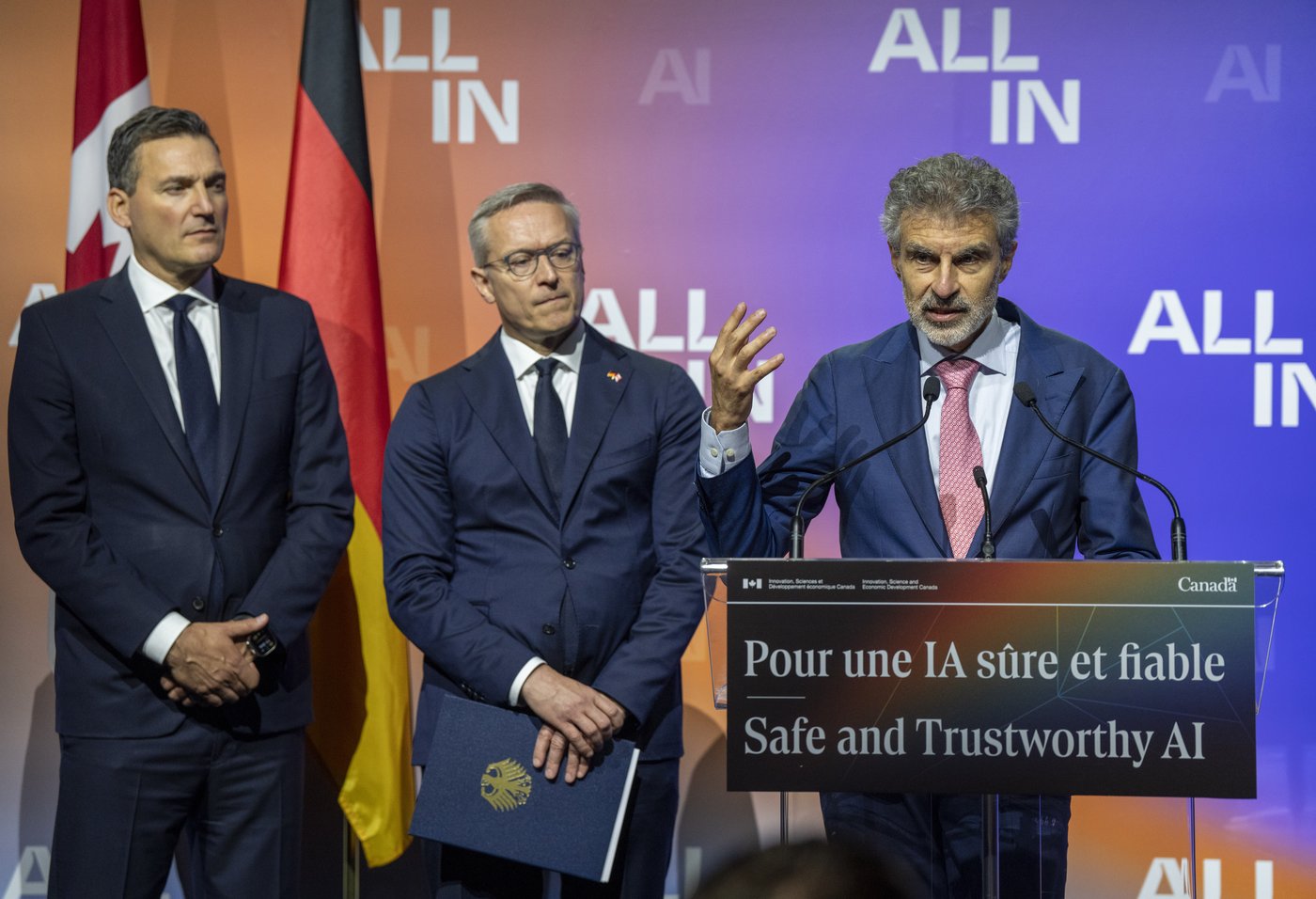
Mila’s Yoshua Bengio made the comments Wednesday morning at the opening of All In, a major artificial intelligence conference in Montreal, where he and federal Artificial Intelligence and Digital Innovation Minister Evan Solomon were set to announce new funding for research into the potential dangers of AI systems.
“Violence is not an answer to these risks and fears, which I can understand,” Bengio said at the AI and tech summit.
Montreal police say a group of about 10 people targeted the building at the corner of Saint-Urbain and Saint-Zotique streets at around 11:45 p.m. on Tuesday, smashing several windows and spray-painting graffiti on its walls.
A 25-year-old woman was arrested near the scene. Johany Charland, a spokesperson for Montreal police, said the woman was released Wednesday afternoon after being interviewed by investigators. Charland would not say if the woman was still considered a suspect in the investigation.
Mila says its central mission is to develop ethical and safe artificial intelligence that serves the public interest. It also says it focuses its mission on core research areas such as health, environment and climate change and that it carries out research using an open science approach to promote collaboration and foster the transfer of knowledge.
At the conference, Bengio said he has spent years examining the responsibilities of researchers, companies and governments as increasingly powerful artificial intelligence systems raise ethical and safety questions.
“How can we make sure that ethics are at the centre of our decisions?” Bengio said, adding that doing so isn’t necessarily easy amid market competition and geopolitical pressures.
He said raising public awareness can lead to democratic debate about the choices society wants to make — “certainly not through violence.”
Solomon also condemned the vandalism, calling it unacceptable in a democracy and saying researchers and students have the right to work in peace and safety.
“There are real questions about technology, and we welcome them in our democracy,” Solomon said. He added that people should be able to ask questions and protest peacefully.
Mila separately condemned what it described as acts of vandalism and intimidation targeting its premises.
“While we respect the fundamental right to express differing opinions and social criticism, we strongly condemn any use of violence, property damage and tactics aimed at intimidating our staff and researchers,” the research institute wrote in a statement Wednesday.
Montreal police said investigators were reviewing surveillance footage and gathering evidence in an effort to identify other suspects. ”The investigation is ongoing,” said Charland.
Montreal police also said their presence at the city’s main convention centre, where the conference is taking place, had not been increased in response to the vandalism. Police said deployments had already been planned and no additional officers were assigned as a result of the overnight incident.
The comments from Bengio and Solomon came as the federal minister announced $150 million in funding for LawZero, a non-profit AI safety research organization founded by Bengio and incubated at Mila.
German federal Minister for Digital Transformation and Government Modernization Karsten Wildberger also announced plans to provide up to 100 million euros for the project, subject to approval by the European Commission.
Bengio said the money will help researchers demonstrate how artificial intelligence can be trained with safety guarantees.
Bengio also said some of the most serious risks posed by advanced AI are difficult to predict, but that doesn’t mean they should be ignored.
“The more powerful it is, the more beneficial it can be — and also the more dangerous,” Bengio said.
This report by The Canadian Press was first published Sept. 16, 2026.
News from © The Canadian Press, . All rights reserved.
This material may not be published, broadcast, rewritten or redistributed.

This site is protected by reCAPTCHA and the Google Privacy Policy and Terms of Service apply.
Want to share your thoughts, add context, or connect with others in your community?
You must be logged in to post a comment.