

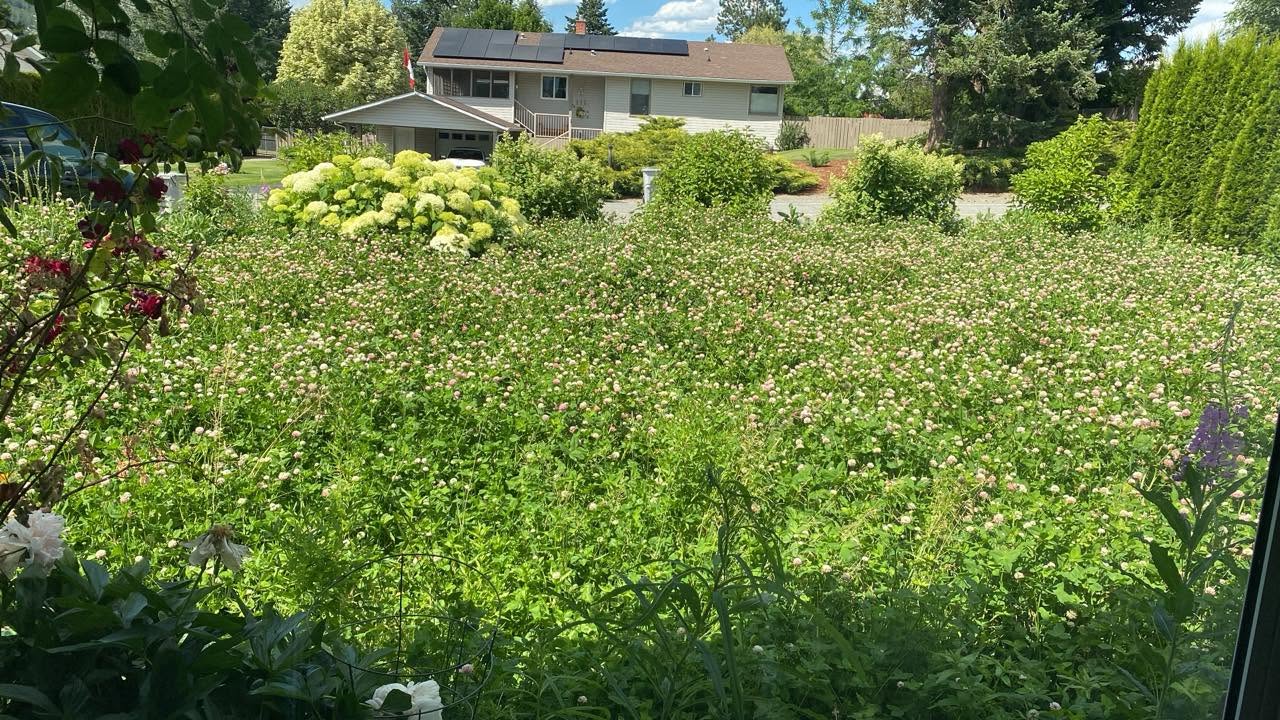
‘So many perks’: Kamloops resident replaces lawn with clover to save water

Erin Weatherwax is a homeowner in Kamloops whose front yard looks a bit different than most, as it’s a sea of tall clover instead of lawn.
The impetus behind the decision to remove her lawn and replant it with clover was to reduce water usage and attract pollinators, and it has resulted in other benefits.
She said there are so many perks.
“You’re feeding pollinators and it smells lovely. You go outside and smell a floral fragrance wafting through the air and people walk by and ask about it,” she told iNFOnews.ca.
Last year, the busy wife and mother with the help of her spouse replaced their lawn with clover and wildflower seed from West Coast Seeds.
“Basically, we mowed the crap out of the lawn and put black tarps everywhere to kill it, then we dug up what we could,” she said. “We seeded the turf mix on top with some dirt on top and initial irrigation was heavy. We got a lovely mix of clover and wildflowers.”
While the initial cost, time and effort was considerable, and irrigation was required to get the seeds growing, it has since become a low maintenance yard with very little watering required.
“This year the clover flourished. You have to irrigate it in early spring but you don’t have to after that, it likes a dry environment,” she said.
Weatherwax said the clover also doesn’t need any fertilizer and puts usable nitrogen into the ground for itself and other plants.
She said the choice has prompted other home owners to ask about the clover, with mixed opinions on the switch from a typical grass lawn.
“Everyone is kind of indoctrinated with having grass, but I find it to be barren and water heavy,” she said. “Our neighbours ask constantly are you going to mow that? It’s hard for some people to get out of that rut of like why don’t you have grass? Some people think clover is weeds, but it looks good and smells good.”
Some concerns from curious onlookers have included the increased risk of stepping on bees the clover attracts or the possibility of toxic plants harming humans or dogs.
“Some comments I get are funny, but it’s common sense stuff,” she said. “If you’re going through a wildflower field you might step on a bee. The point is not to frolic or roll around in it. There’s the possibility of toxic plants growing everywhere, but me and my dog are not going to walk through and start chewing on clover.”
The cost of the bulk bags of clover seed was a couple of hundred dollars. Another cost was the process of removing the lawn, which Weatherwax suspects could be a deterrent for others considering more water-friendly options.
“It’s onerous to take out grass and some people may require renting equipment to do it or hiring someone to remove it,” she said. “The other part is, you have to haul the sod away.
“It’d be cool if the city considered subsidizing the removal of front lawns for things like clover or xeriscaping, especially since every year we’re seeing issues with water shortages. Let’s funnel some of that tax money and think a little of what we can do to help with the water restrictions.”
Bee Turf is a lawn replacement developed by West Coast Seeds in partnership with the City of Richmond. It was made for urban spaces to reduce maintenance costs and improve forage for pollinators. It is designed to require minimal care or water, and is effective for most gardening zones.
News from © iNFOnews.ca, . All rights reserved.
This material may not be published, broadcast, rewritten or redistributed.

Join the Conversation!
Want to share your thoughts, add context, or connect with others in your community?
You must be logged in to post a comment.