

No word on return for Clinton, B.C., residents as fire burns watershed, power lines

The chair of the board in British Columbia’s fire-stricken Thompson-Nicola Regional District says that for a lot of people, the wildfires burning in the area will be “one of the most traumatizing events” they’ll live through.
Barbara Roden told an online meeting with about 350 people on Wednesday to reach out for help if they need it, as properties remain under evacuation order across the region, including the village of Clinton, with no timeline for residents to return.
“No matter what your experience of this fire is, whether you are someone who is finding out or is about to find out that you have lost property, whether you’re someone on evacuation order who is away from your home, whether you were under evacuation alert, it is a traumatic, frightening experience,” she said.
Clinton’s CEO Brian Doddridge told the meeting that property owners will get calls over the next few days to inform them if their home has not survived the large Pear Lake blaze, which measures about 668 square kilometres.
Doddridge said the area’s watershed has been “severely damaged” and work is being done to see what effect that has on water quality.
“We don’t know the specific of what that looks like on the land yet. We are looking to get eyes on that as soon as we can,” he said.
“What we do know is that is going to affect our water quality, and while we know that people don’t need perfect water in order to return to their homes necessarily, we do need to know what the implications of that are for public health and for our water treatment facilities before we can start getting back in there.”
Gregg Jackson, a senior field operations manager with BC Hydro, said the fire has caused “unprecedented damage” to the transmission system in the region, with hundreds of power structures destroyed, including substations and high-voltage lines.
He said they hope to have power back on to the downtown core of Clinton by later next week — as long as fire activity doesn’t increase.
“To put that in perspective, we have 145 structures that are requiring replacement along that corridor and we have approximately seven kilometres of power line itself, the wires that are attached to the polls, that have to be restrung,” said Jackson of the restoration efforts along Highway 97 and the village.
There are about 130 active wildfires burning across the province, including about 50 that are out of control, as the wildfire service warns of the return of a warming and drying trend this week.
Clinton Mayor Roland Stanke said Wednesday that a team was in town to assess the damage and compile the information.
“Homeowners with damage will be personally called. If you’re not called, that is a good thing,” he said in a post on Facebook.
Stanke said there were still many flare-ups and hot spots in town, and “things could change depending on wind conditions.”
Premier David Eby urged people heading out for the August long weekend to exercise “extreme caution” because of the fire risk.
“Parts of the province have never been drier than they are right now, especially in the southeast,” he told an unrelated news conference on Wednesday.
“Your one act could impact people’s lives forever.”
Eby said some people in the Clinton area would be returning to burned homes and businesses, while others forced to flee are waiting to go home.
Residents on the call Wednesday peppered officials with questions, including about the state of their homes and what a return would look like.
One man questioned why there weren’t more aircraft to fight the flames when a backburn was lit near Clinton.
“There was nobody in sight, and we have lakes and creeks all around us. They could have stopped that easily. Watching houses burn,” he said.
Officials apologized for the man’s loss and suggested he could send questions over email or the phone.
Trace amounts of rain on the northern flank of the Pear Lake wildfire helped prevent the extreme fire behaviour that could have resulted from strong winds on Tuesday, the service said earlier Wednesday.
But the drought has left forest fuels highly susceptible to ignition.
Incident commander Bryce Moreira told the meeting that information the fire service uses to measure drought in the fuels is at “an all-time high for this area.”
“Those effects of the rain have diminished and we’re anticipating to see aggressive fire behaviour today and will lead to extreme fire behaviour in the coming days,” he said on Wednesday.
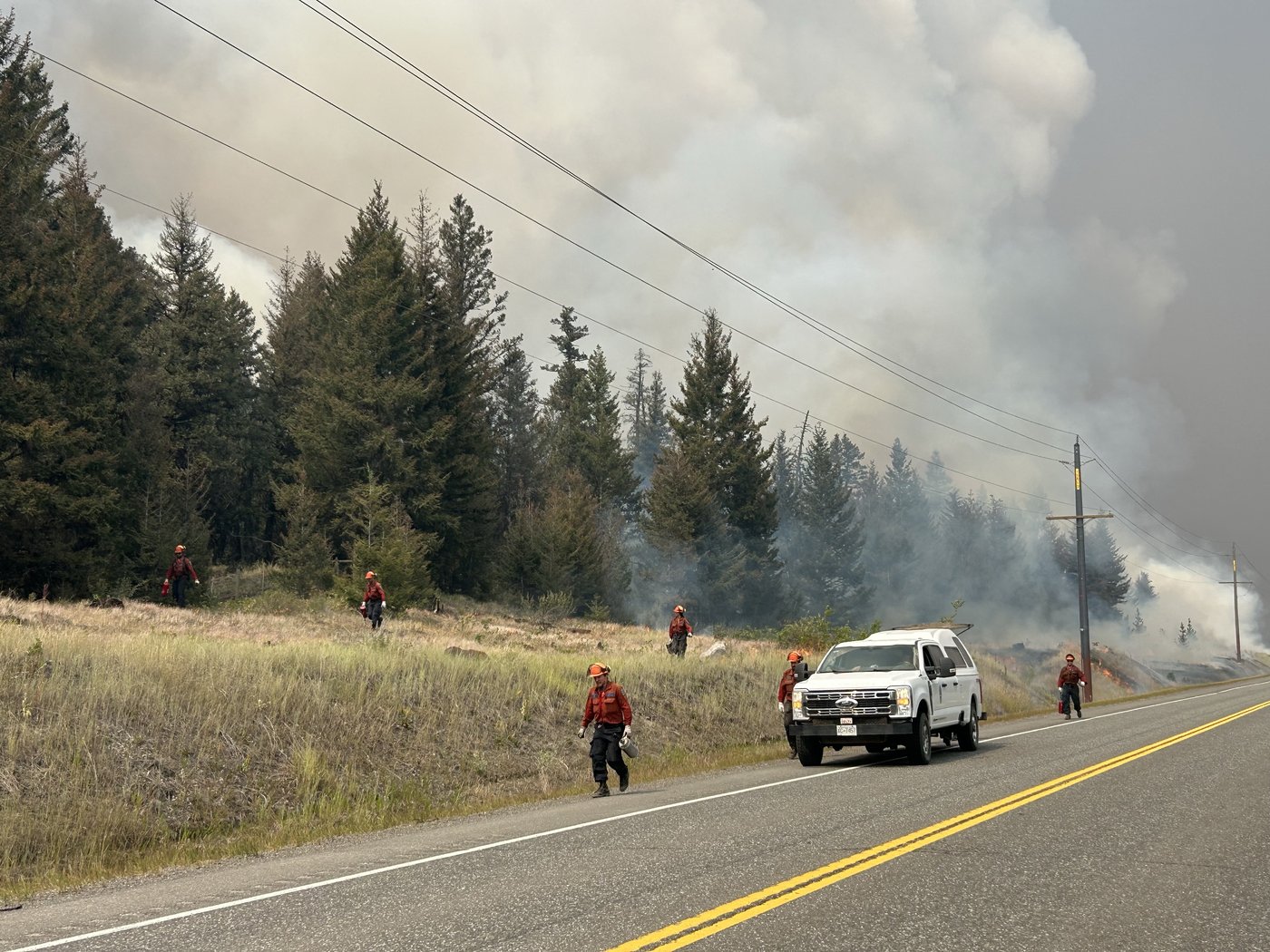
Fire officials said crews were doing a planned ignition on Wednesday to burn fuel around Highway 97, that was between two arms of wildfire.
The province’s drought map shows the south Cariboo — where wildfire destroyed homes northwest of Clinton last week — is at level four on a scale of five.
Like the south Cariboo, Similkameen, Okanagan and Kettle River basins were also sitting at drought level four, while the Upper Nicola River showed a high risk of water scarcity.
The B.C. government announced an order affecting more than 450 water licenses to protect fish in the Salmon River watershed on Tuesday, saying a severe drought has been plaguing the Thompson-Okanagan region and the river has shown persistently low streamflow despite significant voluntary conservation efforts.
Other parts of southern B.C. were classified as drought level three, including eastern Vancouver Island, the Lower Mainland and the Sea to Sky region, as well as the Clearwater and lower and south Thompson basins.
Meanwhile, portions of the One Mile Lake Park have reopened after the Village of Pemberton lifted an evacuation order that had been in place for about two weeks due to the Signal Hill wildfire burning in the province’s Squamish-Lillooet regional district.
This report by The Canadian Press was first published July 29, 2026.
— With files from Nono Shen in Vancouver
News from © The Canadian Press, . All rights reserved.
This material may not be published, broadcast, rewritten or redistributed.

Join the Conversation!
Want to share your thoughts, add context, or connect with others in your community?
You must be logged in to post a comment.