Elevate your local knowledge
Sign up for the iNFOnews newsletter today!
Sign up for the iNFOnews newsletter today!
Selecting your primary region ensures you get the stories that matter to you first.
ECOUST-SAINT-MEIN, France (AP) — For more than a century, the British soldier lay in an anonymous grave, one of so many unidentified victims buried beneath the killing fields of World War I.
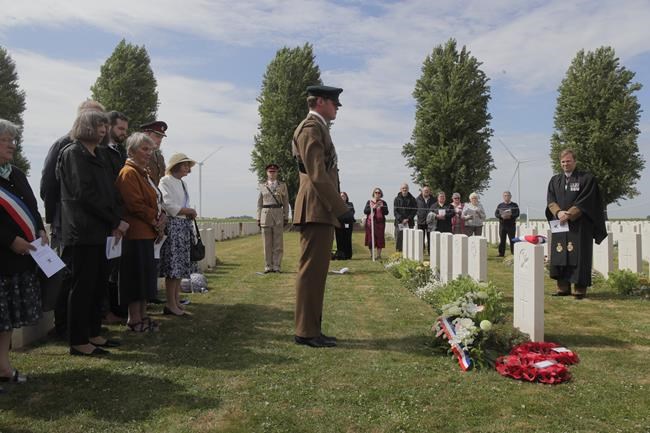
But now, his headstone finally bears a name: 2nd Lt. Osmund Bartle Wordsworth — a great-great-nephew of English poet William Wordsworth — who was recently identified by DNA research, and given a funeral ceremony Tuesday, 105 years after he died.
A new headstone for Wordsworth, who was killed in action in the Battle of Arras on April 2, 1917, was mounted at his gravesite at a cemetery in Ecoust-Saint-Mein in northern France. A cleric led the ceremony, and a British military attache handed Wordsworth’s relatives a carefully folded French flag to place on the grave.
The evolution of DNA technology has allowed for the identification of more and more unknown soldiers from World War I. A service will be held for others in Ypres, Belgium, next week.
News from © iNFOnews.ca, . All rights reserved.
This material may not be published, broadcast, rewritten or redistributed.

This site is protected by reCAPTCHA and the Google Privacy Policy and Terms of Service apply.
Want to share your thoughts, add context, or connect with others in your community?
You must be logged in to post a comment.