Elevate your local knowledge
Sign up for the iNFOnews newsletter today!
Elevate your local knowledge
Sign up for the iNFOnews newsletter today!
Select Region
Selecting your primary region ensures you get the stories that matter to you first.
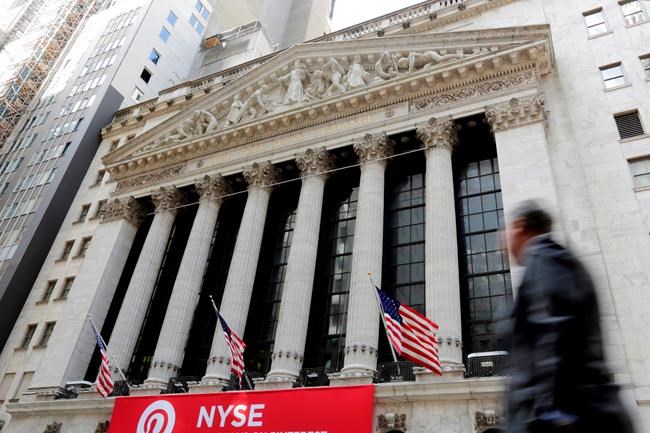
NEW YORK – U.S. stocks finished mostly higher Friday, but they surrendered most of an early gain as worries about rising tariffs once again dampened investors’ enthusiasm as the second quarter came to an end.
The Federal Reserve allowed most of the largest financial institutions in the U.S. to pay bigger dividends to shareholders and buy back tens of billions of dollars in stock. Wells Fargo made its biggest gain since shortly after the 2016 Presidential election. Nike had its biggest surge in almost four years after it said sales in North America improved in its latest quarter.
The Commerce Department said spending by consumers rose a disappointing 0.2 per cent in May. But wages continued to improve, and Shawn Cruz, manager of trader strategy for TD Ameritrade, said that suggests spending will rise.
“Investors wanted to see what the potential is for consumer spending in the future,” Cruz said. “Wage growth came in solid enough that there wasn’t a major concern.”
The S&P 500 index edged up 2.06 points, or 0.1 per cent, to 2,718.37. The Dow Jones Industrial Average gained 55.36 points, or 0.2 per cent, to 24,271.41. The Nasdaq composite rose 6.62 points, or 0.1 per cent, to 7,510.30. The Russell 2000 index of smaller-company stocks lost 1.95 points, or 0.1 per cent, to 1,643.07.
Just before midday the Dow rose as much as 293 points, but those gains eroded as investors again focused on the trade concerns that have rocked the market since late February. Canada announced $12.6 billion in retaliatory tariffs on U.S. goods in response to the U.S. tariffs on steel and aluminum imports. General Motors warned that if the Trump administration places import taxes on cars and car parts, it will likely face retaliation and might have to eliminate jobs in the U.S.
The Federal Reserve allowed 32 of the 35 largest banks in the U.S. to raise their quarterly dividends and buy back more stock. The central bank determined that those institutions are in good enough financial shape to weather a major downturn in the economy.
Wells Fargo gained 3.4 per cent to $55.44. While the Fed’s “stress tests” measure a bank’s financial health and are separate from its business tactics, investors felt the Fed’s approval was a notable win for Wells. Earlier this year the Fed ordered the bank to replace several of its directors and limited its growth in response to abusive practices including opening accounts in consumers’ names without permission. Those actions duped consumers out of millions of dollars.
Wells Fargo admitted to those practices in 2016 and has since agreed to pay more than $1.5 billion in fines, penalties and legal settlements.
Nike said revenue in North America grew after several quarters of declines, and its fourth-quarter profit and sales blew past Wall Street forecasts. The athletic apparel company also said it will buy back $15 billion in stock over the next four years. It gained 11.1 per cent to $79.68.
With trade tensions in focus throughout the second quarter, stocks didn’t make big gains after a very strong round of first-quarter corporate reports. The S&P 500 rose 2.9 per cent over those three months and the Dow added just 0.7 per cent.
Investors felt technology companies and smaller, more U.S.-focused companies were safe picks in case the trade tensions get worse. The Nasdaq composite jumped 6.3 per cent and the Russell 2000 index advanced 7.4 per cent. Both set records as recently as last week.
Only a week remains before the U.S. and China each place tariffs on tens of billions of dollars in imports. Cruz, of TD Ameritrade, said the outcome of the broader trade tensions will help determine what stocks do in the months to come: he said stocks might set more records if the situation is resolved in a way the market likes, but if the tensions end up hurting global economic growth, stocks could fall further.
Energy companies and oil prices continued to climb. Benchmark U.S. crude gained 1 per cent to $74.15 a barrel in New York and rose 14 per cent during the second quarter, to its highest price since late 2014. The S&P 500 index of energy companies climbed almost 13 per cent this quarter, far better than the rest of the market and its biggest gain in six and a half years.
Brent crude, used to price international oils, rose 1.9 per cent to $79.44 a barrel in London.
Wholesale gasoline climbed 2.2 per cent to $2.18 a gallon. Heating oil jumped 1.4 per cent to $2.21 a gallon. Natural gas lost 0.5 per cent to $2.92 per 1,000 cubic feet.
Bond prices wobbled and turned lower. The yield on the 10-year Treasury note rose to 2.86 per cent from 2.84 per cent.
Gold added 0.3 per cent to $1,254.50 an ounce. Silver gained 1 per cent to $16.20 an ounce. Copper fell 0.2 per cent to $2.97 a pound.
The dollar rose to 110.85 yen from 110.64 yen. The euro rose to $1.1672 from $1.1555.
France’s CAC 40 gained 1.1 per cent and the German DAX added 0.9 per cent after a deal on migration relieved pressure on the coalition government of Chancellor Angela Merkel. Britain’s FTSE 100 added 0.3 per cent.
Japan’s benchmark Nikkei 225 edged 0.2 per cent higher. South Korea’s Kospi advanced 0.5 per cent and Hong Kong’s Hang Seng added 1.6 per cent.
___
AP Markets Writer Marley Jay can be reached at http://twitter.com/MarleyJayAP His work can be found at https://apnews.com/search/marley%20jay
News from © iNFOnews.ca, . All rights reserved.
This material may not be published, broadcast, rewritten or redistributed.

This site is protected by reCAPTCHA and the Google Privacy Policy and Terms of Service apply.
Want to share your thoughts, add context, or connect with others in your community?
You must be logged in to post a comment.