Elevate your local knowledge
Sign up for the iNFOnews newsletter today!
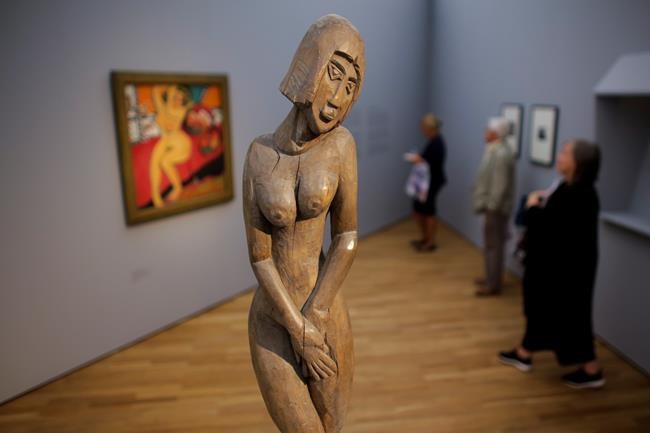
BERLIN – Three bathers jumping through the green waves of the Baltic Sea with a fourth watching from the beach. Two Berlin prostitutes with feathered hats lingering under the gaze of lurking men. A nude model lounging on a red bed in an artist’s studio.
The three iconic paintings by German expressionist artist Ernst Ludwig Kirchner are part of a small, but exquisite exhibition of the artist’s work opening at Berlin’s Hamburger Bahnhof museum.
The show that opens Friday features 17 paintings by Kirchner that are part of the Nationalgalerie’s early 20th century collection.
The exhibit also features photographs Kirchner took during his years in Davos, Switzerland, a rug depicting a traditional Alpine cattle drive in bright colours, and a number of drawings that include some of his fellow artist Max Liebermann.
The show is titled “Ernst Ludwig Kirchner: Hieroglyphs” because the artist sometimes depicted figures, buildings and landscapes as abstract motifs that are comparable to a system of signs, or hieroglyphs, curator Joachim Jaeger said Tuesday.
“Kirchner had his own metaphorical language which is being used over and over again in his works,” Jaeger said. “Hats, shoe tips, window frames … they often take on a life of their own if they’re next to each other.”
Kirchner, who was born in Aschaffenburg in 1880, was one of the founders of the famous expressionist artists’ group Die Bruecke, which turned away from more traditional methods in favour of their own intuitive approaches.
When the group moved from Dresden to Berlin in 1911, Kirchner dived into the seductive fringes of urban nightlife while spending his summers on the Baltic island of Fehmarn — locales that feature prominently in his work from that period.
With the outbreak of World War I, Kirchner volunteered for army service, but suffered from anxiety attacks and other psychological problems. It was only during long stays in Davos sanatoriums that his health improved.
In 1917, he moved to a mountain cabin in Davos where he created “Frauenkirch in the Winter,” a panorama painted with strongly visible brush strokes that captures a snowy, bright yellow valley of little cottages surrounded by red fir trees and steep pink mountains.
Kirchner’s style became even more abstract, sometimes almost two-dimensional, in later years. The evolution is represented in the Hamburger Bahnhof exhibit by the 1930 oil-on-canvas “Singer At The Piano,” a painting of a group of people rendered in pink, mint and purple.
Kirchner killed himself in 1938, depressed over the Nazis’ denouncement of his art as degenerate.
The show, which runs through February 26, 2017, is augmented by two contemporary works.
A painting by New York-based artist Rudolf Stingel is based on one of Kirchner’s Switzerland photos. Italian artist Rosa Barba contributed a film showing the entire collection held in the Nationalgalerie repository.
News from © The Associated Press, . All rights reserved.
This material may not be published, broadcast, rewritten or redistributed.

This site is protected by reCAPTCHA and the Google Privacy Policy and Terms of Service apply.
Want to share your thoughts, add context, or connect with others in your community?
You must be logged in to post a comment.