Elevate your local knowledge
Sign up for the iNFOnews newsletter today!
Elevate your local knowledge
Sign up for the iNFOnews newsletter today!
Select Region
Selecting your primary region ensures you get the stories that matter to you first.
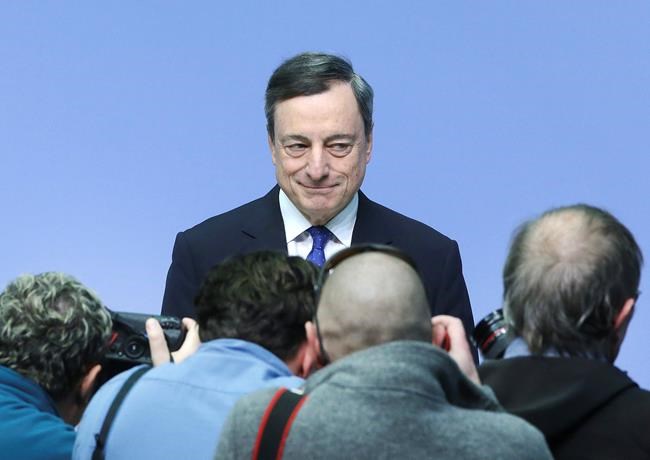
FRANKFURT – The Latest on the European Central Bank’s monetary policy meeting and news conference (all times local):
3:15 p.m.
The head of the European Central Bank says he doesn’t find “any merit in attacking Germany” over its trade surplus, a thinly veiled rebuttal to the U.S. administration’s comment that the country profits from the euro to gain trade advantages.
In a news conference, Mario Draghi noted Thursday that “the exchange rate of the euro is determined by market forces.”
He noted that the U.S. treasury itself has recognized that Germany has not intervened in foreign currency markets since 2011.
White House trade adviser Peter Navarro in February said Germany was using a “grossly undervalued” euro to “exploit” the U.S. and EU, and this week said reducing the U.S. deficit with Germany was “one of the most difficult” trade issues.
___
2:50 p.m.
The European Central Bank has sharply raised its inflation projection for this year, to 1.7 per cent from 1.3 per cent previously.
The bank published new staff estimates after Thursday’s meeting at which it left all its stimulus programs unchanged.
Inflation figures are important because the bank’s key mission is maintaining stable prices, defined as just under 2 per cent. It has already reached that goal with inflation of 2.0 per cent in February. But ECB President Mario Draghi says the recent jump in inflation is due mainly to higher oil prices, not to fundamental pressures in the economy. He says it’s too early to talk about dialing back the bond-purchase stimulus because core inflation excluding oil and food remains stuck at only 0.9 per cent.
The inflation estimates for 2018 was nudged up to 1.6 per cent from 1.5 per cent while the forecast for 2019 was left unchanged at 1.7 per cent.
___
2:45 p.m.
European Central Bank head Mario Draghi says underlying inflationary pressures across the 19-country eurozone remain too weak for the bank to start the process of withdrawing its monetary stimulus efforts.
Draghi said after the bank left policy unchanged that “underlying inflation pressures continue to remain subdued.”
Core inflation, which strips out the volatile items of food, energy, alcohol and tobacco, has been stubbornly low over recent months at an annual rate of 0.9 per cent, even as the headline rate has spiked to 2 per cent.
Draghi also said incoming data increase confidence that the economic expansion will continue “to firm and broaden.” Recent surveys have pointed to an uptick in momentum.
___
1:45 p.m.
The European Central Bank has decided to keep its stimulus programs unchanged.
And that leaves President Mario Draghi with the job of explaining at his post-decision news conference why he is pressing on with the stimulus when the economy is growing and inflation has reached the bank’s goal of just under 2 per cent.
Draghi argues that inflation’s recent rise to 2.0 per cent in February comes from higher oil prices, and not from fundamental pressures in the economy such as higher wages for workers.
Core inflation, excluding volatile fuel and oil, remains stuck at 0.9 per cent.
The bank decided to keep its bond purchases from banks unchanged at 80 billion euros this month and 60 billion euros per month through the end of the year.
News from © iNFOnews.ca, . All rights reserved.
This material may not be published, broadcast, rewritten or redistributed.

This site is protected by reCAPTCHA and the Google Privacy Policy and Terms of Service apply.
Want to share your thoughts, add context, or connect with others in your community?
You must be logged in to post a comment.