Elevate your local knowledge
Sign up for the iNFOnews newsletter today!
TORONTO – Turning an avant-garde play into an avant-garde film was hard to resist for Patricia Rozema.
The veteran Canadian director says there were many reasons not to adapt “Mouthpiece” and its bold exploration of what it is to be a millennial feminist, timely as it is.
The Toronto stage version employed two actresses to simultaneously portray its conflicted heroine, with stars/co-writers Norah Sadava and Amy Nostbakken weaving in and out of their lines while also moving their bodies in sync as they crossed the stage.
Rozema was entranced by a “prismatic, collage-like” storytelling approach that also offered a fresh look at the impact of sexism across generations. As a film, it would require a similarly radical approach, and it results in a genre-pushing feature she describes as both an “experiment” and an “extravaganza.”
“I tried to raise money for it, and everybody said, ‘Yeah, on stage maybe but that’s not going to work so well on film, you can’t do that.’ And I thought, ‘Why can’t you?’” Rozema said back in September when she premiered the film at the Toronto International Film Festival.
“So it was an experiment against the judgment of others and thank the powers that be that I could raise the money — some from private investors who just had faith and also Telefilm and Ontario Film Development Corporation and CBC’s Breaking Barriers (Film Fund). Various funds took the risk with me (and) I am so thrilled with this movie.”
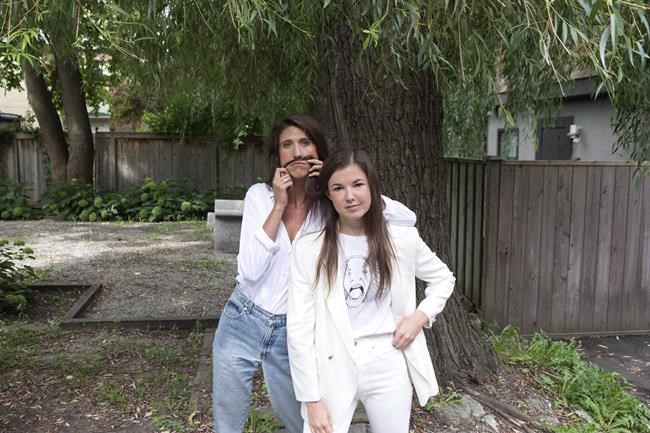
Like the Toronto play it’s based on, “Mouthpiece” details the inner life of a young woman reeling from the sudden death of her mother. Sadava and Nostbakken, who each have long brown hair and appeared in all-white outfits for this interview, also play the main character, Cassandra, in the film.
Over the course of 48 hours, Cassandra must pick out flowers, choose a casket, buy food for mourners, select an outfit for her mother’s corpse, and write the eulogy.
It’s a simple premise, but it’s fuelled by convoluted emotions that overtake Cassandra as she tackles each task, communicated to the audience by an inner dialogue portrayed physically by each actress, while the mother’s story is conveyed through flashbacks.
“There’s so many complicated layers going on inside of the head of this woman as she’s journeying through her experience of discovering all this about herself and about her mother and the differences between herself and her mother and the differences inside her own brain,” says Sadava.
“Those kind of layers required a little bit more than just a single actor going on that journey.”
And there were physical challenges in making such an offbeat portrayal, acknowledges Nostbakken.
She credits the duo’s ability to slip into a single skin to the three years they spent working on the play, and the four years spent touring it.
“We also know each other very well and we’ve spent a lot of time, mostly practising, rehearsing, being in unison,” adds Sadava.
“Also, we often end up speaking in unison by accident or moving in unison because we’ve adopted each other’s habits and tendencies over all that time.”
Rozema says she instantly connected with the emotions of the story, both as a daughter and as the mother of 22- and 14-year-old daughters.
“I’ve had my mother die at that same age that they were when they made this play and I knew that feeling, I knew that shocking loss, that redefinition of yourself…. There’s something really destabilizing and profound about losing a parent that I thought, ‘This is eternal. All of human history knows this,’” said Rozema, whose acclaimed work includes 1987’s “I’ve Heard the Mermaids Singing” and 1999’s “Mansfield Park.”
“(And) I actually really felt like I had something to contribute and I could add a context to what is essentially a millennial sort of outburst and then I could actually add some years and some life experience to it.”
She was also intrigued by the chance to explore feminism through the eyes of women from two generations, each struggling with self-sabotage and double standards despite shifting attitudes.
“We carry (sexism) inside us, without realizing all these assumptions that are not helpful to our flourishing, to our blossoming,” says Rozema.
“Why is that? What is that? What did we inhale, what was in the air that we took in? I think we have this very small view of the history of the species where we think, ‘Oh, a few hashtags of feminism and MeToo and Time’s Up that it’s suddenly going to change.’ And it’s glacial, it’s profound.”
News from © iNFOnews.ca, . All rights reserved.
This material may not be published, broadcast, rewritten or redistributed.

This site is protected by reCAPTCHA and the Google Privacy Policy and Terms of Service apply.
Want to share your thoughts, add context, or connect with others in your community?
You must be logged in to post a comment.