Elevate your local knowledge
Sign up for the iNFOnews newsletter today!
Elevate your local knowledge
Sign up for the iNFOnews newsletter today!
Select Region
Selecting your primary region ensures you get the stories that matter to you first.
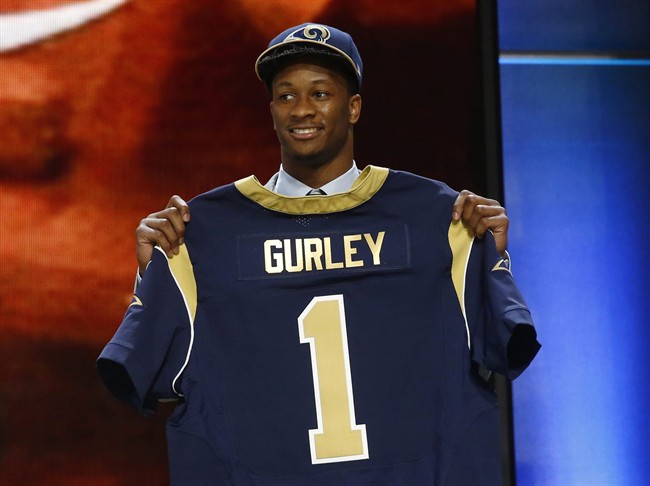
ATLANTA – Georgia Gov. Nathan Deal has signed into law what’s been dubbed the “Todd Gurley bill” — making it a crime punishable by up to a year in prison to entice student athletes to break NCAA rules for money.
Deal’s office said Thursday that he had signed House Bill 3, numbered to reflect the jersey number of the famous former University of Georgia running back who was suspended from the Bulldogs’ football team for four games last fall for accepting money for autographs.
Gurley may never need to sell another autograph — the St. Louis Rams chose him as the 10th overall pick in the NFL draft last week, so his contract will be in the millions.
He was a leading contender for the Heisman Trophy last year when he was suspended for accepting money from a memorabilia dealer for autographs: $400 on jerseys and other items. Then he suffered a year-ending knee injury his first game back and announced in December he’d end his collegiate career to declare for the draft.
He gambled that the knee injury wouldn’t hurt his stock and he was right. Gurley became the first back selected in the first round since 2012.
Angered that a dealer — and a Florida fan at that — had not only arranged for the signature sales but then tried to sell the story to the highest media bidder, state Rep. Barry Fleming, R-Harlem, started thinking about drafting a bill to prevent future shenanigans.
“That’s what really got most peoples’ dander up,” said Fleming, a rabid Bulldogs fan with undergraduate and law degrees from UGA. “I was disappointed when it happened. But I understand the young man comes from a very humble background. His mother didn’t have funds to properly repair the roof on the trailer she raised him in.”
The law has two possible penalties, one criminal, one civil, Fleming said.
“We plugged it into a law about alumni being overzealous,” he said. “Now it’s a misdemeanour of a high and aggravated nature. It can be up to a year in jail and a $5,000 fine.
“On the civil side, the university can sue the person who does this for any damages sustained, like losing a TV contract, not going to bowl games.”
The law comes as numerous states try to curb unethical conduct by sports agents and others that could jeopardize a college athlete’s eligibility.
The Uniform Athlete Agent Act is designed to prevent agents from providing gifts that violate NCAA rules to try to sign athletes. It has been implemented in at least 40 states, including Georgia, though the law’s structure and penalties can vary from state to state.
A committee from the Uniform Law Commission, which seeks to standardize state laws, is working to update the act this summer to broaden its reach and possibly strengthen recommended penalties.
In Georgia, the new law is not retroactive, but that doesn’t mean UGA won’t sue the dealer, he said.
“It’s a good law,” Fleming said. “Now dealers know they can lose money and get in real trouble.”
He said he believes financially disadvantaged players should get some sort of stipend because “many of them can’t get a job, for obvious reasons. They’re spending all their time practicing.”
He said when the news broke that Gurley would be suspended, “I got mad. It hurt our season and Todd Gurley himself.”
And what really made him mad was that the dealer wasn’t on the hook for a fine or jail time.
The Gurley bill won overwhelming approval in both chambers.
___
AP Sports Writer Aaron Beard in Raleigh, North Carolina, contributed to this report.
News from © The Associated Press, . All rights reserved.
This material may not be published, broadcast, rewritten or redistributed.

This site is protected by reCAPTCHA and the Google Privacy Policy and Terms of Service apply.
Want to share your thoughts, add context, or connect with others in your community?
You must be logged in to post a comment.