Elevate your local knowledge
Sign up for the iNFOnews newsletter today!
Sign up for the iNFOnews newsletter today!
Selecting your primary region ensures you get the stories that matter to you first.
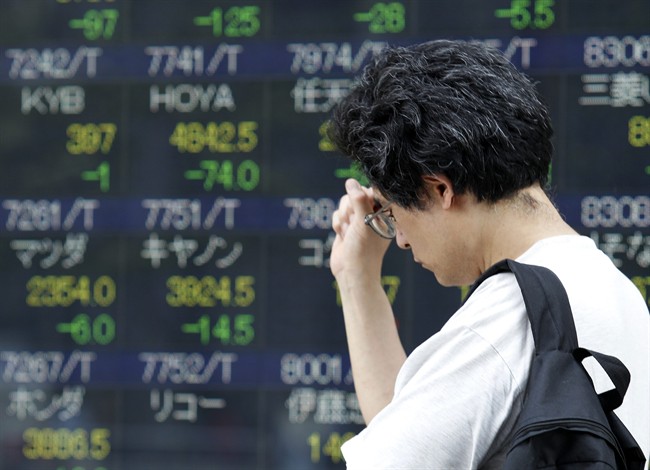
SEOUL, South Korea – The Shanghai share index dived more than 8 per cent Monday as Chinese stocks suffered a renewed sell-off despite government efforts to calm the market.
Other Asian stock benchmarks also were lower. The Shanghai Composite Index closed down 8.5 per cent at 3,725.56.
Monday’s fall was the biggest one-day decline in Chinese stocks since February 2007, according to Guo Yanhong, market strategist at Founder Securities. Some analysts said it was sparked by brokerages restricting credit used to finance stock purchases, also known as margin trading.
“The continuous check on margin trading by security companies has triggered today’s sell-off,” said Xu Xiaoyu, a market strategist at China Investment Securities. “In addition, the recent economic data shows it still takes time for the economy to recover from its sluggishness.”
Chinese shares fell dramatically in June after a sizzling yearlong rally took the market to unsustainable heights.
A period of stability was achieved after the government announced draconian support measures that included forbidding major shareholders from selling any of their shares and ordering state companies and others to buy.
The Chinese sell-off rattled other markets in the region. Hong Kong’s Hang Seng shed 3.1 per cent at 24,288.54 and Japan’s Nikkei 225 dropped 1 per cent to 20,350.10. South Korea’s Kospi fell 0.4 per cent to close at 2,038.81. Stocks in Southeast Asia were lower. But Australia’s S&P/ASX 200 gained 0.4 per cent to 5,589.90.
Asian stocks had already started the week on a dour note, rattled by a last week’s report on Chinese manufacturing that sparked a sell-off in gold as well as copper and other commodities.
Prices of copper and gold hit their lowest levels in several years following the survey that showed China’s manufacturing contracted in July. On Monday, the price of gold bounced back from a five-year low but other metal prices lost more ground.
A drop in China’s industrial profits has also added to signs that stimulus efforts are taking time to take hold in the world’s No. 2 economy.
The National Bureau of Statistics said China’s industrial profits contracted 0.3 per cent in June over a year earlier, marking a second straight month of decline.
Elsewhere, traders were turning their minds toward the U.S. Federal Reserve as they try to assess when the central bank will start raising interest rates. The market appears split between those who think it will happen in September or December.
Ultra low interest rates have been a boon for stock markets worldwide for several years and the start of U.S. rate hikes is likely to ruffle markets. The Federal Reserve Open Market Committee has a two-day policy meeting that ends Wednesday.
In energy markets, benchmark U.S. crude was down 17 cents at $47.97 a barrel in electronic trading on the New York Mercantile Exchange. The contract fell 31 cents to close at $48.14 a barrel in New York on Friday. International benchmark Brent crude was down 11 cents at $43.41 a barrel on the ICE future exchange in London.
In currency trading, the euro strengthened to $1.1077 from $1.0991 on Friday. The dollar weakened to 123.32 yen from 123.79 yen.
___
AP researcher Yu Bing in Beijing contributed.
News from © The Associated Press, . All rights reserved.
This material may not be published, broadcast, rewritten or redistributed.

This site is protected by reCAPTCHA and the Google Privacy Policy and Terms of Service apply.
Want to share your thoughts, add context, or connect with others in your community?
You must be logged in to post a comment.