Elevate your local knowledge
Sign up for the iNFOnews newsletter today!
Sign up for the iNFOnews newsletter today!
Selecting your primary region ensures you get the stories that matter to you first.
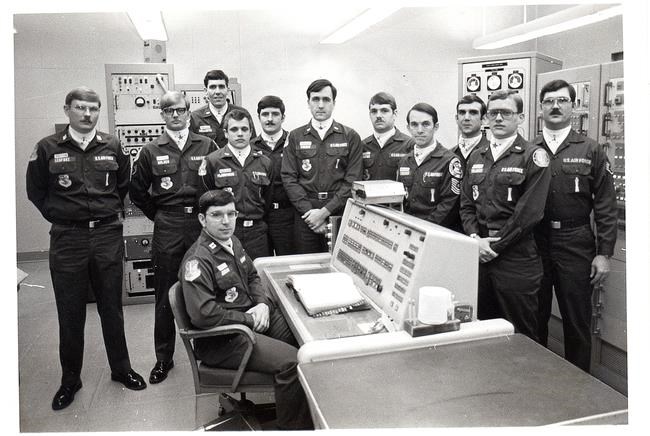
LITTLE ROCK, Ark. – For about 10 hours in 1980, the United States faced a nuclear threat of its own making after an airman performing maintenance on a Titan II missile dropped a 9-pound socket 70 feet, ripping a hole in a fuel tank and leading to an explosion that propelled a 9-megaton warhead out of the ground.
Using decades-old U.S. Air Force training footage, re-enactments and drone-shot video from a mothballed silo, director Robert Kenner recalls the tense time that began beneath the northern Arkansas landscape. His documentary, “Command and Control ,” airs Tuesday on PBS as part of its American Experience series (9 p.m. EST).
“The real story is how close we came to blowing up a quarter of the country,” Kenner said in a telephone interview. “The warhead going off would have changed history.”
In the heat of the Cold War, the U.S. placed nuclear warheads atop 54 Titan II missiles and spread them evenly among Arizona, Arkansas and Kansas. The U.S. Air Force never confirmed their presence, but it was common knowledge that they dotted the Arkansas hills, said Skip Rutherford, then an aide to Sen. David Pryor.
On the night of the accident, airmen who had previously raised concerns with Pryor about missile safety called Rutherford — interrupting him while he was having dinner with a friend — to say that a volatile mix of rocket fuel and oxidizer was sure to blow.
“We don’t know what that means,” Rutherford said this week. “We don’t know what the missile does — is there a radiation leak, a nuclear explosion? Something is going to happen and it’s not going to be good. It’s just what degree of bad it is.”
The vapours exploded in the middle of the night, killing one airman and injuring 21 others. The force of the blast cast the warhead out of the eight-story underground bunker; searchers found it later, in a ditch 200 yards away.
“If the system worked properly, someone dropping a tool couldn’t send a nuclear warhead into a field,” Eric Schlosser, who wrote the book “Command and Control” in 2013, says in the documentary.
With the Arkansas rockets, plus those in the other states, the U.S. intended to show the Soviet Union and the rest of the world that the nation was ready for a fight. They were dismantled by 1987, and their silos left open so the Soviets could use satellite imagery to verify their removal.
As they stood, airmen didn’t want to push the button to launch a missile but knew the day might come when they had to, said Allan Childers, a member of a missile combat crew.
“You had to be prepared to destroy an entire civilization,” he says in the film. “As heartless as it sounds, I never had a problem. I was doing it for my country. … Deterrence is worthless if you don’t demonstrate that you’re willing to do it.”
Schlosser and Kenner, who share screenwriting credits, make a point that every weapon built for use elsewhere also poses a threat at home, in one way or another. In Damascus, Arkansas, about 45 miles north of Little Rock, the human error involved an airman using a socket wrench in a missile silo rather than a torque wrench called for in an updated checklist.
“Luck is a bad policy,” Kenner said, paraphrasing a theme from the documentary, which is on the 15-film short list for Best Documentary at this year’s Academy Awards. “This is a story about human beings making mistakes, but the consequences of making a mistake with this missile and warhead are tremendous.”
___
Online: http://www.commandandcontrolfilm.com/
___
Follow Kelly P. Kissel on Twitter at www.twitter.com/kisselAP and go to http://bigstory.ap.org/author/kelly-p-kissel to see his work.
News from © The Associated Press, . All rights reserved.
This material may not be published, broadcast, rewritten or redistributed.

This site is protected by reCAPTCHA and the Google Privacy Policy and Terms of Service apply.
Want to share your thoughts, add context, or connect with others in your community?
You must be logged in to post a comment.