Elevate your local knowledge
Sign up for the iNFOnews newsletter today!
Sign up for the iNFOnews newsletter today!
Selecting your primary region ensures you get the stories that matter to you first.
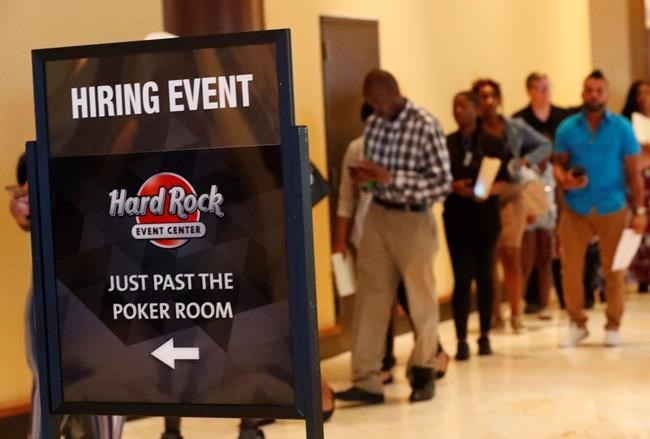
WASHINGTON – The number of open U.S. jobs slipped 0.4% in July, while hires climbed slightly, a sign that some employers may be growing cautious amid rising economic uncertainty.
The Labor Department said Tuesday that employers advertised 7.22 million available jobs in July, down from a revised 7.25 million in June. Job openings reached a peak of 7.6 million last November but have fallen by about 400,000 since then. This is the second consecutive month in which job openings have declined.
Still, total hiring edged up to 6 million. The number of quits, which tends to increase when people are confident in the prospect of finding a new job, rose to 3.6 million.
The figures point to a largely healthy job outlook, said Daniel Silver, an economist at JPMorgan Chase Bank, in a note to clients.
“Like many other recent labour market indicators, the JOLTS report signals that job market conditions are reasonably healthy, but that they are not as upbeat as they were at some earlier stages of the expansion,” Silver said.
After U.S. employers added a modest 130,000 jobs in August, some economists view the declining job openings as a sign of weakness for the labour market.
“Last week’s jobs report sparked a debate over whether the slowdown in hiring is due to an economy hitting full employment, but today’s JOLTS report indicates that this is actually a labour market that is losing momentum,” said Nick Bunker, an economist at jobs site Indeed.
There are 1.2 job openings for every unemployed person, suggesting that many businesses still remain hungry for workers. Additional hiring could be especially significant in fueling consumer spending, which is the primary driver of economic growth.
But Julia Pollak, a labour economist at online job marketplace ZipRecruiter noted that Tuesday’s report revealed rising layoffs in the manufacturing and mining industries.
“Production industries are really starting to show signs of decline, while the service industries are doing pretty well,” Pollak said. “But the service providing industries are typically far less volatile during a downturn. Production is really the tail that wags the dog.”
News from © iNFOnews.ca, . All rights reserved.
This material may not be published, broadcast, rewritten or redistributed.

This site is protected by reCAPTCHA and the Google Privacy Policy and Terms of Service apply.
Want to share your thoughts, add context, or connect with others in your community?
You must be logged in to post a comment.