Elevate your local knowledge
Sign up for the iNFOnews newsletter today!
Sign up for the iNFOnews newsletter today!
Selecting your primary region ensures you get the stories that matter to you first.
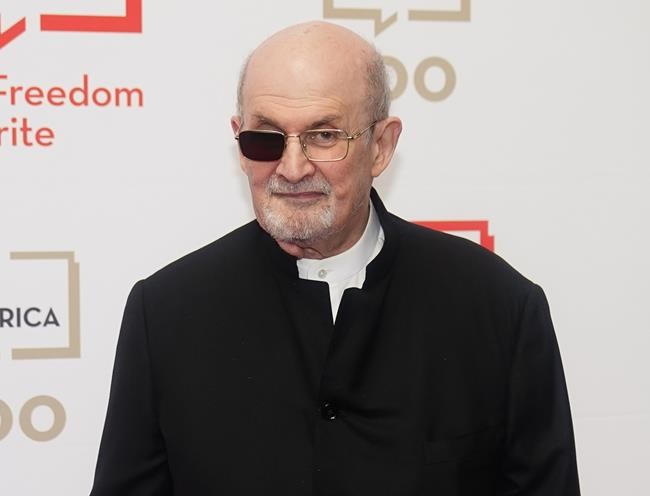
NEW YORK (AP) — Salman Rushdie has a memoir coming out about the horrifying attack that left him blind in his right eye and with a damaged left hand. “Knife: Meditations After an Attempted Murder” will be published April 16.
“This was a necessary book for me to write: a way to take charge of what happened, and to answer violence with art,” Rushdie said in a statement released Wednesday by Penguin Random House.
Last August, Rushdie was stabbed repeatedly in the neck and abdomen by a man who rushed the stage as the author was about to give a lecture in western New York. The attacker, Hadi Matar, has pleaded not guilty to charges of assault and attempted murder.
For some time after Iran’s Grand Ayatollah Ruhollah Khomeini issued a 1989 fatwa calling for Rushdie’s death over alleged blasphemy in his novel “The Satanic Verses,” the writer lived in isolation and with round-the-clock security. But for years since, he had moved about with few restrictions, until the stabbing at the Chautauqua Institution.
The 256-page “Knife” will be published in the U.S. by Random House, the Penguin Random House imprint that earlier this year released his novel “Victory City,” completed before the attack. His other works include the Booker Prize-winning “Midnight’s Children,” “Shame” and “The Moor’s Last Sigh.” Rushdie is also a prominent advocate for free expression and a former president of PEN America.
“’Knife’ is a searing book, and a reminder of the power of words to make sense of the unthinkable,” Penguin Random House CEO Nihar Malaviya said in a statement. “We are honored to publish it, and amazed at Salman’s determination to tell his story, and to return to the work he loves.”
Rushdie, 76, did speak with The New Yorker about his ordeal, telling interviewer David Remnick for a February issue that he had worked hard to avoid “recrimination and bitterness” and was determined to “look forward and not backwards.”
He had also said that he was struggling to write fiction, as he did in the years immediately following the fatwa, and that he might instead write a memoir. Rushdie wrote at length, and in the third person, about the fatwa in his 2012 memoir “Joseph Anton.”
“This doesn’t feel third-person-ish to me,” Rushdie said of the 2022 attack in the magazine interview. “I think when somebody sticks a knife into you, that’s a first-person story. That’s an ‘I’ story.”
News from © iNFOnews.ca, . All rights reserved.
This material may not be published, broadcast, rewritten or redistributed.

This site is protected by reCAPTCHA and the Google Privacy Policy and Terms of Service apply.
Want to share your thoughts, add context, or connect with others in your community?
You must be logged in to post a comment.