Elevate your local knowledge
Sign up for the iNFOnews newsletter today!
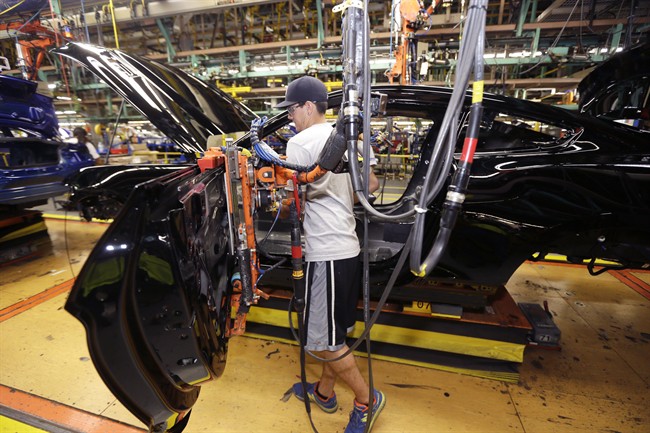
WASHINGTON – U.S. manufacturing production fell for the second straight month in September as factories cranked out fewer appliances, computers, and electronics.
Factory output declined 0.1 per cent, the Federal Reserve said Friday, following a drop of 0.4 per cent in August. Manufacturers also cut back on production of steel and other metals.
The decline suggests that a strong dollar, weak overseas economies, and cautious U.S. consumers are holding back factory output. Many companies are also focused on reducing stockpiles that were built up in the spring by cutting back on orders for new goods.
Overall industrial production, which includes mining and utilities, fell 0.2 per cent, also its second straight decline. Mining output plunged 2 per cent as energy companies sharply reduced oil and gas drilling. Utility output rose 1.3 per cent.
Factories have had a tough year and there is little sign of improvement any time soon. A strong U.S. dollar and weak overseas growth have hammered U.S. exports. The dollar has risen about 13 per cent in value against other currencies in the past 12 months. That makes U.S. products more expensive, and therefore less attractive, in other countries.
Overall industrial production has increased just 0.4 per cent in the past year, its weakest showing since the Great Recession.
“In 2015 it has been one thing after another hammering manufacturing in almost everything except motor vehicles,” Michael Montgomery, an economist at HIS Global Insight.
Auto sales jumped nearly 16 per cent in September from a year earlier and are at the highest level in a decade. That has boosted auto production, which 0.2 per cent last month.
But outside of cars, Americans are spending cautiously. Retail sales have barely grown in the past two months. That’s left many businesses with warehouses full of unsold goods. With such large inventories they see little need to order new products.
Big overseas economies are grappling with slower or nonexistent growth, including China, Canada, Europe, and Brazil. Canada, the United States’ largest trading partner, is in recession.
China and Brazil had been critical sources of demand for American-made industrial machinery, such as mining trucks, construction equipment, and agricultural machines. Their economic slowdowns have hit sales and profits for companies such as Caterpillar and United Technologies.
Falling oil prices have also dragged down factory output. Crude oil prices, which were around $60 per barrel in the spring, have fallen to about $49. The decline has forced energy firms to curtail drilling, eliminating much of the need for new pipelines and equipment that had boosted factory orders in previous years.
A private survey earlier this month found that U.S. manufacturing activity expanded last month at the slowest pace in two years. Measures of new orders and production also dropped sharply, suggesting weakness in manufacturing is likely to continue.
Overall, the economy is expected to expand at just a 1 per cent to 1.5 per cent annual rate in the July-September quarter, a sharp slowdown from 3.9 per cent in the April-June quarter.
News from © The Associated Press, . All rights reserved.
This material may not be published, broadcast, rewritten or redistributed.

This site is protected by reCAPTCHA and the Google Privacy Policy and Terms of Service apply.
Want to share your thoughts, add context, or connect with others in your community?
You must be logged in to post a comment.