Elevate your local knowledge
Sign up for the iNFOnews newsletter today!
Sign up for the iNFOnews newsletter today!
Selecting your primary region ensures you get the stories that matter to you first.
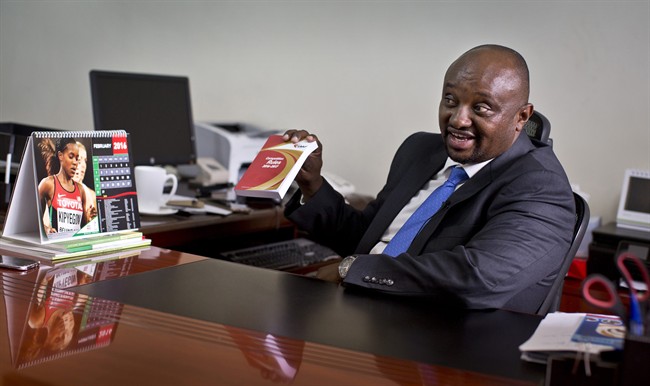
NAIROBI, Kenya – The chief executive of Kenya’s track and field federation has taken temporary leave after two athletes alleged in an interview with The Associated Press that he asked them for a bribe to reduce their doping bans.
Athletics Kenya CEO Isaac Mwangi said in a letter to the federation’s acting president that the allegations by 400-meter runner Joy Sakari and hurdler Francisca Koki Manunga were “unsubstantiated” and “have caused me a lot of mental anguish.”
He asked for 21 days’ leave while the allegations are investigated.
In the AP interview, Sakari and Manunga alleged that Mwangi asked them each for a $24,000 bribe in an Oct. 16 meeting, but that they could not raise the money. The athletes, both police officers in Kenya, tested positive for a banned diuretic at the 2015 world championships in Beijing. They are serving four-year bans.
The athletes told AP they never filed a criminal complaint alleging wrongdoing by Mwangi because they had no proof to back up their bribery accusation and also feared repercussions.
In a separate AP interview, Mwangi dismissed the allegations as “just a joke,” denied ever meeting privately with the runners and said Athletics Kenya has no power to shave time off athletes’ bans.
In his letter to acting federation president Jackson Tuwei, dated Monday, Mwangi asked for AK’s disciplinary panel to investigate.
“I am anxious to have my name cleared,” he wrote in the letter, a copy of which was seen by AP. “It is my hope that the investigations will be expeditious, fair and should include relevant authorities.”
Mwangi’s leave was voluntary and started Monday, Tuwei told a news conference on Tuesday in Nairobi.
The world governing body of track and field, the IAAF, has referred the athletes’ allegations to its ethics commission. It already was investigating allegations that AK officials sought to subvert anti-doping in Kenya, solicited bribes and offered athletes reduced bans. The probe has led to the suspensions of AK’s president, Isaiah Kiplagat, a vice-president, David Okeyo, and AK’s former treasurer, Joseph Kinyua.
Sharad Rao, a former director of prosecutions in Kenya who also has adjudicated cases for the Court of Arbitration for Sport, is leading the ethics investigation for the International Association of Athletics Federations.
Sakari and Manunga told AP they would be willing to testify to investigators. Tuwei said the athletes have since filed complaints to the commission. Previously, as many as a half-dozen banned athletes had privately indicated to the commission that AK officials sought to extort them and that they feel their sanctions might have been less if they had paid bribes, Rao said.
AP’s interview with Sakari and Manunga was the first time Kenyan athletes detailed such allegations publicly.
“That information would, of course, be very, very significant, very important for us,” Rao told AP.
Tuwei said Kenya’s fledgling anti-doping agency also is going to form a committee to investigate, starting next Monday for two weeks.
“They will of course invite anybody else they wish to give evidence,” he said.
The World Anti-Doping Agency said Tuesday that it also is “in the process of sourcing more detailed information on the allegations from those concerned” so it can determine whether to launch its own probe or leave it to the IAAF’s commission.
___
Mutwiri Mutuota in Nairobi and John Leicester in Paris contributed.
News from © The Associated Press, . All rights reserved.
This material may not be published, broadcast, rewritten or redistributed.

This site is protected by reCAPTCHA and the Google Privacy Policy and Terms of Service apply.
Want to share your thoughts, add context, or connect with others in your community?
You must be logged in to post a comment.