Elevate your local knowledge
Sign up for the iNFOnews newsletter today!
Elevate your local knowledge
Sign up for the iNFOnews newsletter today!
Select Region
Selecting your primary region ensures you get the stories that matter to you first.
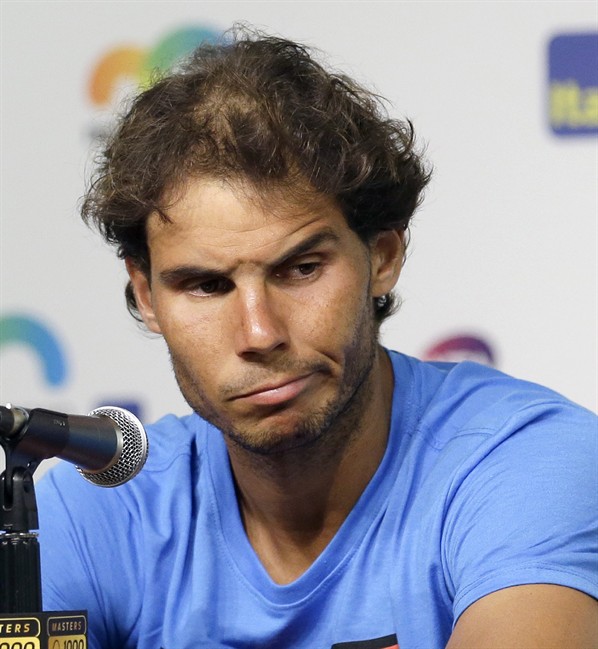
KEY BISCAYNE, Fla. – Rafael Nadal slumped in a changeover chair, the blood pressure gauge strapped to his mighty left arm serving as a scoreboard.
He was on the verge of defeat, and a few points later he retired from a match for the first time in six years.
Nadal faded in the subtropical heat and conceded after falling behind in the third set of his opening match Saturday at the Miami Open against Damir Dzumhur.
No. 12 Milos Raonic of Thornhill, Ont., fared better in the heat. The runner-up at Indian Wells this month beat Denis Kudla 7-6 (4), 6-4.
The No. 5-seeded Nadal trailed 2-6, 6-4, 3-0 when he called it quits after losing a point to fall behind 30-15. He had earlier consulted with a trainer between games three times, and had his blood pressure checked.
Nadal said he started feeling badly at the end of the first set.
“It was getting worse and worse and worse,” the Spaniard said. “I get a little bit scared — too dizzy. I felt I was not safe, so I decided to go. I wanted to finish the match, but I seriously couldn’t.”
His departure left the draw without three of the five highest-seeded men. No. 4 Stan Wawrinka lost to Andrey Kuznetsov 6-4, 6-3, and No. 3 Roger Federer withdrew Friday because of a stomach virus.
Eight-time champion Serena Williams avoided the upset bug and seemed unfazed by the weather. The South Floridian earned her 20th consecutive victory at Key Biscayne and reached the fourth round by beating Zarina Diyas 7-5, 6-3.
“I live down the street, and I’m used to these conditions,” she said. “Even though it was a little humid, I’m used to it and I love this weather.”
Nadal’s match lasted less than two hours, but the temperature approached 90 degrees and was even higher on the sunbaked stadium hardcourt.
Nadal said he felt fine before the match and wasn’t sure whether he was contracting an illness.
“Hopefully it’s just the extreme conditions,” he said. “It’s tough for me, because I felt I was playing well. It’s a hard accident. That’s life.”
Nadal later pulled out of doubles.
The 14-time Grand Slam champion hasn’t won a tournament since August. But it had been 443 matches since he retired — in the 2010 Australian Open quarterfinals against Andy Murray.
Key Biscayne remains one of the biggest tournaments Nadal has never won. He’s 0-4 in finals.
Dzumhur is a 23-year-old Bosnian who was a child actor before he decided to focus on tennis. Ranked 94th, he rallied with a variety of tactics, including half a dozen drop shots for winners and an occasional serve and volley.
Nadal had to work hard from the start, failing to convert nine break-point chances during a marathon second game before Dzumhur double-faulted to lose serve.
The heat also bothered the 154-pound Dzumhur, who consulted with a trainer following the first set.
“It was really tough to play,” he said. “I felt really tired and heavy and in some moments dizzy.”
Nadal finished 3 for 13 converting break points. Dzumhur was 4 for 4.
In other men’s play, No. 13 John Isner double-faulted on his final two service points and lost to qualifier Tim Smyczek 6-2, 2-6, 7-6 (5).
No. 6 Kei Nishikori defeated qualifier Pierre-Hughes Herbert 6-2, 7-6 (4).
On the women’s side, No. 8 Petra Kvitova lost to No. 30 Ekaterina Makarova 6-4, 6-4. No. 3 Agnieszka Radwanska, the 2012 champion, eliminated Madison Brengle 6-3, 6-2.
News from © The Associated Press, . All rights reserved.
This material may not be published, broadcast, rewritten or redistributed.

This site is protected by reCAPTCHA and the Google Privacy Policy and Terms of Service apply.
Want to share your thoughts, add context, or connect with others in your community?
You must be logged in to post a comment.