Elevate your local knowledge
Sign up for the iNFOnews newsletter today!
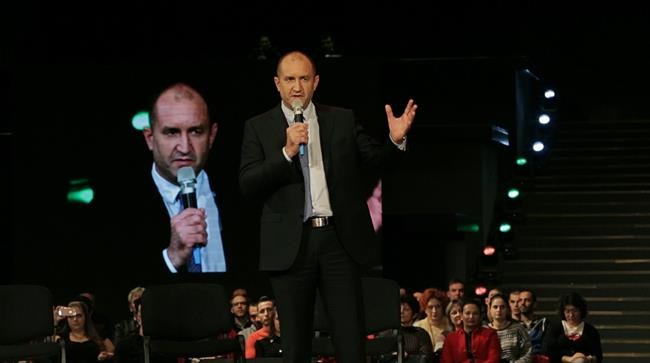
SOFIA, Bulgaria – A former Bulgarian Air Force officer who has called on the European Union to lift its sanctions against Russia was the likely winner of the country’s presidential election Sunday, but he did not secure enough votes to avoid a runoff, exit polls showed.
The exit polls gave opposition Socialist candidate Rumen Radev a narrow lead over the candidate of the ruling centre-right party, Parliament Speaker Tsetska Tsacheva, who was seen as the race’s front-runner ahead of Sunday’s voting.
The Balkan nation’s relations with Russia, the future of the European Union and increasing immigration since neighbouring countries closed their borders to refugees and migrants fleeing Africa and the Middle East dominated the election campaign.
Bulgaria, which joined the European Union a decade ago, remains the poorest member of the bloc. The slow pace of reforms to eliminate graft and poverty has fueled disillusionment, while over 1 million young people in the nation of 7.2 million have emigrated in search of better futures abroad.
Radev, 53, and Tsacheva, 58, were two of 21 candidates seeking the largely ceremonial presidency in an election that for the first time made voting for the position compulsory for Bulgaria’s 6.8 million voters.
If officials uphold the election results, the two will go head-to-head in a runoff election on Nov. 13.
Most political analysts said Radev’s likely victory in the runoff poses a threat for Prime Minister Borisov and his ruling GERB party, possibly prompting early general elections next spring that could shake up Bulgaria’s political scene.
Radev, a former fighter pilot, has pledged to comply with Bulgaria’s European obligations, if he is elected. But he also has said that “being pro-European does not mean being anti-Russian” and insisted that sanctions on Moscow need to be lifted.
Bulgaria joined NATO in 2004, but many in this Black Sea country still share deep historical and cultural ties with Moscow. Energy-strapped Bulgaria is also heavily reliant on Russian supplies.
If she becomes Bulgaria’s first female president, Tsacheva is widely expected to continue the pro-Europe foreign policy of incumbent Rosen Plevneliev.
“I voted for a stable and secure Bulgaria with educated and prospering people living there,” she said while casting her ballot.
Although the head of state has no executive powers, and all major policies must be approved by Parliament, the popular election imbues the post with a fair amount of political influence.
The president also leads the armed forces, can veto legislation and signs international treaties.
A poll conducted by the Alpha Research agency had Radev receiving 24.8 per cent of the vote on Sunday, Tsacheva 23.5 per cent.
Another poll by the Gallup International agency gave Radev 26.7 per cent and Tsacheva 22.5 per cent.
Although official results are not expected before Tuesday, they are not expected to change the need for or makeup of the runoff context.
News from © The Associated Press, . All rights reserved.
This material may not be published, broadcast, rewritten or redistributed.

This site is protected by reCAPTCHA and the Google Privacy Policy and Terms of Service apply.
Want to share your thoughts, add context, or connect with others in your community?
You must be logged in to post a comment.