Elevate your local knowledge
Sign up for the iNFOnews newsletter today!
Sign up for the iNFOnews newsletter today!
Selecting your primary region ensures you get the stories that matter to you first.
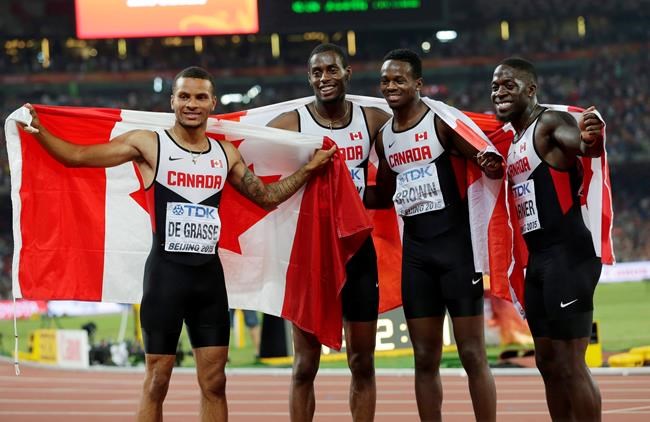
TORONTO – When Aaron Brown broke the 10-second barrier in the 100 metres last weekend, he became only the second Canadian sprinter in the last 17 years to do so.
He had hoped to be the first. Andre De Grasse beat him to it last summer.
But De Grasse’s breakout season lit a fire under Brown, who is running faster than ever. And suddenly Canada has two stars in track and field’s marquee event.
“I always wanted to be the first one to bring it back, but I said ‘OK, if someone else is doing it, I don’t want to be left behind, I don’t want to be left knocking at the door,’” Brown said. “I had to look at myself in the mirror and say: ‘OK, you can do it too, there’s no reason why you can’t if this person’s done it.’
“It’s actually helped me a lot, in training to get through hard workouts, having somebody in my own country that runs that fast, it keeps me humble and puts things in perspective as far as knowing that I have really stiff competition within my own country. And I have to step my game up. It’s no longer something that I’m wishing for, it was a must.”
The 24-year-old from Toronto ran 9.96 in Saturday’s heats of the Star Athletics Meet in Montverde, Fla.
Much like the four-minute mile once was, a sub-10 100 metres is among the most acclaimed and recognizable achievements in sports. Only about 100 men on the planet have done it. When De Grasse first cracked the 10-second barrier last summer, he became the first Canadian to do so since Bruny Surin in 1999, and along with Donovan Bailey, just the third Canadian to record a sub-10. Ben Johnson’s sub-10 times were officially erased from the record books due to doping.
De Grasse was happy for Brown.
“Me and him, we go way back. . . it’s pretty awesome because it’s been a long time, he should have been running 10 seconds last year, but now that he’s done that, I’m pretty happy for him,” De Grasse said in Toronto on Tuesday.
“When you’re the best in Canada, you’re kind of laid back, relaxed, you kind of forget that there’s other goals you need to accomplish, and I think that was good for him to see that I came in and ran sub-10, and he’s motivated now to do the same thing, and he believes in himself that he can do it.”
Brown said he’d had his eyes on that mark virtually “ever since I’ve been in track.”
“When I first started running, in high school, I thought breaking 11 seconds was like the Holy Grail, running 10 seemed insane,” he said, laughing. “And when I first did that, I was like ‘Man, I did it, I ran 10 seconds.’ And then as I got older and started learning more about track, I saw that all the professionals were running nine seconds, and I was like ‘Man, that’d be great to do.’”
He got close in college when he ran 10.05 at the 2013 NCAA championships. He’s been chasing sub-10 ever since.
“It was really frustrating chasing that barrier, because I’ve been so close but never broken through,” he said.
After all that waiting, he had to wait a bit longer on Saturday. When he crossed the finish line, the scoreboard still had the wind reading from the previous heat — an illegal 2.50 metres per second. He went on to run 10.01 to finish second in the final.
“I thought ‘Awww, knocking on the door. I’m right there. Then I saw the official sheet and it said 2.0 (allowable wind is anything 2.0 and lower), and people were telling me ‘Yeah, you ran 9.9 and it was legal,’” he said. “I was a little skeptical at first, I was thinking ‘Wait, I’ve been chasing this for a long time, I don’t want to have it taken away from me.’ So I waited until I saw it ratified on the IAAF, and once it was there I celebrated then. I actually did it.”
Brown figured he was on a fast pace in the heats when he edged American star Tyson Gay (9.97).
“He’s one of the fastest sprinters of all time. And when he made his move, I made a move too, and he didn’t pass me, we were step for step,” Brown said. “I thought ‘This guy’s really fast and the track was really fast, and the wind was good and the conditions were great. I just felt like if I was able to come out ahead of him, then the time must be something pretty good.”
Brown’s speedy time will make for an interesting Canadian Olympic trials early next month in Edmonton. He also plans to run the 200 in Rio — he missed the 200 finals at the 2012 London Games by just one spot. He’s also a key member of Canada’s 4×100 relay, helping the team to bronze both the 2013 and 2015 world championships.
News from © The Canadian Press, . All rights reserved.
This material may not be published, broadcast, rewritten or redistributed.

This site is protected by reCAPTCHA and the Google Privacy Policy and Terms of Service apply.
Want to share your thoughts, add context, or connect with others in your community?
You must be logged in to post a comment.