Elevate your local knowledge
Sign up for the iNFOnews newsletter today!
Sign up for the iNFOnews newsletter today!
Selecting your primary region ensures you get the stories that matter to you first.
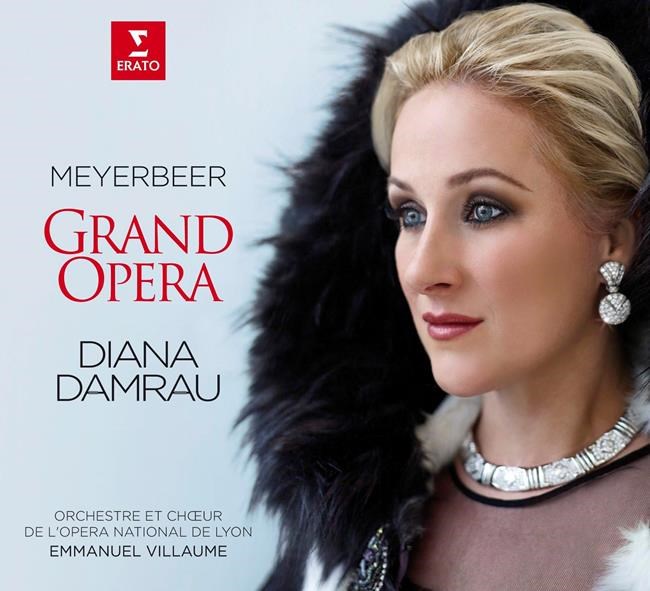
“Grand Opera,” Diana Damrau (Erato)
Once considered a giant of 19th century opera, Giacomo Meyerbeer has been relegated over the century to the second tier of composers, admired for his craftsmanship but faulted for lacking that intangible ingredient called genius.
Still, in recent years there have been stirrings of a Meyerbeer revival, with productions of several of his operas in European houses. And now the superb German soprano Diana Damrau aims to further the cause with an album of 11 arias that survey his long multinational career.
An aria from “Alimelek,” composed in 1814, shows a youthful facility, with orchestrations reminiscent of Mozart and Carl Maria von Weber. Finding no success in his native country, Meyerbeer went to Italy, where he composed five operas heavily influenced by Rossini. Arias from “Emma di Resburgo” and “Il Crociato in Egitto” represent this phase of his career.
It was upon moving to Paris that Meyerbeer hit pay dirt, collaborating in 1831 with librettist Eugene Scribe to produce one of the first truly grand operas, “Robert le Diable,” a five-act extravaganza complete with spectacular scenic effects and a scandalous ballet for ghostly nuns. The aria “Robert, toi que j’aime” represents Meyerbeer at his best, its long arching phrases creating genuine pathos as Robert’s fiancee Isabelle begs him to repent.
Perhaps his most famous work, “Les Huguenots,” followed in 1836 and is represented here by Marguerite de Valois’ “O beau pays,” which requires coloratura fireworks that Damrau dispatches nimbly. Both this aria and the “Shadow Duet” from “Dinorah,” written in 1859, display Meyerbeer’s skill at spinning out catchy tunes punctuated with plenty of high notes, and they remain popular soprano showpieces.
Damrau, long fascinated by Meyerbeer, writes in album notes that she admires “above all his ability to enter into the spirit of different national styles of music.” That’s true, but it also reflects Meyerbeer’s lack of a strong, individual musical identity that might have elevated him to the front rank of 19th century composers.
Damrau, ably accompanied by Emmanuel Villaume conducting the Orchestra and Chorus of L’Opera National de Lyon, makes as strong a case as could be imagined for re-examining his talents. Despite their efforts, in the end we’re left with more showiness than substance.
News from © iNFOnews.ca, . All rights reserved.
This material may not be published, broadcast, rewritten or redistributed.

This site is protected by reCAPTCHA and the Google Privacy Policy and Terms of Service apply.
Want to share your thoughts, add context, or connect with others in your community?
You must be logged in to post a comment.