Elevate your local knowledge
Sign up for the iNFOnews newsletter today!
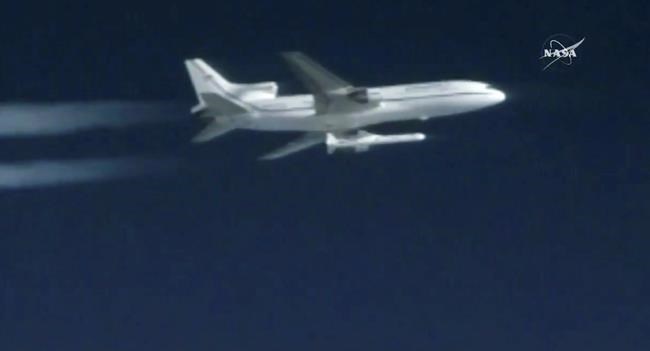
CAPE CANAVERAL, Fla. – NASA launched eight mini-satellites Thursday morning to measure surface wind deep in the heart of hurricanes.
The plane carrying the satellites took off shortly after sunrise Thursday from Cape Canaveral Air Force Station. An hour later, the co-pilot pushed the button that released the Pegasus rocket and attached satellites from the belly of the plane, 39,000 feet above the Atlantic and 100 miles east of Daytona Beach.
The Pegasus fired five seconds later, propelling the satellites into an orbit more than 300 miles high. The satellites successfully peeled away from the rocket’s upper stage two at a time, at half-minute intervals, generating applause in Launch Control.
The $157 million Cyclone Global Navigation Satellite System, or CYGNSS, is meant to improve hurricane forecasting. The satellites have GPS navigation receivers to frequently measure the surface roughness of oceans, enabling scientists to calculate wind speed and storm intensity. Unlike weather satellites already in orbit, these spacecraft can peer through rain swirling in a hurricane, all the way into the eye, or core.
“It looked beautiful,” NASA launch manager Tim Dunn said. “We’re very excited.”
Each spacecraft is just 64 pounds, with a 5-foot wingspan.
The University of Michigan’s Christopher Ruf, the principal researcher, said the satellites will undergo a few months of testing and should start churning out full-fledged science data in the spring for NASA and the National Weather Service. Scientists want the satellites up and running before the start of hurricane season on June 1.
NASA opted for an air launch by aerospace company Orbital ATK, versus a traditional rocket liftoff from the ground, to cut costs. The first launch attempt, on Monday, was foiled by a tripped circuit breaker on the plane that prevented the satellite-release system from working. Then on Wednesday, a spacecraft software issue forced another delay.
___
Online:
NASA:
https://www.nasa.gov/cygnss/
News from © The Associated Press, . All rights reserved.
This material may not be published, broadcast, rewritten or redistributed.

This site is protected by reCAPTCHA and the Google Privacy Policy and Terms of Service apply.
Want to share your thoughts, add context, or connect with others in your community?
You must be logged in to post a comment.