Elevate your local knowledge
Sign up for the iNFOnews newsletter today!
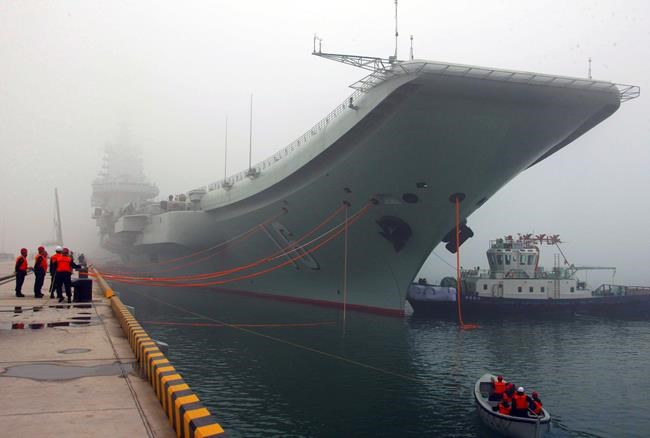
TAIPEI, Taiwan – Taiwan’s defence ministry said China’s sole aircraft carrier on Wednesday was transiting the Taiwan Strait amid heightened tensions between the mainland and self-governing island it claims as its own territory.
A ministry statement said the Liaoning was travelling northwest along the centre line dividing the strait, along with its battle group.
It said the military was closely monitoring the vessels’ passage and urged the public not to be alarmed. Taiwan regularly dispatches planes and ships to keep a watchful eye on Chinese forces’ movements around the island, although the ministry statement gave no details about the military’s response.
The heavily trafficked 160 kilometre- (100 mile-) wide Taiwan Strait separates Taiwan from southeastern China.
The carrier was on its way back from its first journey to the Western Pacific, where it carried out a training exercise.
Based on a Soviet-built platform and commissioned in 2012, the Liaoning earlier this month carried out what Beijing called routine combat drills in the South China Sea which Beijing claims almost in its entirety and has fortified with man-made islands. That followed China’s November declaration that the carrier and its complement of J-15 fighter jets was combat ready, setting off jitters in an already tense region.
The Liaoning set off for the Western Pacific last month, passing through the Miyako Strait, south of Okinawa, and then the Bashi Channel separating Taiwan from the Philippines as it entered the South China Sea.
Japanese and Taiwanese surveillance aircraft and ships closely monitored the Liaoning along its journey, seen by some as a sign of how China plans to use the carrier to demonstrate its willingness to back up its territorial claims with military muscle.
China and Taiwan split amid civil war in 1949 and Beijing has never renounced its threat to use force if it considers that necessary to prevent the island’s permanent independence from the mainland.
Relations between the sides have deteriorated badly since Taiwanese elected independence-leaning President Tsai Ing-wen last year, and Chinese officials have warned of more turbulence ahead unless she endorses Beijing’s view that Taiwan is part of China.
China has been steadily ratcheting-up the economic and political pressure on Tsai, discouraging Chinese tourists from visiting the island of 23 million and intervening to prevent its participation in international forums. That has fueled speculation that Beijing will seek to win away more of the island’s dwindling number of diplomatic allies, which now stand at just 21.
“Looking ahead in 2017, the development of cross-strait relations faces increased levels of uncertainty and the challenge of risk has risen,” Ma Xiaoguang, spokesman for the Cabinet’s Taiwan Affairs Office, told reporters at a bi-weekly briefing on Wednesday.
Ma said he had no information on the Liaoning’s passage through the Taiwan Strait and referred questions on the matter to the Defence Ministry, which did not immediately respond.
Having been thoroughly overhauled in China, the Liaoning represents a new degree of sophistication in the Chinese armed forces that includes ballistic missile submarines and prototype stealth fighters.
China announced in 2015 that it was building additional carriers entirely with domestic technology.
News from © The Associated Press, . All rights reserved.
This material may not be published, broadcast, rewritten or redistributed.

This site is protected by reCAPTCHA and the Google Privacy Policy and Terms of Service apply.
Want to share your thoughts, add context, or connect with others in your community?
You must be logged in to post a comment.