Elevate your local knowledge
Sign up for the iNFOnews newsletter today!
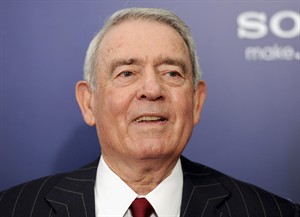
Fifty years later, there are probably at least 500 conspiracy theories about the assassination of U.S. president John F. Kennedy. One man who was at the scene, however, doesn’t buy any of them.
“I believe that one gun, one shooter, and the shooter was Lee Harvey Oswald,” says Dan Rather.
The 82-year-old newsman spoke with reporters on a conference call this week to promote the hour-long AXS TV special, “My Days in Dallas: A Remembrance with Dan Rather.” It premieres Monday, November 18th at 8 p.m. ET, 5 p.m. PT.
AXS TV is a Hi-Def U.S. cable network owned by “Shark Tank” billionaire Mark Cuban. Availability in Canada is limited.
In 1963, rising news star Rather was made chief of CBS’s southwest bureau in Dallas and thus was on the scene when the presidential motorcade veered past the Texas Book Depository on November 22, 1963.
Rather confirmed Kennedy’s death after talking to eye witnesses, and doctors —as well as two priests called to Parkland Hospital to give last rites. Legendary CBS news anchor Walter Cronkite took Rather’s call, live on air, telling disbelieving viewers that Kennedy was dead. Cronkite waited, however, until the government confirmed the story to make it official (some 35 minutes after the shootings).
Why does Rather believe Oswald acted alone?
“Remember that he killed policeman J.D. Tippit, murdered him in cold blood as he tried to get away, get out of Dallas,” he says. “I think, beyond a reasonable doubt, that Oswald was certainly a shooter. I think he was the shooter.”
Rather is open-minded about the notion that Oswald may have had some support. “But, up to and including now, no one has presented evidence to me that convinces me that there was a conspiracy.”
The reason conspiracy theories abound — Rather calls them a “cottage business” — is because, in Rather’s words, “the Warren Commission did not do its job perfectly.”
He believes “they reached the right conclusion, but their process was flawed as most homicide investigations one way or the other are.” He also agrees that “the CIA and the FBI did not co-operate with the Warren Commission nearly as much as they should have.”
Rather was asked how things would be different if the assassination had taken place today, in 2013.
“Hard to imagine all the ways in which it would be different,” he said. “In 1963, no cellphones, no Internet (and) very few families had a home motion picture camera.”
Besides hundreds of people capturing the shooting on cellphones and mobile devices, “you would also have people texting, Facebooking, Twittering, sending out voice messages from cellphones, from every nook and corner of Dealey Plaza, including the grassy knoll and the overpass. It just boggles the mind to realize how different the coverage would have been.”
As it was, Rather was among the first to view the only record of the actual shooting — the Zapruder film.
“Someone mentioned to a policeman they thought they’d seen a man with a home movie camera,” recalls Rather. CBS and others tracked down Dallas businessman Abraham Zapruder.
Rather helped arrange for Kodak to develop the 8mm film overnight — a rush order in those days. The next morning, “Mr. Zapruder had engaged an attorney,” recalls Rather. The lawyer instructed Rather, as well as Dick Stolley from Life Magazine, that they would see the film one time and one time only — after which bids would be entertained for buying rights to the film.
The images were projected against a wall.
“I was absolutely drop-jawed and bug-eyed at the whole thing,” says Rather. “I mean, the assassination is laid out in front. It didn’t last that many seconds but wow, it really knocked you back emotionally.”
Rather’s first instincts were to file on what he saw. He raced out of the lawyer’s office and went straight to the local CBS affiliate, where he described the images to editors in New York. By the time he returned, the film rights had been sold to Time Life.
“As a result of that, the public in general did not see the Zapruder film for years,” says Rather. Life magazine ran frame blow ups, choosing not to show the more gruesome images, and mothballed the film until the ’70s.
Today, he figures, “the Zapruder film would have been on TV almost instantly.”
Rather addressed not being asked to be part of any CBS tributes to Kennedy despite succeeding Cronkite as anchor and holding the post for 24 years longer than any other U.S. network news anchor.
Rather left CBS under a cloud after accusations of bias in his reporting. He later tried unsuccessfully to sue the network for damages to his reputation.
“Look, I’m at peace,” he told veteran Dallas-based reporter Ed Bark. “I know what my record is…This follows a pattern that they’ve had for some years in effect trying to airbrush me out of their history.”
Rather says he’s “very pleased” to work now for Cuban, “who is giving me complete, total creative and editorial control.”
As for suggestions that the Kennedy anniversary coverage is over-the-top, Rather is ready to “let the consumer decide. Put me on the side of everybody who wants to and should get a crack at it, even what I consider the most outlandish of the conspiracy theorists. This is America. Let them have their say.”
___
Bill Brioux is a freelance TV columnist based in Brampton, Ont.
News from © The Canadian Press, . All rights reserved.
This material may not be published, broadcast, rewritten or redistributed.

This site is protected by reCAPTCHA and the Google Privacy Policy and Terms of Service apply.
Want to share your thoughts, add context, or connect with others in your community?
You must be logged in to post a comment.