Elevate your local knowledge
Sign up for the iNFOnews newsletter today!
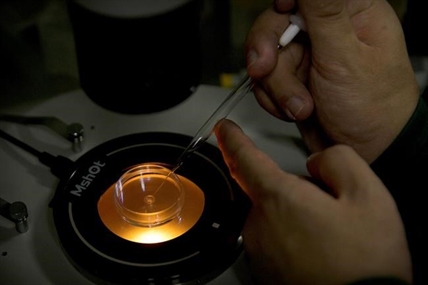
NEW YORK – An international group of scientists and ethicists on Wednesday called for a temporary global ban on making babies with edited genes.
It's the latest reaction to last November's announcement that gene-edited twins had been born in China, which was widely criticized.
Mainstream scientists generally oppose making babies with altered DNA now, citing safety and ethical issues that must be addressed first. Such genetic changes may be passed to future generations, unlike gene editing done in parts of the body not involved in reproduction.
So news last year that Chinese scientist He Jiankui claimed to have edited DNA of embryos provoked widespread condemnation.
Some scientists had called for a moratorium before the latest proposal, which carries no legal authority. It came from 18 researchers from seven countries who published a commentary in the journal Nature. They included prominent gene-editing experts Feng Zhang and David Liu of the Broad Institute of MIT and Harvard in Cambridge, Massachusetts. They receive money from the Howard Hughes Medical Institute, which also supports The Associated Press Health & Science Department.

The researchers want a temporary ban on research designed to produce a baby from sperm, eggs or embryos that bear altered DNA. Roughly 30 nations already prohibit making babies from such "germline" gene editing, the authors said. It's essentially banned in the U.S.
This "will place major speed bumps in front of the most adventurous plans to re-engineer the human species," they wrote. "But the risks of the alternative … are much worse."
The moratorium would allow time for discussion of technical, scientific, societal and ethical issues that must be considered, they said.
Among the proposals: Individual nations should pledge to block such research for a specific period, perhaps five years. After that, each country could decide on its own about what to allow, but only after taking steps like providing public notice, joining international discussions about the pros and cons, and determining whether its citizens support proceeding with such gene editing. The proposal does not cover gene-editing experiments that don't involve trying to establish a pregnancy.
In a letter to the journal, Dr. Francis Collins, head of the National Institutes of Health in Bethesda, Maryland, said he supported the moratorium idea.
News from © The Associated Press, . All rights reserved.
This material may not be published, broadcast, rewritten or redistributed.

This site is protected by reCAPTCHA and the Google Privacy Policy and Terms of Service apply.
Want to share your thoughts, add context, or connect with others in your community?
You must be logged in to post a comment.