Elevate your local knowledge
Sign up for the iNFOnews newsletter today!
Elevate your local knowledge
Sign up for the iNFOnews newsletter today!
Select Region
Selecting your primary region ensures you get the stories that matter to you first.
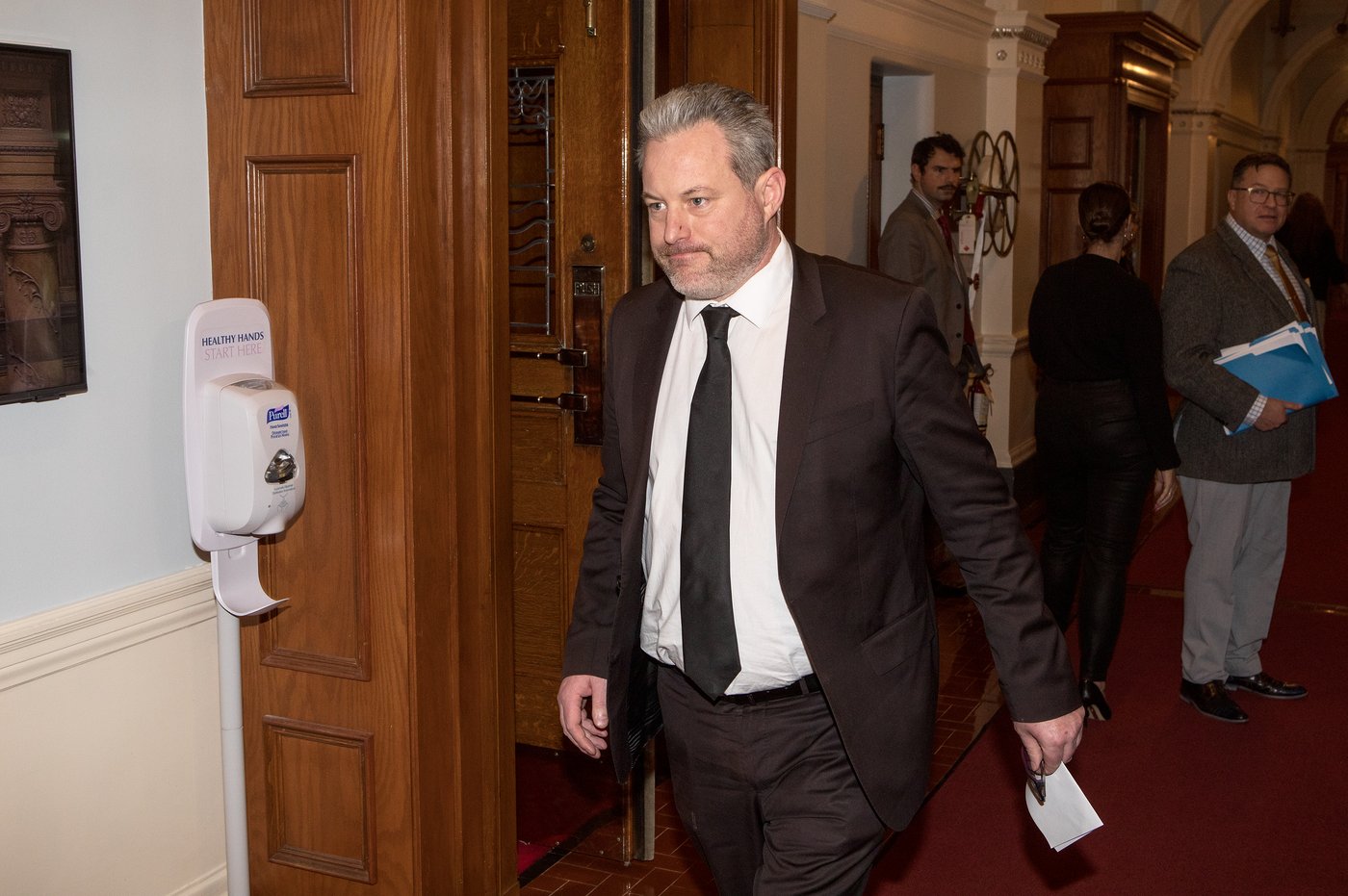
VICTORIA — Opposition politicians and a business group are urging the British Columbia government to recall the legislature in order to repeal the Declaration on the Rights of the Indigenous Peoples Act after the province’s Appeal Court ruled in favour of Indigenous groups over the mineral claims regime.
Trevor Halford, the interim leader of the Conservative Party of B.C., said Monday the uncertainty can’t drag on until the next session of the legislature in February.
“Reconvening the (legislature) is appropriate, when a court decision creates urgent legal, or constitutional consequences requiring immediate legislative action,” Halford said, standing just outside the closed doors to the main legislative chamber.
The Dec. 5 ruling says that the provincial declaration should be “properly interpreted” to incorporate the UN declaration into law immediately, and the Crown has a duty to address “inconsistencies” between the UN declaration and B.C. laws.
In Vancouver on Monday, Eby said the government is reviewing the court’s decision.
“It will take some time for us to come up with the appropriate amendments, but clearly amendments are needed. When we set up (DRIPA), we made it very clear that this wasn’t the territory of courts. This is the territory of the government, negotiating with First Nations, setting the pace, and choosing the laws to bring into alignment.” Eby said.
The premier said the government wants to make sure that the pending amendments do not create additional uncertainty themselves, when asked whether it was acceptable to make British Columbians and investors wait until the legislature returns in February.
Chris Gardner, president of the Independent Contractors and Businesses Association, said in a statement that Eby must immediately recall the legislature and repeal DRIPA.
“British Columbians were told by David Eby and the NDP that DRIPA was about symbolism, reconciliation, and ‘frameworks,’” Gardner said.
However, last week’s ruling made it clear that DRIPA is now “hard law” with “sweeping consequences” for every statute, regulation, permit and project in B.C., he said.
“You cannot bolt a vague UN declaration onto all laws in B.C. and then be surprised when judges start using it to rewrite provincial laws from the bench,” Gardner said.
Halford said the ruling gives the UN declaration “immediate legal force” across all B.C. laws “contrary to what legislators were told in 2019” when DRIPA passed unanimously, adding that it “places core legislative authority in the hands of the courts,” instead of with members of the legislature.
Halford said the ruling is causing “uncertainty” and “chaos” across communities now, and if Eby waits until the next regular session of the legislature, it would be an “abdication of leadership.”
He said his party has sent a letter to Eby asking for the recall and the Conservatives will co-operate with the government if it means repealing the law as quickly as possible.
“We can get this work done in two to three days,” Halford said. “I’m also saying to the premier directly, we will forego all question periods, all two-minute statements, all private member’s bills. I believe, right now, we need to be in this (legislature), doing the work of the people.”
Eby said after the ruling came out on Friday that his government is open to amending the legislation, after he had acknowledged that it potentially puts the courts, rather than British Columbians through their MLAs, in the “driver’s seat.”
Eby also acknowledged the possibility of appealing the decision to the Supreme Court of Canada.
“But to be frank, it is absolutely crucial that it is British Columbians through their elected representatives that remain in control of this process, not the courts,” Eby said. “Too much rides on it in terms of our province’s prosperity and certainty going forward.”
Halford said the B.C. Conservatives had campaigned on repealing the legislation during the last election campaign in October 2024.
“For us, if the premier has different ideas on what to do, behind me, inside that legislature, let’s see what they are,” he said. “Let’s have that conversation. But why would we wait beyond 60 days to do that?”
Gardiner said the decision creates “significant uncertainty” across B.C. with economic consequences.
“Follow the law on the books today only to have a court decide years from now that the rules mean something different because of UNDRIP?” he said.
“That’s not reconciliation — that’s regulatory roulette and a recipe for economic chaos. We are making British Columbia un-investable.”
A’aliya Warbus, the Conservative House Leader and a member of the Sto:lo Nation, who joined Halford in front of reporters Monday said economic issues, not the concerns of First Nations, are more pressing.
“We’re in an economic squeeze, an economic detriment, and we really need that certainty for the whole of British Columbia. Indigenous nations and leaders are such a critical part of that work. But in thinking about everybody, we have to be able to put those priorities first,” Warbus said.
Asked whether repealing DRIPA might threaten the support of First Nations for major resource projects, Warbus said the decision also impacts the economic future of First Nations.
“Economic viability in British Columbia affects Indigenous communities just as much as everybody else,” Warbus said. “I think the place that we need to get to today is recognizing the interdependence that exists and has always existed. So, if B.C. is not economically viable, neither are those Indigenous communities on their own.”
The First Nations Leadership Council did not immediately return a request for comment about the call to repeal the legislation.
Regional Chief Terry Teegee said in a statement last week that the ruling “sends a ground-shaking message to the provincial government.”
“The (provincial) Declaration Act is legally binding and cannot be implemented or interpreted in a unilateral Crown approach,” he said.
This report by The Canadian Press was first published Dec. 8, 2025.
News from © The Canadian Press, . All rights reserved.
This material may not be published, broadcast, rewritten or redistributed.

This site is protected by reCAPTCHA and the Google Privacy Policy and Terms of Service apply.
Want to share your thoughts, add context, or connect with others in your community?
You must be logged in to post a comment.