Elevate your local knowledge
Sign up for the iNFOnews newsletter today!
Sign up for the iNFOnews newsletter today!
Selecting your primary region ensures you get the stories that matter to you first.
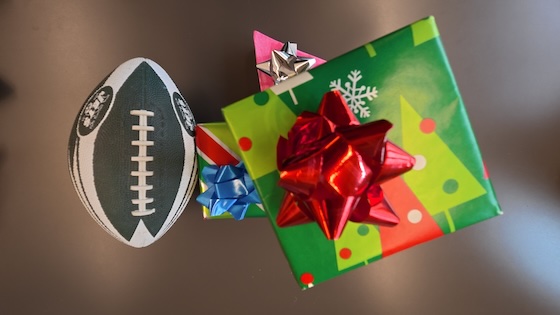
It’s that time of year where you sit down and stare at a weirdly shaped gift you bought for someone and convince yourself that the clumps of tape, scrunched up corners and little tears in the wrapping aren’t that noticeable.
University of British Columbia mathematics postdoctoral fellow and differential geometer Dr. Adam Martens explains why sometimes it’s not that you’re bad at wrapping gifts, some things just can’t be wrapped.
Martens said wrapping anything that isn’t flat is basically impossible to do properly, as in without any creasing or folding.
“Wrapping paper is inherently flat and rigid. It can be folded, but from a mathematical point of view, it cannot be warped so that it lies flat on a curved surface,” he in a media release. “Technically, any shape that is not flat is equally difficult because they are all impossible.”
A box is going to be the only thing you can perfectly wrap without extra cuts and tape.
“You cannot bend the wrapping paper to fit non-flat shapes. You could work around this by cutting and taping, but if any point is not flat, it’s impossible – at least not without creasing the wrapping paper,” Martens said.
A sphere is impossible to wrap, so give up on that basketball now and just put it in a gift bag.
Don’t be insecure about putting something in a gift bag instead of wrapping it. Martens said people find rectangles pleasing to the eye. A certain ratio of rectangles is especially satisfying.
“A lot of it has to do with the golden ratio — 1.618, also known as Ph — which we can find in nature, including in the radial spiral of pinecones or sunflower seeds, in art in the proportions of the Mona Lisa’s face and torso, and architecture, in the proportions of the Parthenon,” he said. “I even have it tattooed on my arm.”
A lot of the time people are trying to make things optimal and symmetrical, but there’s something gratifying about rectangles.
“Many people think that some of these appearances in nature are just a coincidence or selection bias, but something about this ratio is very pleasing to the eye,” he said.
If you’re set on wrapping your gifts like a pro this year, then the best way to wrap your oddly shaped items is to put them in a cubed box to reduce the amount of wrapping paper needed, according to Martens’ math.
“In geometry, the isoperimetric inequality is a principle that tells us that a sphere is the most efficient shape for enclosing an item,” he said. “In this sense, a sphere would be your most optimal shape for minimizing wrapping, except it wouldn’t really because, as we know, you can’t really wrap a sphere very well.
“The next best option would be a cube — not an arbitrary rectangular box — where all sides are equal in length. For a fixed volume, a cube minimizes the surface area that needs to be covered in wrapping paper.”
Martens can even do the math on wrapping gifts that exist in four dimensions, which no one is going to have to do this season unless they’ve decided to break the laws of physics.
“There are shapes that seem impossible to wrap but are actually technically doable. Take a donut shape, what we call a ‘torus’ in math. This object sits inside four-dimensional space where, if you were a 4D creature, you could make a torus flat and wrap it — so potentially not very helpful for your holiday shopping since we’re 3D beings and can’t visualize what is going on,” he said.
For people who want to visualize how it would work if they were some kind of 4D creature wrapping a mind-bending donut to give someone for the holidays, Martens has a little experiment that involves a flat piece of paper.
“If you glued the long sides together, you would get a cylinder. You can’t do this in 3D because the paper would crinkle, but if you bend the paper and glue the short ends together, you’re able to take a flat piece of paper and bend it into a torus,” he said.
Martens said gift wrapping isn’t just an art, it’s math in disguise.
News from © iNFOnews.ca, . All rights reserved.
This material may not be published, broadcast, rewritten or redistributed.

This site is protected by reCAPTCHA and the Google Privacy Policy and Terms of Service apply.
Want to share your thoughts, add context, or connect with others in your community?
You must be logged in to post a comment.














One response
I love this. My wrapping always looks like 2 year old did it. Now I know why