Elevate your local knowledge
Sign up for the iNFOnews newsletter today!
Sign up for the iNFOnews newsletter today!
Selecting your primary region ensures you get the stories that matter to you first.
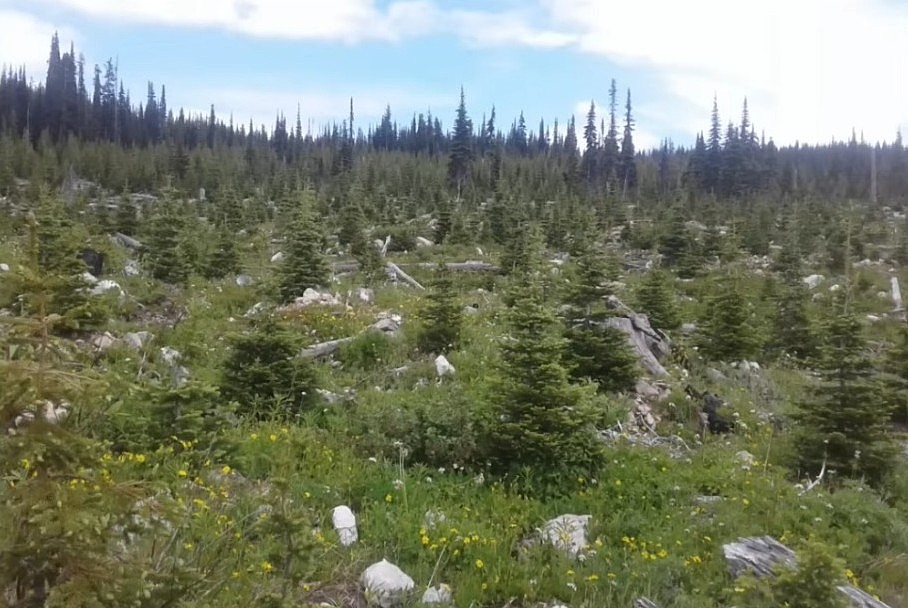
A grassroots group is pushing the province to change local forest management policies to better protect primary forests and stabilize the logging industry, following a wave of mill closures in the province.
Jennifer Houghton is the spokesperson for the Boundary Forest Watershed Stewardship Society in Grand Forks.
She said the forest industry is a big and complex system, and points to a lack of timber supply as a major factor to mills shutting down.
“BC ran out of the easily accessible, high-quality timber because the system was designed to liquidate forests fast, not to manage them long-term,” she said. “For decades, BC’s system rewarded high volume clear cutting of primary forests that were cheaper to access, dense and more profitable. It created a temporary boom and now a predictable bust. What we are seeing is due to decades of over-cutting.”
Primary forests are those that have not been impacted by industry. Houghton said what is left of it is far away from the mills and hard to access on steeper slopes which is expensive to harvest.
Younger tree plantations are growing slowly and yielding less volume.
“A lot of younger plantations are not growing as well these days because the climate is hotter and drier and there is more drought,” Houghton said. “The expectation that tree plantations will replace millions of hectares of mature forests is unrealistic.”
Houghton got involved with forestry reform in 2018 after a catastrophic flood in Grand Forks in 2018. Several community members came together and looked at the connection between the flooding and the massive scale of over-cutting in the Kettle River Watershed.
“Our watershed is sparsely populated and made up of 8,000 square kilometres of mountains in between the Kootenays and the Okanagan,” Houghton said. “It has been between sixty to seventy per cent clearcut in the past three decades. We got a massive flood because there was no forest left to hold the water.”
The society formed with a focus on changing forest policy and wrote a report on the state of the watershed and recommendations to fix it. Members include former Ministry of Forest workers and retired loggers.
Last year, they created the New Forest Act proposal in an aim to shift BC from volume-driven logging system to one that protects primary forests and watersheds, restores damaged landscapes that are contributing to floods and fires, and manages logging in ways that keep forests working long-term with a focus on producing value-added products in mills.
The model incorporates professional and public community input.
“We had a lot of help writing this proposal, I’ve had fantastic mentors over the years,” she said. “We’ve had contributions from silviculture specialists from the Ministry of Forests and ecologists.
“It was important that I understood the whole picture. I’ve come across people who are dedicated to environmentalism, and our two retired loggers took me on a weeklong trip through our watershed.”
The society is proposing harvesting according to ecological limits, with mills focussed on producing value-added products like laminated products, panelling and furniture as opposed to cheaper dimension lumber like two by fours and raw log exports.
“We need the forest to keep functioning, so we want to shift to cutting less while getting more value out of each tree that is logged,” she said. “If the mills want to stay open, the forest has to stay healthy and functioning.
“We’re talking about shifting to a model that produces the same amount of jobs. There are generations of jobs to be had in restoration work across BC.”
The society has sent the proposal to the premier and Ministry of Forests but has not had a response yet, however, BC’s Minister of Forests, Ravi Parmar made a post regarding the BC forest industry on social media earlier this week:
“Forestry is at a crossroads in its history. It is being pulled in different directions,” the post reads. “But in 2026, we are going to make the sector work for people. We are going to build the resilience and predictability that workers and communities need. No more boom-and-bust, but a clear path to a strong future.”
In recent months, the society has had residents from ridings in BC set up meetings with their MLAs where society members are making presentations of the New Forest Act framework. The society has presented to five BC Interior MLAs to date.
A public petition is being released later in the month, and a BC wide tour of presentations by society members is in the works for June.
A future goal is to set up community forest boards made of locals interested in making decisions about what gets protected and restored, and how much logging takes place.
News from © iNFOnews.ca, . All rights reserved.
This material may not be published, broadcast, rewritten or redistributed.

This site is protected by reCAPTCHA and the Google Privacy Policy and Terms of Service apply.
Want to share your thoughts, add context, or connect with others in your community?
You must be logged in to post a comment.