Elevate your local knowledge
Sign up for the iNFOnews newsletter today!
Sign up for the iNFOnews newsletter today!
Selecting your primary region ensures you get the stories that matter to you first.
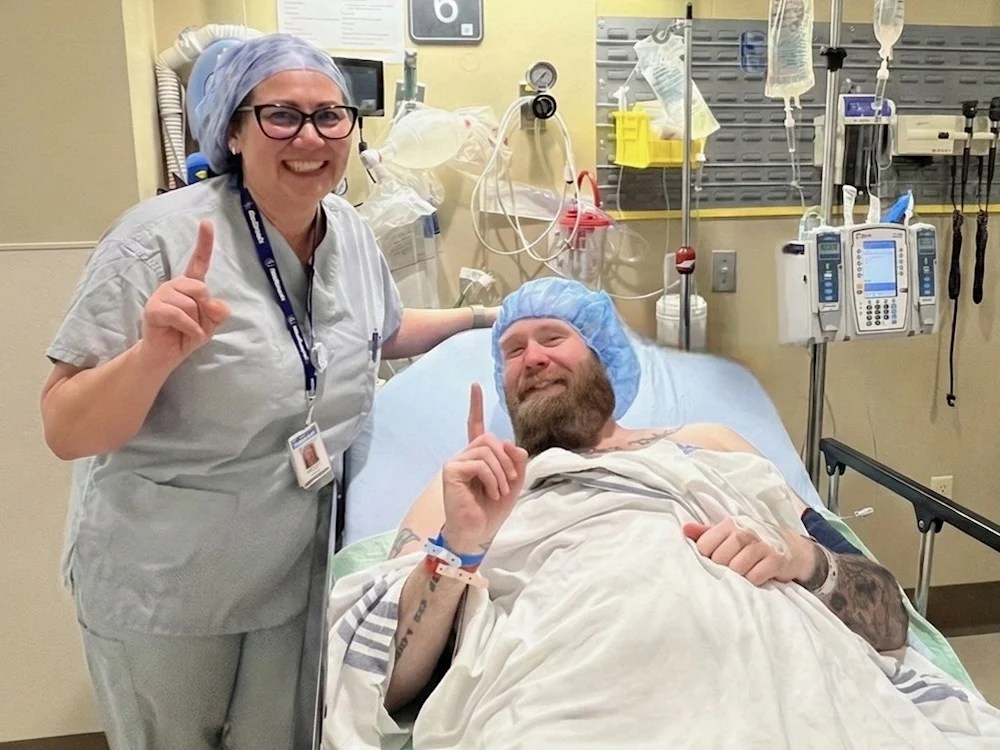
As the local anesthetic faded after surgery, Sean Forsberg waited for the pain to come back.
The 39-year-old Surrey resident had been living with chronic pain for two decades after a motorcycle accident. He dealt with aching lower back pain and shooting nerve pain in his lower body.
But the pain never came back after surgery. A small electrical device, roughly the size of two stacked loonies, was sending a small current through his spine, interrupting pain signals before they got to his brain.
“Today the nerve pain in my leg and foot is 70 to 75 per cent gone, which is very tolerable and manageable,” he said, adding his back pain was more than halved. “I used to wake up with such extreme pain in my leg and foot I’d want to chop it off. My body was at war with me for no reason.”
In February, Forsberg became the first Canadian to get a closed-loop spinal cord stimulator implanted in his back for chronic pain management. Since then, 16 other patients have received the device, built by Medtronic, from St. Paul’s Hospital.
Vancouver Coastal Health and Island Health each fund 12 spinal cord stimulators per year. Sometimes private donations can increase the total number of devices available in a year.
Funding from VCH goes to St. Paul’s Hospital, which takes patients from VCH, Interior Health, Fraser Health, Northern Health, Yukon and Northwest Territories.
A spokesperson for Providence Health Care, which manages St. Paul’s Hospital, said it is up to each health authority to choose to fund, or not fund, spinal cord stimulators for its population.
The Tyee asked Interior, Fraser and Northern Health why they didn’t fund spinal cord stimulators, and what other services they offered for pain management.
Interior Health said it does not have the infrastructure to implant spinal cord stimulators and instead focuses on funding several pain clinics. Fraser Health similarly said it focuses its resources on personalized community-based treatment for pain and escalates specialized treatment as needed. Northern Health said its population was too small to support specialized treatments like spinal cord stimulators and it instead funds an interdisciplinary regional pain clinic where staff have additional training for pain.
All three health authorities said they had referred patients to St. Paul’s for spinal cord stimulators.
Doctors call for more spinal cord stimulator funding
Pain experts told The Tyee they were being forced to make tough decisions because there aren’t enough spinal cord stimulators available to meet demand, and it’s having a negative effect on patients.
Dr. Jill Osborn, director of the Interventional Pain Clinic at St. Paul’s Hospital, said that about eight per cent of her patients say they’re considering medical assistance in dying if they can’t get approved for a spinal cord stimulator.
She said she’s been advocating for the province to increase how many devices it funds.
Spinal cord stimulators cost between $20,000 and $30,000 each. That might seem like a steep initial price tag, but it becomes cost-effective within three years because the patient isn’t using other health-care and social support services, she said.
Osborn wants B.C. to fund at least 120 trials and 80 devices, which she said would be proportional to how many Ontario funds annually.
But Ontario is also struggling to meet the needs of patients with chronic pain.
Ontario currently funds 175 spinal cord stimulators, and teams across the province are able to implant about 120 per year, said Dr. Anuj Bhatia, clinical director of chronic pain at the University Health Network in Toronto and a professor at the University of Toronto.
Ontario hasn’t increased the funding provided for spinal cord stimulators in 20 years, so provincial funding covers only about 60 per cent of the cost with hospitals having to make up the rest, Bhatia said.
Ideally the province would fund between 400 and 500 spinal stimulators per year, he said, which would be comparable to how many are funded in the United States, Australia and the United Kingdom.
Spinal cord stimulators became mainstream treatment in 1986 and expanded in use with advancements in rechargeable batteries, Osborn said.
The technology has jumped ahead again, and now the Inceptiv device can self-adjust its current output so users don’t have to. Previous versions of the device came with a remote control that could adjust the current to match physical activity.
Having a higher current than necessary can cause a vibrating or tingling feeling, but the biggest problem is in constantly checking in with and paying attention to your pain, which is a bad strategy for pain management, Forsberg said.
Pain is the most common reason people seek out health care, and Canada needs to improve how it teaches doctors about pain and help encourage more doctors to specialize in pain — as well as increase funding for pain management and care, including implants, Bhatia said.
How spinal stimulators work
Think of rubbing an elbow after smacking it against a wall. The device works in a similar way, sending a non-painful sensation through the body’s nerves to override or reduce the painful sensation, Osborn said.
Pain is complex and not as simple as an injury sending a signal to the brain, she said.
There’s acute pain, which is a defence mechanism that responds to an injury, and chronic pain, which is a pain signal sent to the brain long after the injury has healed.
Things like anxiety, stress, how much sleep a person has had, a person’s history of physical, emotional or sexual trauma, and culture affect how a person experiences pain, Osborn said.
“The pain is real even if we experience it differently,” she added.
Chronic pain is more like being sick than sore, Forsberg said. For example, you could have a shower and then be so exhausted you have to rest for 10 minutes before you can get dressed.
He said people living with chronic pain have to constantly think about how they will spend their energy. Will they make a healthy dinner or throw a pizza in the oven so they can do laundry? Will they buy groceries or put that off so they can see a friend?
Unlike recovering from a virus, he added, chronic pain is for the rest of your life.
Treating pain
In 2020, lower back pain affected 619 million people worldwide. The World Health Organization estimates this number will reach 843 million by 2050 as the population grows and ages.
Lower back pain is one of the most common reasons people will experience chronic pain, Osborn said.
B.C. follows WHO guidelines to treat pain that lasts more than three months and isn’t linked to disease.
Osborn said clinicians first start patients on non-opioid medications, exercise, physiotherapy and diet. If that doesn’t work, a patient may be prescribed weak opioids. If the pain persists, treatments such as steroid injections or nerve cauterization are considered, or an opioid prescription can be increased.
Once a patient has tried all of this “conventional” therapy, they can be considered for a spinal cord stimulator if the pain is in a single part of their body, Osborn said.
The device doesn’t work on full-body pain and isn’t perfect.
Over time about two to three per cent of patients can start to feel pain again as their nervous system learns to override the signals, Osborn said. Electrodes can move or fracture, which requires surgery to address.
Patients also can’t go deep-sea diving or skydiving, jump on trampolines, ski moguls or go off bike jumps, she added.
Patients need to recharge their batteries by holding a wireless charging device against the implant, which generally sits under the skin on the back, in between the ribs and the hips.
Forsberg said he wants to share his story so other people living with chronic pain can know to ask their doctor about the surgery.
The procedure changed his life, he said.
Shortly after the surgery he started dreaming again. For years he’d been kept awake by pain for days until he was exhausted enough to fall asleep for a couple of hours. Now he sleeps through the night.
This summer, he said, he was able to walk across uneven ground, go on small hikes and go kayaking.
He’d also previously given up on long-term relationships because the pain and his erratic sleep schedule meant he wouldn’t be able to show up how he wanted.
“I’ve since started dating somebody and we’re quite happy,” he said. “It’s going better than I could have imagined.”
— This article was originally published by The Tyee
News from © iNFOnews.ca, . All rights reserved.
This material may not be published, broadcast, rewritten or redistributed.

This site is protected by reCAPTCHA and the Google Privacy Policy and Terms of Service apply.
Want to share your thoughts, add context, or connect with others in your community?
You must be logged in to post a comment.