Elevate your local knowledge
Sign up for the iNFOnews newsletter today!
Sign up for the iNFOnews newsletter today!
Selecting your primary region ensures you get the stories that matter to you first.
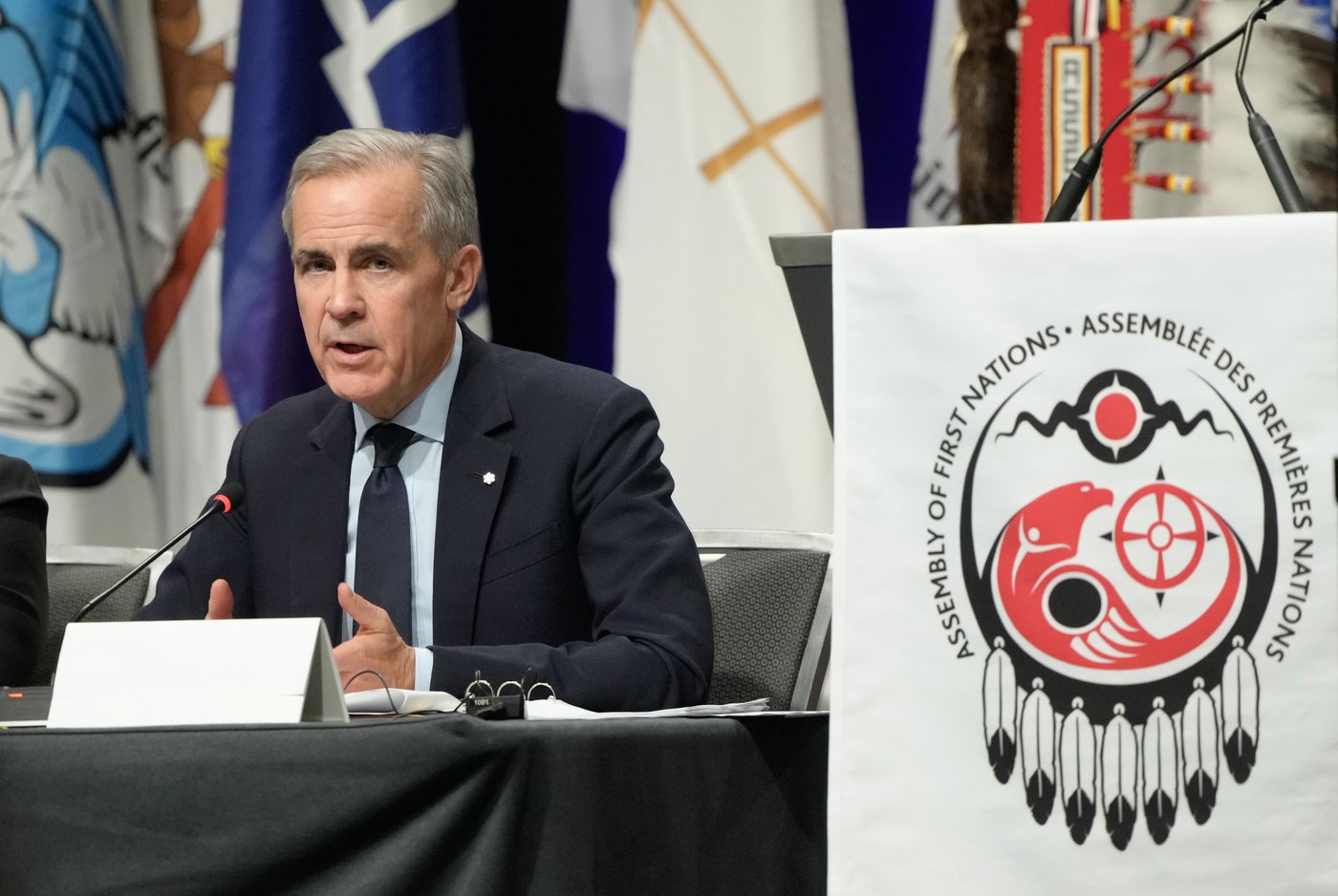
PRINCE RUPERT — Coastal First Nations president Marilyn Slett said she called on Prime Minister Mark Carney in a meeting Tuesday to maintain and protect the oil tanker moratorium in his government’s pipeline talks with Alberta, saying afterwards that “it would take just one spill to destroy our way of life.”
“We reiterated that there is no technology that can clean up an oil spill at sea,” she told a news conference after the meeting in Prince Rupert, B.C.
Slett, who is also the elected Chief Councillor of the Heiltsuk Tribal Council, said local First Nations “must be in the room” for any discussion about their territories.
The meeting was held to restart relations between Carney and the advocacy group, which works to protect the B.C. coastline and the Great Bear Rainforest.
Tuesday’s meeting happened amid heavy rain and wind, and Slett said that it was important for Carney to directly see local conditions and the perilous nature of the northern B.C. coast for himself, to understand the concerns of First Nations about the risks of allowing oil tankers to return.
Haida Nation president Jason Alsop, also known as Gaagwiis, said there was an “urgent need” to prepare the coast for shipping traffic from other resource-related projects in the region.
“So our message was clear: we are not ready,” he said. “The coast is not ready right now to respond to accidents and emergencies.”
Relations between Ottawa and the group soured late last year when Carney and Alberta Premier Danielle Smith signed an agreement that opened the door to a pipeline to B.C.’s coast and a potential suspension of the coastal tanker ban moratorium.
“We have not deviated from that position (on a moratorium) at all … We made it clear to Prime Minister Carney that we would always support the oil tanker moratorium, and we called on him to support it to protect — to grow — our sustainable economy,” Slett said.
She criticized the federal government and the Alberta government for failing to consult with First Nations before signing that agreement last year.
Natural Resources Minister Tim Hodgson was forced to apologize after quipping in a television interview that he could have met with alliance members through Zoom. He apologized again to First Nations leaders in the meeting Tuesday.
“We’re looking forward,” Slett said when asked about the state of relations between her group and Hodgson.
Before the meeting, Carney said he was treating it as a chance for “dialogue” and to explore how First Nations can partner with the federal government to build the economy. He said his government also recognizes its “huge responsibility” to protect the environment.
“So how do we work together to preserve that, to enhance it while we’re looking for opportunities for development?” he said.
“Today is not a day for big announcements. It is a day, as I said, for dialogue, for listening and working.”
First Nations leaders speaking to media after the meeting made it clear they can only support an economy that values environmental stewardship.
They repeated their opposition to a bitumen pipeline to the B.C. coast and called on the federal government to respect their constitutional rights and the United Nations Declaration on the Rights of Indigenous Peoples.
That declaration, adopted by the federal government, says that free, prior and informed consent must be obtained before natural resource projects are developed on their territories.
Asked how far they’re willing to go to protect their rights, Alsop, who is also vice-president of the Coastal First Nations, didn’t rule out a legal challenge.
“We’ll always employ every tool that we have as communities. But we’re also very reasonable,” he said.
Carney was joined by Hodgson and Housing and Infrastructure Minister Gregor Robertson at the meeting. Crown-Indigenous Relations Minister Rebecca Alty was not in attendance.
Slett has said there is no support among the group’s members for a pipeline to the Pacific or the suspension of the legislated ban that keeps large oil tankers off the northern B.C. coast.
Carney said the meeting was arranged to work through those issues and find ways for Ottawa and Coastal First Nations to move forward together.
His short visit to Prince Rupert, about 750 kilometres northwest of Vancouver, came ahead of a trip to China later in the day.
It included a trip to the Indigenous-owned bakery Saltwater Bakery, where Carney spent about $60 plus tip on croissants, butter tarts and other baked treats that he said were for journalists travelling with him to China.
“We discussed many things,” Carney said after the Coastal First Nations meeting, as head baker and general manager Elena Ledyard filled up two boxes with baked goods. “We talked a lot about conservation, we talked a lot about opportunities, partnership.”
Slett said of Carney that she “felt that he was listening,” adding that “he was attentive to hearing what we were saying with his body language.”
But Slett also added that more discussions are needed. “This can’t be a one-off meeting,” she said. “We do have to be able to work together and continue to have that dialogue, and I think that there is a commitment here to ensure that that dialogue happens.”
A description of the meeting from the Carney’s office made no mention of the tanker moratorium or the pipeline proposal.
It said the discussions “focused on how the federal government and the CFN can work in partnership to strengthen marine conservation and ocean protection, and to build a strong and sustainable economy.”
The agreement signed by Smith and the federal government sets a path forward for a proposed bitumen pipeline. Smith has said her government will submit a pipeline proposal to Ottawa’s major projects office this summer.
That office has promised to review projects within two years. Citing recent promises by the U.S. to ramp up oil production in Venezuela following the capture of that country’s President Nicolas Maduro, Smith recently called on Carney to approve the project no later than the fall.
Smith, who also met with Carney recently, said the developments in Venezuela and global energy markets have underscored the need for a new pipeline to supply Asian markets.
While the agreement with Alberta does not spell out the route for a pipeline, the proposal has faced opposition from First Nations along B.C.’s northern coast because it would require lifting the federal tanker ban.
The agreement signed by Smith and Carney in late November includes language that opens the door to changing the ban, “if necessary.”
The opposition from First Nations along the coast comes despite promises of Indigenous co-ownership and other unspecified economic benefits.
Opposition to the project has also come from the province. B.C. Premier David Eby has said repeatedly the project lacks the necessary private proponent.
Eby also has said the proposed pipeline would threaten the “fragile” consensus on other “real” energy and mining projects in northern B.C.
This report by The Canadian Press was first published Jan. 13, 2026.
— With files from Alessia Passafiume in Ottawa
News from © The Canadian Press, . All rights reserved.
This material may not be published, broadcast, rewritten or redistributed.

This site is protected by reCAPTCHA and the Google Privacy Policy and Terms of Service apply.
Want to share your thoughts, add context, or connect with others in your community?
You must be logged in to post a comment.