Elevate your local knowledge
Sign up for the iNFOnews newsletter today!
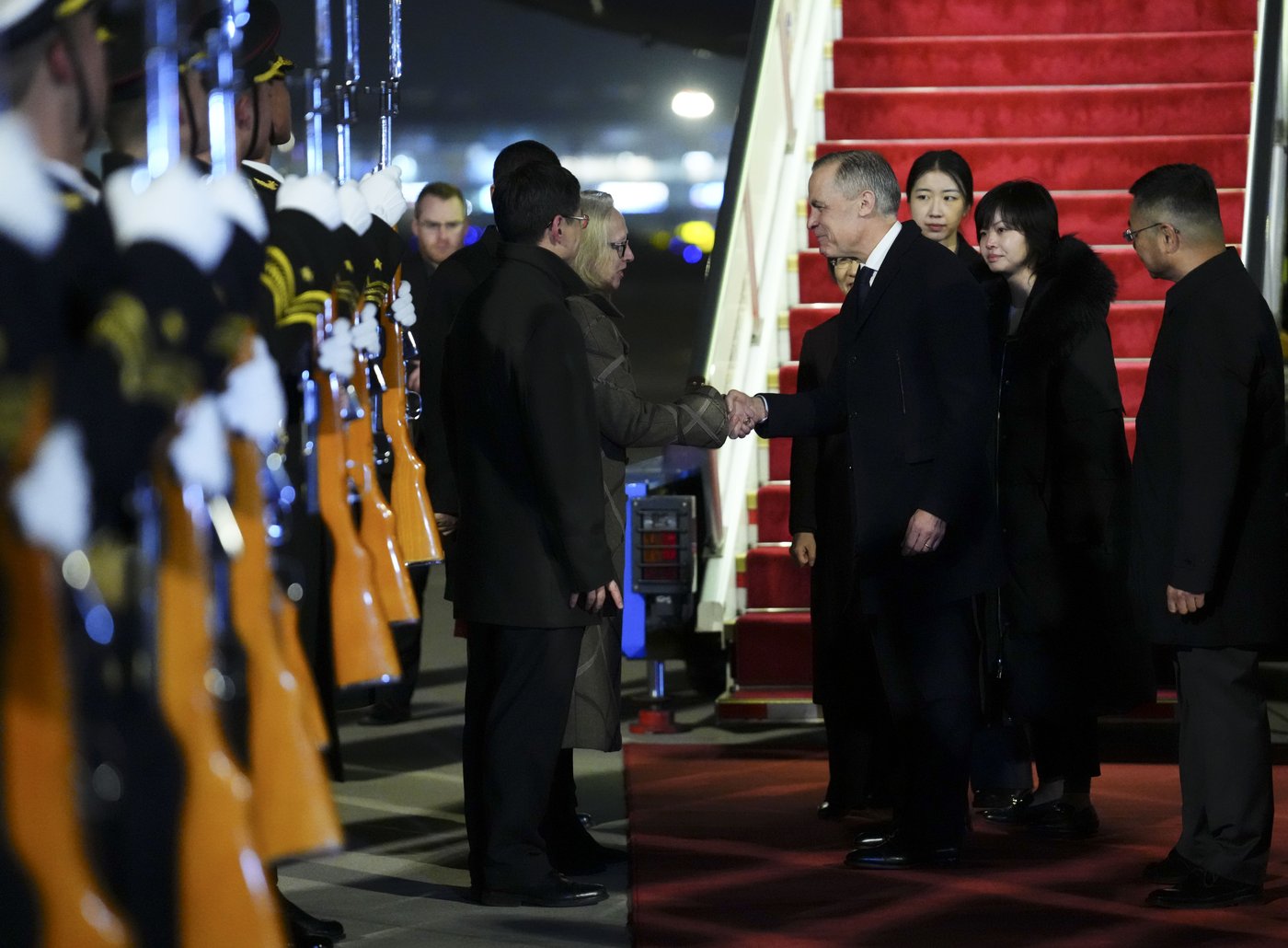
Prime Minister Mark Carney’s visit to China appears to have been greeted by Chinese media with less fanfare than Justin Trudeau received in 2016, but a researcher says that’s more reflective of new geopolitical realities than new personalities.
Carney’s arrival in Beijing on Wednesday was greeted by a three-paragraph article in state news service Xinhua that urged the Canadian leader to take the visit as an opportunity to increase dialogue, “advance mutual political trust” and “resolve each other’s concerns.”
A day earlier there had been a four-paragraph report outlining plans for the visit and two-paragraph biography of Carney.
Shanghai-based state-owned publication The Paper noted in a short article on Carney’s arrival that “Canada needs to expand new partnerships both in the energy sector and in trade.”
The coverage from Xinhua and other Chinese news outlets of Carney’s visit is in contrast to that received by Trudeau in August 2016, when the state news agency published a lengthy commentary heralding the potential for a “new golden era of relations” between the two countries.
Xinhua also reported Trudeau’s high-profile meetings closely, including an elaborate welcome ceremony in Beijing with then-Chinese premier Li Keqiang and a sit-down with Chinese tech magnate Jack Ma, as well as a Sina.com report on Trudeau playing basketball with NBA legend Yao Ming at a Shanghai school.
Another publication, the Shanghai Observer, reported on Trudeau’s high visibility on Chinese social media, with one post from the former prime minister thanking Li for providing a “warm welcome” for Trudeau’s daughter Ella-Grace.
“Both being important countries in the Asia-Pacific, China and Canada should put aside their differences, enhance mutual political trust and enrich the connotation of their strategic partnership,” Xinhua said in its English-language commentary about Trudeau’s 2016 visit.
“It is hoped that Trudeau will follow the path of his liberal predecessors — his father Pierre Trudeau who pioneered in setting up the diplomatic ties with China and Jean Chrétien who started a golden decade of bilateral ties — to create another golden era of relations with China.”
Trudeau received the fond nickname of “Little Potato” in China, derived from his surname sounding like the Mandarin word for potato, tudou, and to differentiate him from his father.
Coverage of Carney’s visit has featured cautious wording, with Xinhua’s article on Wednesday sticking to the kind of language familiar to readers of the state outlet.
“A Chinese Foreign Affairs Ministry spokesperson had previously expressed that China looks forward to the visit as an opportunity to increase dialogue, advance mutual political trust, expand pragmatic co-operation, improve the management of differences and resolve each other’s concerns, to solidify the turnaround in China-Canada relations and benefit the people of both countries,” it says.
After Trudeau’s 2016 visit, the relationship between Ottawa and Beijing was put on ice by the arrest of Chinese tech executive Meng Wanzhou in Vancouver in late 2018, and China’s detention of Canadians Michael Kovrig and Michael Spavor.
L. Philippe Rheault, director of the China Institute at the University of Alberta, said Wednesday that while the Chinese response has not been as “exuberant” as it was for Trudeau, the tone is nonetheless positive.
“They think that he’s a pragmatist, that they’re willing to express some hope that he is going to deal with things in a way that works for China,” Rheault said. “So, actually, I think that is reflected in Chinese messaging.”
Rheault said the reaction to Trudeau also reflected his father’s government establishing official diplomatic relations with China in 1970, and efforts by the younger Trudeau to advance progressive trade values in economic talks with China after the 2016 trip were more challenging for Beijing to accept.
“A lot of excitement there was in large part a function of the fact that Justin Trudeau was seen as maybe going to China to build on his father’s legacy,” Rheault said.
“I think it’s clear at this point that Prime Minister Carney is going to take a much more pragmatic and practical approach to engaging with China, probably less emphasis on progressive values and more emphasis on the commercial opportunity.”
He said the Chinese reaction reflecting more pragmatic engagement also stems from a changed geopolitical landscape, where the United States is no longer seen as a background player in the Canada-China relationship but rather a “catalyst” in triggering both sides’ desire for trade diversification.
This report by The Canadian Press was first published Jan. 14, 2026.

News from © The Canadian Press, . All rights reserved.
This material may not be published, broadcast, rewritten or redistributed.

This site is protected by reCAPTCHA and the Google Privacy Policy and Terms of Service apply.
Want to share your thoughts, add context, or connect with others in your community?
You must be logged in to post a comment.