Elevate your local knowledge
Sign up for the iNFOnews newsletter today!
Sign up for the iNFOnews newsletter today!
Selecting your primary region ensures you get the stories that matter to you first.
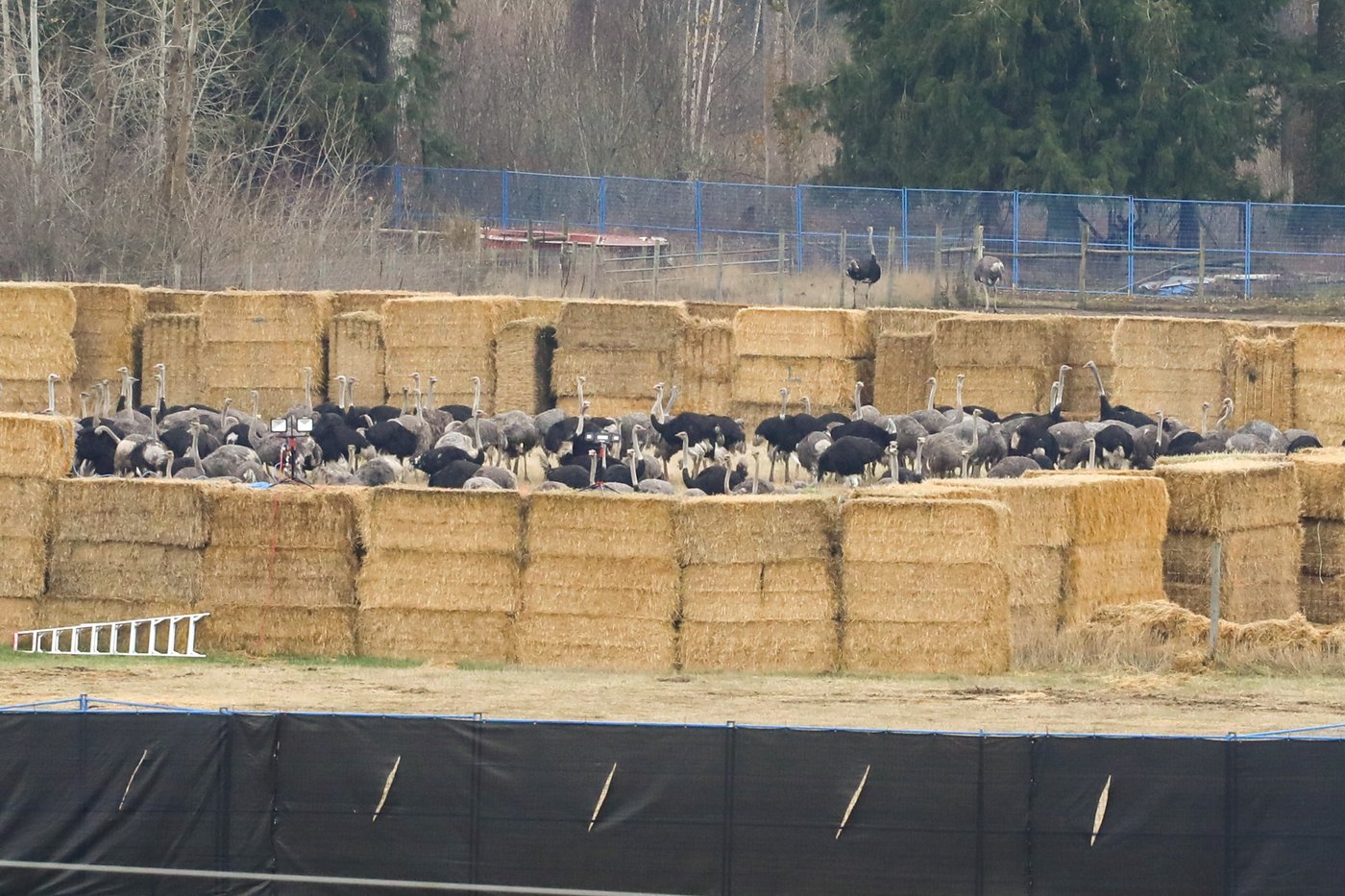
The showdown at the Universal Ostrich Farm cost taxpayers $6.8 million, mostly in policing costs.
Numbers released by Parliament show the Canadian Food Inspection Agency, the Department of Justice and the RCMP had a combined cost of $6,810,846, with the bulk of the expenditure due to the policing involved.
The publicly released figures come after Vernon-Lake Country-Monashee Member of Parliament Scott Anderson requested the breakdown of costs in May 2025.
The figures show the Canadian Food Inspection Agency spent $1.6 million, including $14,000 on animal feed, $221,000 on straw, $82,500 on “destruction” and $166,000 on disposing of the birds. The Canadian Food Inspection Agency almost spent $100,000 on travel expenditure and almost $150,000 on portable washrooms and hand-wash stations.
More than half of all the costs involved came from the RCMP at $3,800,000.
That’s the bill for the chaos that swept over the area. Thousands of people quickly became adhered to the cause, defined differently by many, some for the animals, others for politics and conspiracy theories. In September 2025, multiple businesses complained that they’d received threats for working with, or being accused of working with, the Canadian Food Inspection Agency. The RCMP said that some businesses had received thousands of threats, including death threats.
That same month, police allege protestor Tim Regan doused gas on the farm’s 72-year-old neighbour and allegedly assaulted her. He was later charged with assault with a weapon, assault, and mischief, and his file is ticking through the court system.

The expenditure report shows the RCMP spent $2 million on wages with another $1 million on transportation and telecommunications. It also spent $650,000 on “professional and special services.”
The farm made numerous legal appeals, costing the Department of Justice $1.38 million, although no breakdown was given.
On a post to social media, Anderson points the finger at the Canadian Food Inspection Agency, saying it “disrupted the lives of the farmers, (and) the entire town of Edgewood,” while protesters “sang around a campfire.”
However, much of the disturbance in Edgewood came from the protestors, whom the farm owners encouraged to visit and give them money.
The saga began when the Universal Ostrich Farm owners, David Bilinski and Karen Espersen, failed to report to the authorities when their birds began dying in late 2024. The couple didn’t bring in a vet and the Canadian Food Inspection Agency were only notified when an anonymous tip came in.
“The (Universal Ostrich Farm) knew that its birds were sick. It observed several symptoms in their birds that are symptoms of avian influenza in ostriches. The (farm’s) owners purport to be experts in ostrich health and welfare. And yet they failed to exercise the same level of adherence to the Health of Animals Act that a reasonably prudent person would have done in a similar situation,” the Canada Agricultural Review Tribunal said in a decision upholding a $10,000 fine.
While the farm raised almost $200,000 in donations the owners also owe roughly $250,000 to three creditors who have all taken legal action in the last couple of years to recoup their money.
Espersen is also involved in a legal suit against her sister, who bought the property in 2013 when it went into foreclosure.
In early 2024, the Canadian Food Inspection Agency had said it was prepared to compensate the farm owners up to $3,000 per bird. With 314 ostriches killed, the cull could net them $942,000, although this was on the condition that they cooperated.
While the Canadian Food Inspection Agency was heavily criticized for mandating and carrying out the cull, experts largely agreed that its “stamping out” policy was needed to control avian flu.
Since 2022, almost 10 million birds have been culled or died in more than 250 outbreaks, according to the Canadian Food Inspection Agency.
News from © iNFOnews.ca, . All rights reserved.
This material may not be published, broadcast, rewritten or redistributed.

This site is protected by reCAPTCHA and the Google Privacy Policy and Terms of Service apply.
Want to share your thoughts, add context, or connect with others in your community?
You must be logged in to post a comment.















One response
Good to see our local politician is as usual, just like his party, agitating putting out fake news, trying to get into the news, instead of doing some legislative work