Elevate your local knowledge
Sign up for the iNFOnews newsletter today!
Elevate your local knowledge
Sign up for the iNFOnews newsletter today!
Select Region
Selecting your primary region ensures you get the stories that matter to you first.
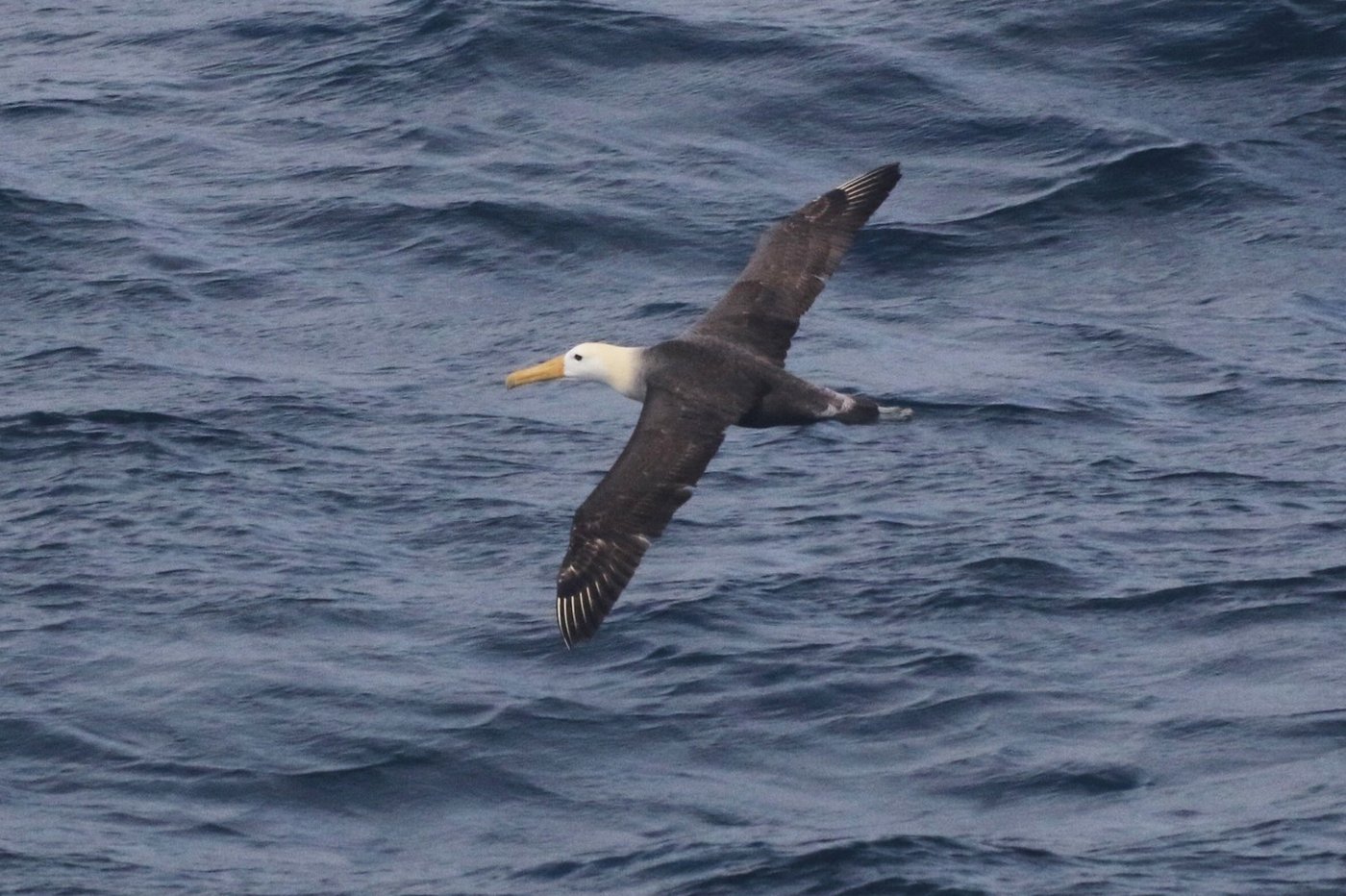
LOS ANGELES (AP) — Scientists on a research vessel off the central California coast spotted a waved albatross, marking just the second recorded sighting of the bird north of Central America.
The yellow-billed bird with black button eyes, which can have an 8-foot (2.4-meter) wingspan and spends much of its life airborne over the ocean, also came with a mystery: Researchers wonder how and why a species known to breed in the Galapagos Islands — roughly 3,000 miles (4,800 kilometers) away — ventured so far north.
To scientists, it’s a “vagrant” bird, one traveling far outside its typical range. It was spotted 23 miles (37 kilometers) off the coast of Point Piedras Blancas, roughly midway between San Francisco and Los Angeles.
The adult bird “doesn’t seem to be in a hurry to get back south,” said marine ornithologist Tammy Russell, who was on board the vessel and noted that the same bird apparently was spotted in October off the Northern California coast.
“I can’t even believe what I saw,” Russell wrote on Facebook. “I’m still in shock.”
Russell, a contract scientist with the Farallon Institute and a postdoctoral scholar at the University of California, San Diego, Scripps Institution of Oceanography, said it’s all but impossible to determine why the bird ended up so far from its home.
It could have been driven north by a storm. Some birds have a rambling spirit and just go farther than others.
“It likely didn’t breed last season because adults lay their egg in spring and the chicks leave the nests by January,” Russell said in an email. “Perhaps it went wandering on its year off and will soon return to the Galapagos to be reunited with its mate for the next season?”
“Who knows how long it will stay around or if it will ever return?” Russell added. “But that’s why these sightings are so special.”
Marshall Iliff, eBird project leader at Cornell University’s Lab of Ornithology, said seabirds such as albatrosses can travel great distances in search of food.
“The odd individual routinely may turn up far from home, even in the wrong hemisphere or exceptionally in the wrong ocean,” Iliff said via email. “Food shortages could prompt a bird to wander, but a single bird could also be a fluke accident. There is no evidence at this point that this is anything but a fluke.”
The International Union for Conservation of Nature calls the bird — the largest in the Galapagos — critically endangered. According to the American Bird Conservancy, its range is restricted to the tropics. It nests on lava fields amid scattered boulders and sparse vegetation.
The life span of the birds can reach 45 years. They feed primarily on fish, squid and crustaceans.
Russell noted that if multiple birds were being seen in California, it could be a sign they were being driven northward by environmental factors. Previously, she has written about five species of Booby that are now common off California because of warming temperatures and marine heatwaves.
As for the lone albatross, “If this is a sign of this species moving north, we now have some baseline data when we first detected one,” Russell added.
News from © The Associated Press, . All rights reserved.
This material may not be published, broadcast, rewritten or redistributed.

This site is protected by reCAPTCHA and the Google Privacy Policy and Terms of Service apply.
Want to share your thoughts, add context, or connect with others in your community?
You must be logged in to post a comment.