Elevate your local knowledge
Sign up for the iNFOnews newsletter today!
Sign up for the iNFOnews newsletter today!
Selecting your primary region ensures you get the stories that matter to you first.
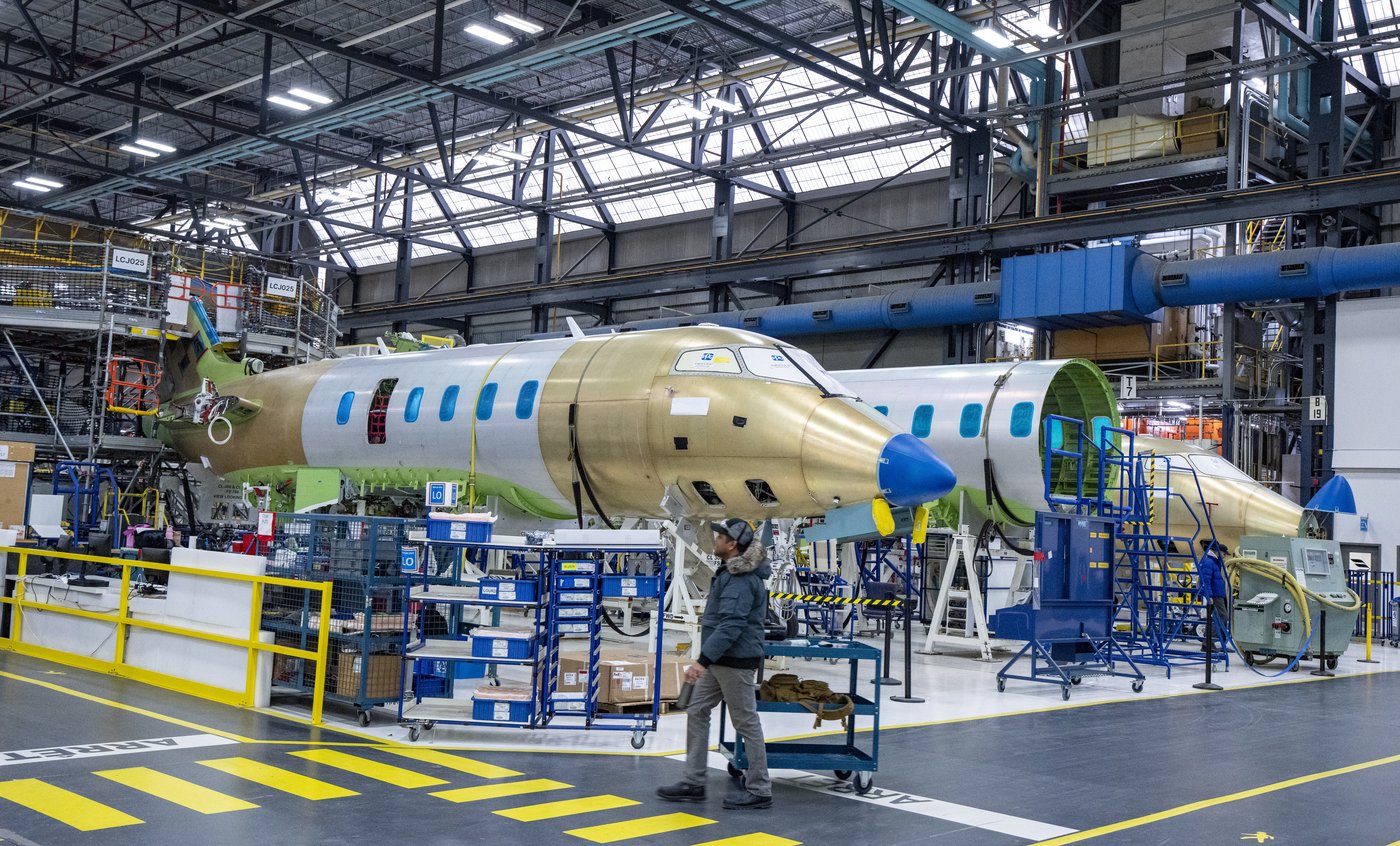
MONTREAL — Experts are casting doubt on U.S. President Donald Trump’s ability to ban new Canadian-made aircraft from American skies in a proposed move that would deal a blow to plane makers, airlines and travellers on both sides of the border.
Regulatory authority for plane certification in the U.S. rests with the Federal Aviation Administration, former Canadian Transportation Agency member Jean-Denis Pelletier said.
“The FAA is controlling the certification,” he said. “Mr. Trump has no authority to do that.”
Added John Gradek, who teaches aviation management at McGill University: “The president doesn’t decertify; the FAA decertifies.”
On Thursday, Trump singled out Bombardier Inc. in a threat to decertify and tariff Canadian-made aircraft, marking the latest escalation of trade tensions between the two countries.
The president inaccurately alleged in a Truth Social post that Canada has refused to certify four types of business jets made by Bombardier-rival Gulfstream, based in Savannah, Ga., framing the decision to hold off as illegal. Canada has certified two — the G500 and the G600, but not the G700 or G800.
“We are hereby decertifying their Bombardier Global Expresses, and all Aircraft made in Canada, until such time as Gulfstream, a Great American Company, is fully certified, as it should have been many years ago,” Trump said.
The U.S. administration later tempered that statement, indicating the ban would apply only to new aircraft rather than the more than 5,400 Canadian-built planes and helicopters registered in the United States.
“Subsequent clarifications by administration officials suggest that Canadian-made aircraft in operation already would not be grounded due to a move to decertify,” said National Bank analyst Cameron Doerksen in a report. A White House official confirmed to The Canadian Press that only aircraft that have yet to roll off the assembly line would be affected.
Aircraft constructed in Canada include Bombardier luxury jets and regional planes, A220 single-aisle jets made by French aerospace giant Airbus and helicopters from Texas-based Bell Textron. De Havilland Aircraft of Canada also produces the Dash 8-400 turboprop along with a number of other aircraft.
Historically, plane groundings by regulators have related strictly to safety, such as the Boeing 737 Max 8 being banned from the skies for 20 months during the first Trump administration.
“Threatening action by a safety regulator for political purposes would set a dangerous precedent in the aerospace industry — the FAA may not even have legal authority to ground a plane at the whim of the president,” Doerksen said.
The prospect of decertifying new planes even as identical aircraft already in service retain their airworthiness posed another head-scratcher.
“This is really strange, because certification of aircraft is a very, very long process. It takes years,” said Ross Aimer, CEO of California-based Aero Consulting Experts.
Gradek speculated that Trump’s threat to Canadian aircraft could stem from business interests at Virginia-based General Dynamics, which owns Gulfstream.
“Is there a safety concern with these airplanes? Is there a structural problem with these airplanes? No, you’re doing it for commercial reasons.”
In the lofty world of ultra-long-range business jets, Bombardier and Gulfstream are head-to-head rivals, with the Global series battling for market share against Gulfstream’s latest models.
The G700 and G800, which have not been green-lit in Canada, have been flagged because of possible de-icing concerns.
Canadian regulators typically follow their counterparts in the U.S. and Europe, where the planes have been approved.
But the U.S. certificate is conditional. Gulfstream has until the end of this year to prove that the two plane models function “properly under the probable operating conditions where ice may form in the fuel system,” according to a temporary exemption granted by the FAA in January 2024.
Any blow to Bombardier would be a blow to American companies, too.
Bombardier said it employs 3,000 people across nine sites south of the border and has 2,800 U.S. suppliers. The company’s jets typically boast at least 40 per cent U.S. content.
Meanwhile, the U.S. enjoys a large trade surplus with Canada in aerospace, meaning the general trade imbalance Trump has cited to justify other levies does not apply.
The International Association of Machinists and Aerospace Workers highlighted the tight-woven integration of the sector’s supply chains across the neighbouring countries, and the consequences of a potential tariff.
“It makes you less competitive to the U.S. market. By being less competitive, you sell less aircraft,” said David Chartrand, who heads the union’s Canadian contingent, in a phone interview from Toronto.
“It means job reductions. It means loss of contracts … There would immediately be casualties on that side of the border also.”
Chartrand, whose union represents some 15,000 aerospace and aviation workers in Canada, stressed that politics should have no influence over safety matters.
“You can’t weaponize the certification process and use it as a threat like that,” he said. “There’s no winner in this.”
Bombardier’s share price dropped about six per cent to close at $232.61 on the Toronto Stock Exchange.
Transport Minister Steven MacKinnon said in a social media post that departmental officials were in touch with their U.S. counterparts. He also said he spoke with Bombardier CEO Éric Martel on Thursday night as well as executives at General Dynamics.
“We are going to continue to support the aerospace industry and to ensure that we are there for Bombardier,” added Foreign Affairs Minister Anita Anand in an address at the Montreal Council on Foreign Relations — a speech that Bombardier executives skipped as they went into crisis mode.
A few kilometres north in the Montreal suburb of Laval, Jean-Denis Pelletier called for calm while warning about the economic risks should the groundings and tariff go ahead.
“I don’t think we have to panic,” said the former transportation agency official. “But this would affect very dangerously our economy in Quebec.”
This report by The Canadian Press was first published Jan. 30, 2026.
— With files from Kelly Geraldine Malone in Washington, D.C., and Dylan Robertson in Ottawa
Companies in this story: (TSX:BBD.B)
News from © The Canadian Press, . All rights reserved.
This material may not be published, broadcast, rewritten or redistributed.

This site is protected by reCAPTCHA and the Google Privacy Policy and Terms of Service apply.
Want to share your thoughts, add context, or connect with others in your community?
You must be logged in to post a comment.