Elevate your local knowledge
Sign up for the iNFOnews newsletter today!
Sign up for the iNFOnews newsletter today!
Selecting your primary region ensures you get the stories that matter to you first.
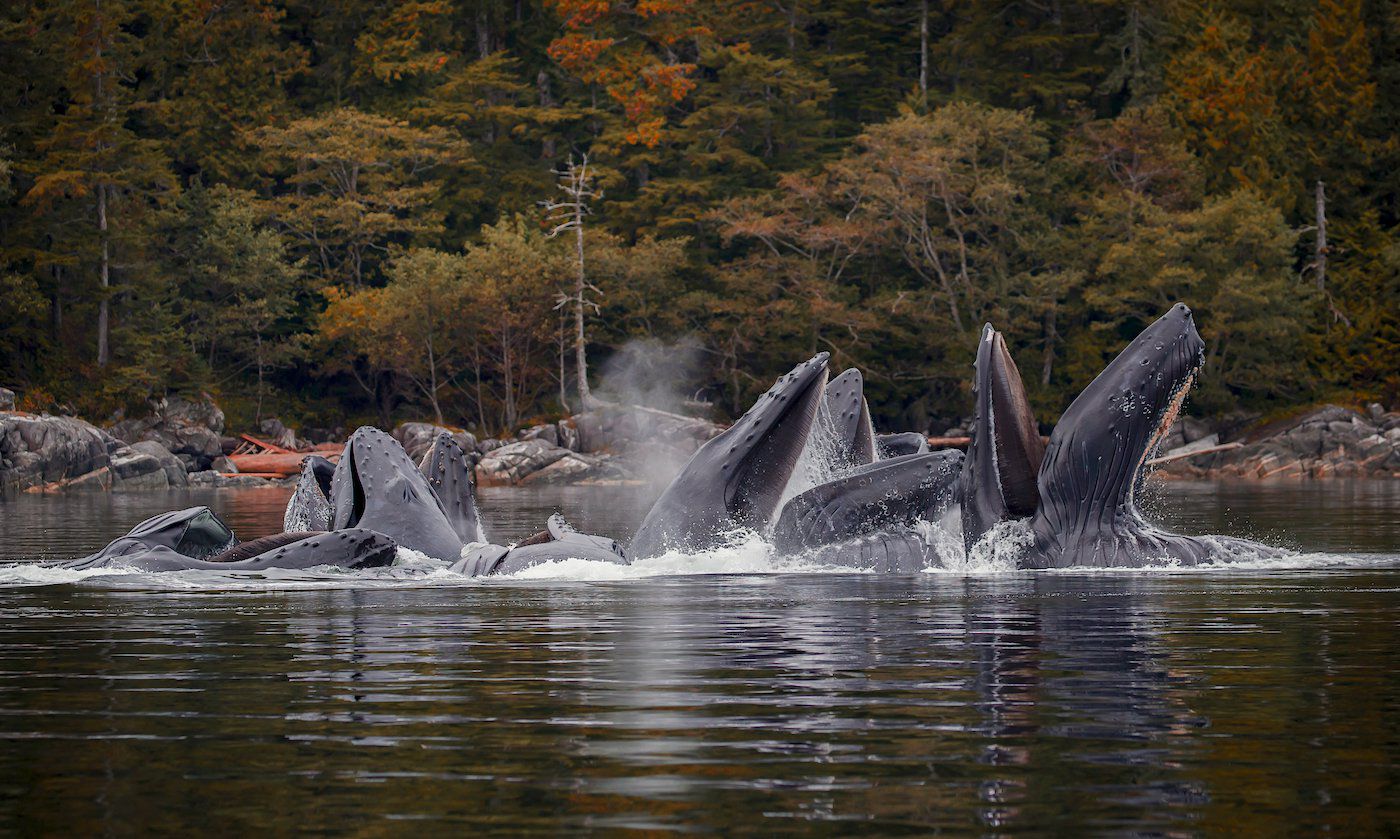
Whale researcher Janie Wray vividly remembers the first time she saw humpbacks bubble-net feeding on the northern BC coast more than 20 years ago.
First, the mournful calls begin at depth, followed by a perfect ring of bubbles rising through the water. Moments later, herring scatter and flash as they leap from the ocean as up to a dozen humpbacks surge upwards in unison, breaking the surface with their maws agape.
“We were a little blown away at first,” said Wray, CEO of BC Whales. “It’s just such a stunning observation.”
What the scientists on the Fin Island research station, which is located at the entrance to the Kitimat Fjord System, didn’t realize at the time was that what they witnessed wasn’t just a feeding event — but rather a shift in the whales’ cultural learning.
Bubble-net feeding is a cooperative, coordinated humpback hunting strategy that relies on the division of labour. One whale is tasked with singing the haunting song and another with blowing the bubble net, both of which concentrate the herring into a tight “bait ball” that makes it easier for all whales in the group to get a good mouthful.
Northern BC humpbacks aren’t just feeding — they’re learning bubble-net foraging through their social networks — expanding their menu and helping them adjust to a ocean changing rapidly due to human activity and warming waters. Video courtesy of BC Whales.
The strategy was initially limited to a core group of whales who repeatedly hunted alone or in groups. However, use of the tactic has dramatically increased over the past two decades among humpbacks that return to the region year after year, a new study by the North Coast Cetacean Society (BC Whales), the Gitga’at First Nation and Scotland’s University of St Andrews indicates.
Over time, humpbacks that hadn’t practiced bubble-net feeding joined experienced hunters, most likely learning the behaviour socially instead of relying on instinct, Wray said. The number of known bubble-net-feeding whales has grown from about 28 individuals in 2004 to 282 currently, representing nearly half of the humpback population of approximately 600 whales that frequent Gitga’at territorial waters, up from 27 per cent of the population at the time, she said.
Bubble-net feeding has long been documented in Alaskan waters, Wray said. The initial core group using the technique might have immigrated to BC from US waters as the Canadian humpback population began to rebound in the early 2000s after being nearly wiped out by commercial whaling. Long-term monitoring shows many humpbacks that now use the technique are regular BC residents, not newcomers that arrived already knowing how to do it, she added.
Whales will solo bubble-net, but tend to prefer to working in coordinated groups that can range from two to up to a dozen whales, Wray said. New learners have gone on to form their own buddy groups because the behaviour relies on strong relationships and cooperation, Wray said.
For example, two longstanding bubble-net feeders, Smiley and Jupiter, seem to play key roles and have been involved with other members of that original core group that feed together to this day, she said.
“These whales have a social bond that’s now lasted almost a quarter-century, which is remarkable,” she said.
Solo bubble-net feeders don’t always use the foraging call, but groups always do, Wray said.
“It’s pretty incredible to listen to. If I was to imitate it, I’d say it sounds a little bit like a wolf calling.”
The Fin Island researchers generally rely on underwater hydrophones to capture recordings of the call.
“Though, if you are close by when the whales are feeding you can hear it through the hull of the boat,” Wray said.
It’s not a given that all BC humpbacks will adopt bubble-net feeding. Some whales, especially older ones, don’t appear interested. Others attempt to join an established feeding team but don’t seem to make the grade.
“It’s interesting. We’ve seen whales that we’ve never seen bubble-net feed before go in, and they become part of the group,” Wray said. “Other whales have not been accepted, so we don’t know what’s behind that.”
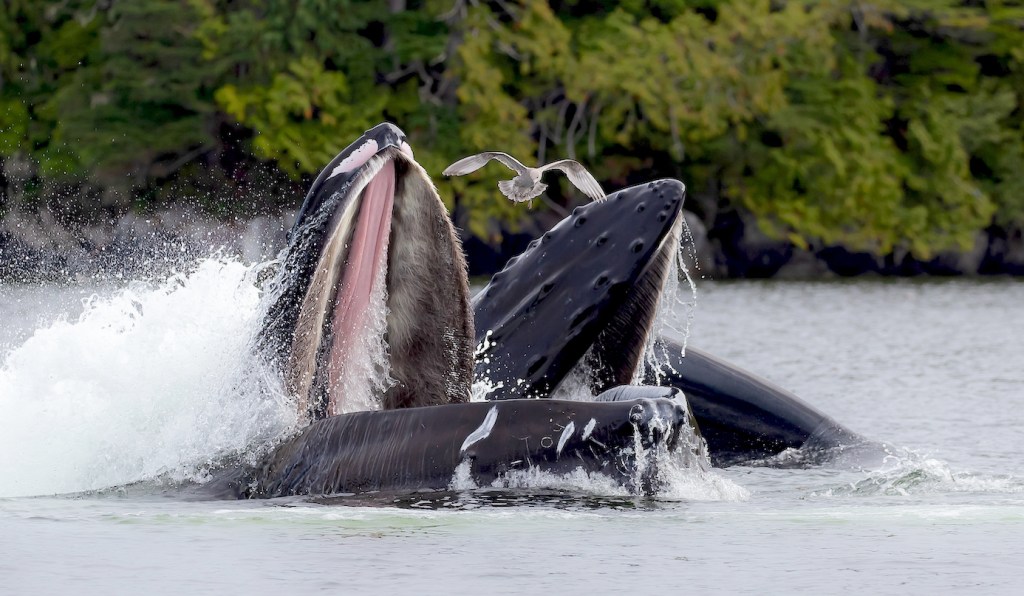
Longstanding partners and bubble-net feeders Smiley and Jupiter have helped teach other BC humpbacks the coordinated foraging technique that can help take advantage of different food sources and make the whales more adaptable to changing oceans.
The evolutionary advantage of adapting new ideas has been demonstrated in human societies, and the research shows that it’s also important for BC humpbacks’ survival and recovery, said Éadin O’Mahony, the study’s co-lead author.
“Species recovery isn’t just a numbers game,” O’Mahony said. “The survival and success of the population depends on whether important knowledge is shared and maintained within their social networks.”
The expanding cultural knowledge among BC’s humpbacks may help how well they adapt to shifts in the ocean environment due to human activity and climate crisis.
Bubble-net feeding is an additional foraging tool that expands the humpbacks’ menu, providing more access to fish, particularly herring, Wray said. Prior to taking up bubble-net feeding, humpbacks on the northern coast relied primarily on lunge feeding, often at night, when the animals charge schools of shrimp-like krill at the water’s surface with mouths open and strain them from water with their baleen plates.
The study’s findings have implications for marine conservation in narrow, intricate channels in the Kitimat Fjord system as shipping traffic, underwater noise and changes to prey supply from global warming continue to accelerate, the researchers noted.
A new swell of tanker traffic to the LNG Canada project in Kitimat means the humpbacks — either individually or when feeding in groups — are at greater risk of lethal ship strikes or having their foraging song and activities disrupted by the din of underwater noise from vessels, Wray said.
Finding ways to eliminate or minimize the impact of human activity on humpbacks and their key resources and feeding hotspots will allow them to continue sharing their knowledge with others, she said, adding bubble-net feeding is starting to pop up in southern BC waters.
“Protecting areas where distinct learned behaviours are concentrated could deliver conservation benefits that ripple far beyond local waters,” O’Mahony added.
“Cultural loss can be just as damaging as population loss — and potentially just as hard to restore.”
— This article was originally published by Canada’s National Observer
News from © iNFOnews.ca, . All rights reserved.
This material may not be published, broadcast, rewritten or redistributed.

This site is protected by reCAPTCHA and the Google Privacy Policy and Terms of Service apply.
Want to share your thoughts, add context, or connect with others in your community?
You must be logged in to post a comment.