Elevate your local knowledge
Sign up for the iNFOnews newsletter today!
Sign up for the iNFOnews newsletter today!
Selecting your primary region ensures you get the stories that matter to you first.
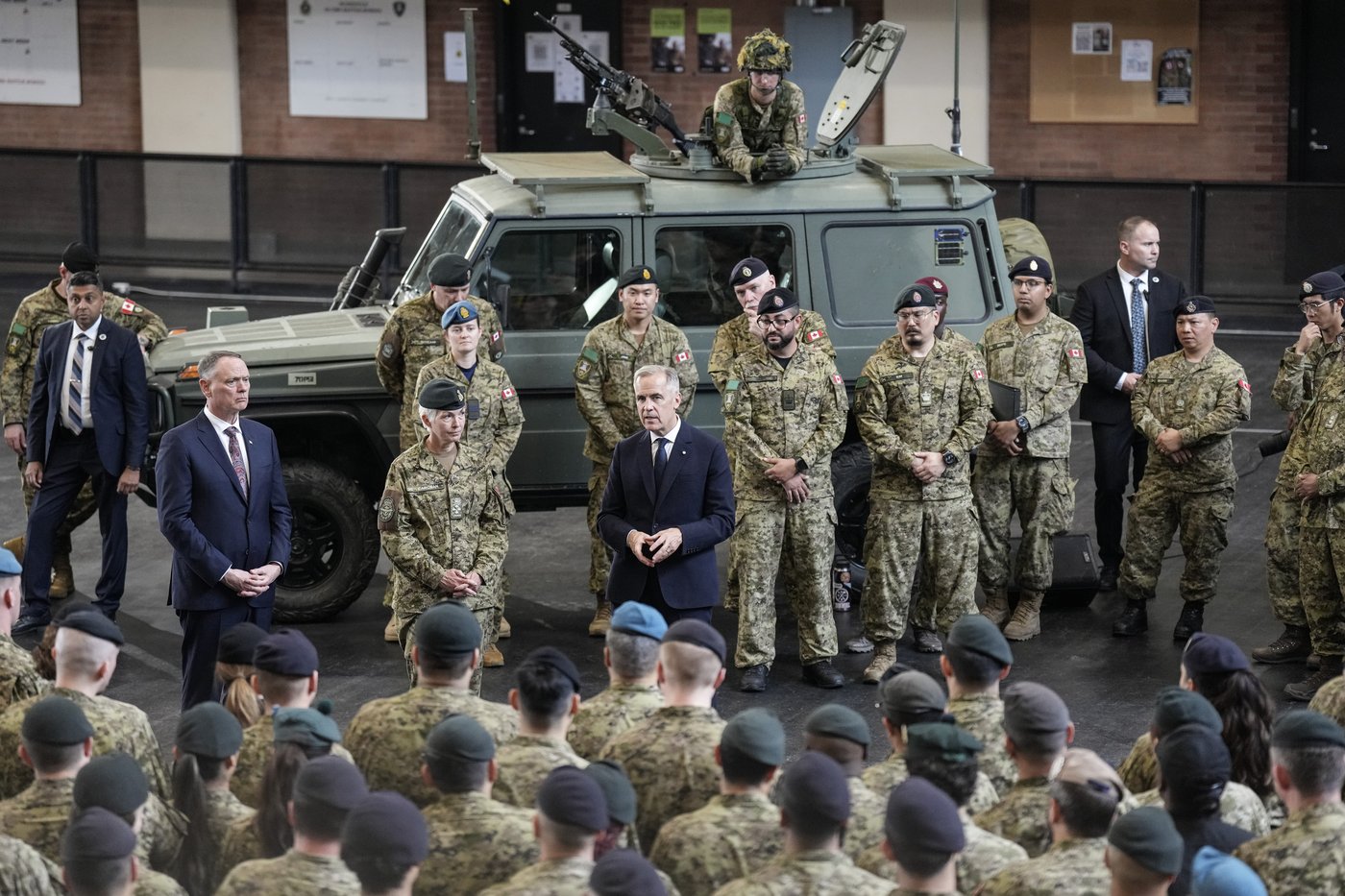
OTTAWA — Prime Minister Mark Carney sent a clear signal through his overtures to the domestic defence industry on Tuesday: it’s time to grow.
Carney announced the country’s first defence industrial strategy in Montreal, a $6.6 billion plan that lays out how Ottawa wants to build out the defence industrial base and scale up small and medium-sized Canadian businesses to create anchor firms on which the military can rely.
“This is a defining moment,” said Glen Lynch, CEO of Volatus Aerospace, a company that produces drones for both commercial and defence purposes.
His company has some 180 full-time employees across Canada, the U.S., the U.K. and Norway. It’s one of several drone companies the Canadian Army has been in talks with as it searches for ways to integrate modern unmanned aerial systems into its operations.
Lynch said his firm believes Ottawa is serious about scaling up firms in his sector — and is even making business decisions driven in part by the Carney government’s bold talk about boosting the defence sector.
Volatus is ramping up a drone manufacturing hub in Montreal, which is expected to add some 200 jobs over the next two years.
It also purchased an intellectual property portfolio out of the U.K. last year for large aerial platforms specifically designed for use in Canada’s Arctic, and is in the process of moving those manufacturing and engineering teams to Canada.
“For our industry, honestly, right now this is a rising tide,” he said.
Christyn Cianfarani, president of the Canadian Association of Defence and Security Industries, called the strategy a “landmark document” and the first federal strategy to publicly lay out a clear vision for the industry and a preference Canadian firms.
Right now, Canada’s defence manufacturing sector is made up of some 600 firms that employ around 81,000 workers.
The strategy vows to increase Canadian firms’ share of federal defence contracts to 70 per cent, boost Canada’s defence exports by 50 per cent and add 125,000 jobs to the sector over the next decade.
“Those are pretty aggressive,” Cianfarani said. “You’re not going to get there by just sitting on your hands and doing the same thing that you’ve always been doing.”
The government’s new strategy, which leaked out over the weekend but launched officially Tuesday, prioritizes building military gear domestically — especially to cover “sovereign capabilities” critical to national defence or Canada’s commitments to allies.
If the equipment can’t be built at home, the strategy says, Ottawa will partner with allies or buy directly from them under “strong conditions that spur reinvestment into the Canadian economy.”
The strategy also states Ottawa will select certain Canadian defence firms as “key strategic partners” and enter into formal partnerships with them to build “world-leading champions that can meet Canada’s needs.”
The blueprint seeks to strengthen supply chains. It also warns of a need to “mitigate” the risk of Canada getting locked into advanced military systems owned and controlled by foreign governments that can exert control over their intellectual property.
Deepak Dutt is the founder of Zighra, an Ottawa-based firm which makes counter-drone technology and is looking to scale up. He called the strategy “quite ambitious” and said it’s the kind of “reset we haven’t seen for decades.”
Dutt’s firm works in some of those “sovereign capability” fields mentioned in the strategy — artificial intelligence, sensors and electronic warfare — and he said he likes what he’s hearing about protections for IP and digital rights.
“It all comes down to execution,” he said. “The demand signal from a policy perspective is there. Now the procurement signal has to come. Then the capital will come.”
Not everyone is convinced that the government’s internal procurement processes will speed up without other reforms.
Conservative Leader Pierre Poilievre dismissed the plan as a buzzword-heavy document that leans on new bureaucracy rather than removing obstacles within the system that slow down procurement decisions.
“We have to move quickly, and that means eliminating all the bureaucracy and empowering our military personnel to make purchases directly of the new technology and equipment they identify and need with fewer steps,” Poilievre told reporters Tuesday outside the House of Commons.
“The days of having like 15 or 20 year procurement processes — they have to end,” he said, calling for “nimble” and “MacGyver-like” procurement of equipment and gadgets that can win wars.
The defence strategy promises a suite of policy shifts to come — such as planned legislative changes to the new Defence Investment Agency to make it an independent office.
But the document also cautions that “even with more efficient defence procurement, Canadian companies will still need to engage with multiple agencies.”
This report by The Canadian Press was first published Feb. 17, 2026.
News from © The Canadian Press, . All rights reserved.
This material may not be published, broadcast, rewritten or redistributed.

This site is protected by reCAPTCHA and the Google Privacy Policy and Terms of Service apply.
Want to share your thoughts, add context, or connect with others in your community?
You must be logged in to post a comment.















One response
And PP is dismissing it. Of course he is. Always trying to work together for the betterment of Canada (said with sarcasm)