Elevate your local knowledge
Sign up for the iNFOnews newsletter today!
Sign up for the iNFOnews newsletter today!
Selecting your primary region ensures you get the stories that matter to you first.
A decade ago, Bonnie and I completed and filed the required documents, paid our fees and our first adoption was a done deal. It was our Valentine’s Day gift to each other that year. We were very happy…so much so that we would pursue four more adoptions over the next ten years.
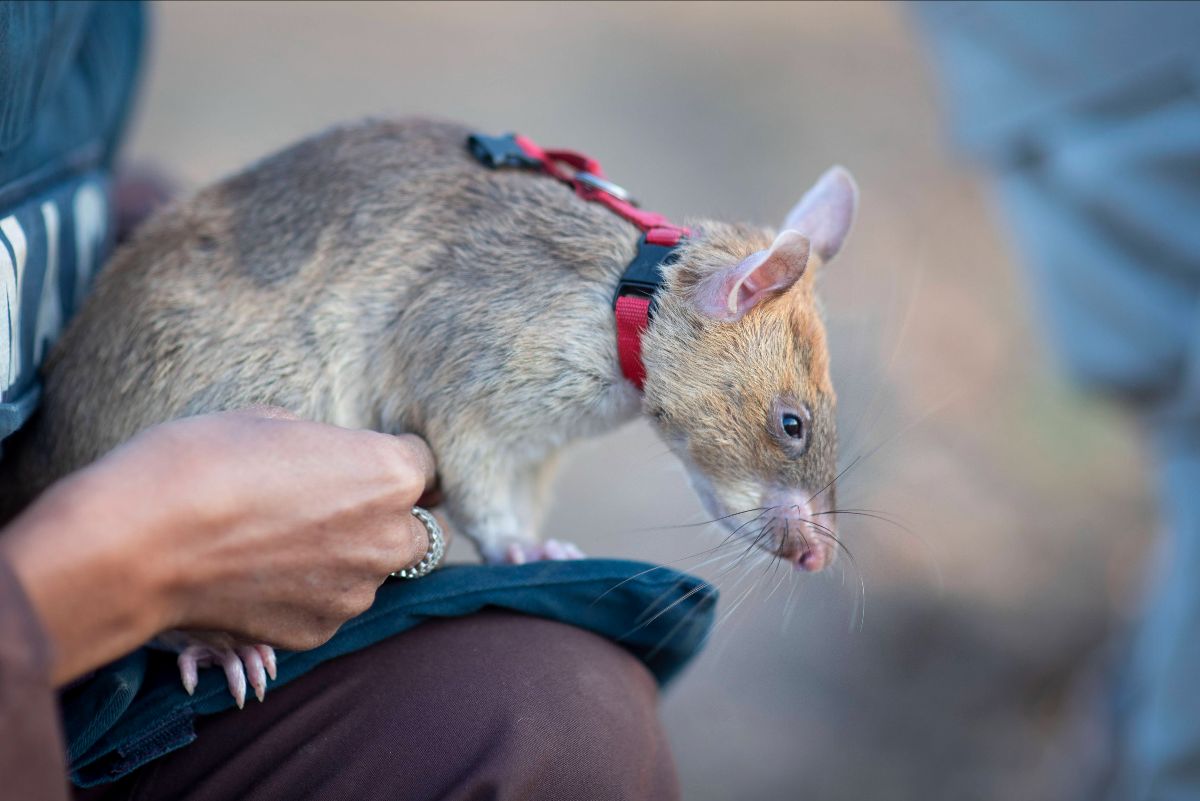
So, inevitably last week…we celebrated our fifth adoption…a little fellow named Imeldo. Born in Morogoro, Tanzania, on Sept. 16, 2024, he’s small, a little shy, but curious and hardworking. Wait, hardworking? He’s a year-and-a-half old!
As with all our other adoptees, Imeldo lives in Cambodia. And like his previous “brothers” and “sisters”…Imeldo is a rat. Obviously, not an ordinary rat. He is one of about nearly 200 Gambian pouched rats – members of the Muroidea super-family that includes hamsters, mice and voles and nearly 1,400 other rodent cousins – to earn the title…HeroRAT.

A HeroRAT is a special breed…they can develop skills and talents that range from detecting land mines in war-torn nations to diagnosing tuberculosis in humans. Indeed, all of our adopted rats are heroes. Nisay, a girl, was our first rat, then a string of boys…Marcous, Magawa, and Ronin…and now, Imeldo.
Sadly, Ronin died after a sudden illness earlier this year. The others “retired” happily. I always envision a rat sitting poolside beneath an umbrella popping banana chips with whatever might be a favourite rat beverage.
Ronin was a bit of a Super HeroRAT. He detected 111 landmines and 16 other unexploded ordinances during his career. He cleared 232,060 square meters of land in Cambodia…imagine the equivalent coverage of 900 tennis courts.
Ronin – like most HeroRATS – worked 30 minutes a day…covering roughly the area of one tennis court during that time. Ronin is in the Guinness Book of World Records for finding more landmines than any rat…any dog…or any human.
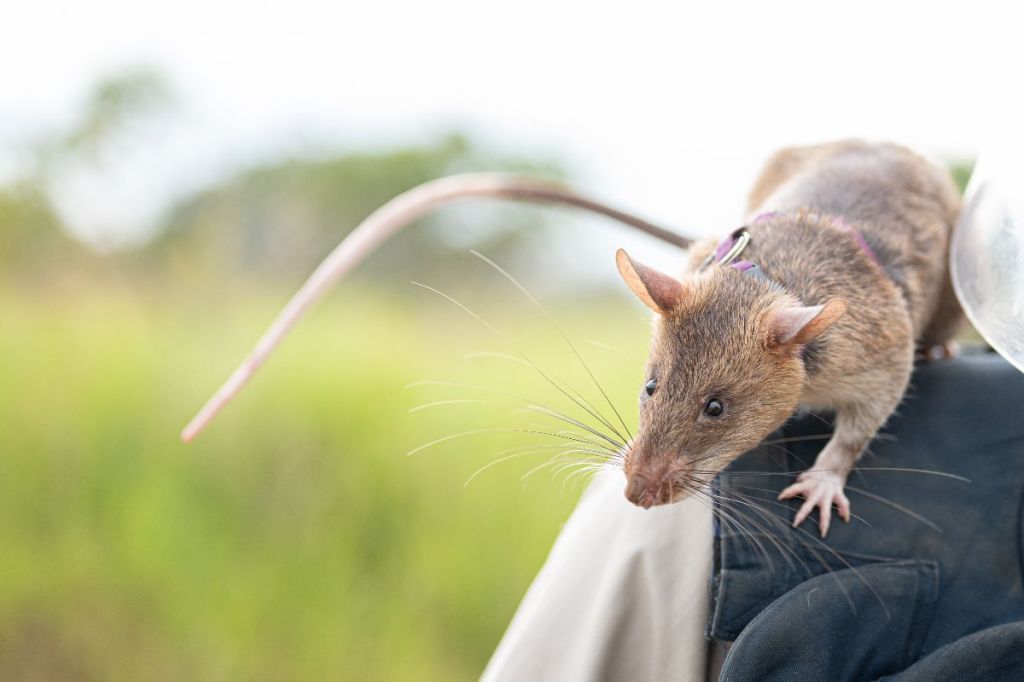
Beyond the record is the deeper meaning: families are able to return to their land, farmers are able to cultivate safely, and children are able to walk through their communities without fear of losing life or limbs.
By the way, Gambian pouched rats got their name from their cheeks, great for packing away their favourite fruits and nuts, though they are omnivorous creatures. The rats weigh no more than about three pounds…and their eyesight is so bad that members of the opposite sex always look good.
What they lack in visual acuity…they more than make up for in a highly sensitive sense of smell. They have better noses than Bloodhounds. Typically, land mines require about 11 pounds of pressure to detonate…trouble for humans…and even for trained bomb-detecting dogs.
But these HeroRATS have been on the job for nearly three decades…and not a single rat has died clearing land mines in areas ravaged by wars from Mozambique to Cambodia. Specifically, HeroRATS and their human handlers have cleared more than 130,000 land mines…returning more than 6,000 acres of land to farms and homes.
Unexploded land mines plague 64 countries worldwide. Some 6,279 people – mostly women and children – were killed and maimed last year, according to the International Campaign to Ban Landmines. Funding for land mine removal from governments have dropped for almost a decade…making private donations and adoptions critically important.
HeroRATS were the brainchild of Bart Weetjens, a Belgian student who kept rats for pets as a boy growing up in Antwerp. He knew they had highly developed olfactory skills, and as a humanitarian, he thought they could be trained to detect land mines. He founded a not-for-profit in Belgium called APOPO in 1997. It is an acronym that in English translates as Anti-Personnel Landmines Detection Product Development.
The trainers rely on operant conditioning, using a combination of click training and food rewarding. APOPO moved its headquarters from Antwerp to Morogoro, Tanzania in 2000, largely because of its affiliation with Sokoine University of Agriculture and the Tanzanian People’s Defence Force. This group trains the rats, and conducts rat-related research and development programs.
The training starts at weaning and takes about nine months. Most rats detect mines for about five years before retiring like Marcous…with not a worry for the remainder of their lives. Most rats live to be eight or nine years old. Like most rats, these rodents are nocturnal, which means they are docile and easy to manage during their workday.
And that workday consists of maneuvering through a mined area wearing a wired harness that allows them freedom of movement. Their sensitive little noses a couple inches from the ground and constantly twitching, the rats are trained to find trinitrotoluene (TNT), the chemical explosive component of virtually all land mines.
Their handlers mark with small flags the mines the rats detect, and a human crew comes by at day’s end with a small charge that detonates the mines from a safe distance. The rats work five days a week…weekends off.
The rats are well cared for…with regular veterinarian visits and comfortable free-ranging cages for homes. Also, the rats are accustomed to human handling early on – usually six weeks old – and don’t mind human touch. In fact, in hot climates the handlers often slather sun block on their little co-workers to ensure they aren’t sunburned.
If the rat story ended here…it would still amount to a rat PR coup, and start to make up for that whole “Black Death” thing in the 14th century. But, the story doesn’t end here. The research and development folks at APOPO in Tanzania started training the rats to sniff out tuberculosis (TB).
TB is one of the world’s most infectious disease killers…affecting nine million people each year, with another estimated 3 million going undiagnosed, and more than 1.5 million deaths.
Slow, inaccurate detection is a problem to be sure, with over-worked and under-funded government labs throughout Africa often miss-diagnosing or simply missing patient samples.
APOPO collects TB sputum samples from clinics, places them in rows of ten in the rat testing cages, and the rats start sniffing. Rats without fail sniff each sample in the row, and when the come to a positive sample, they sniff longer…a full four seconds.
They are more accurate by far than conventional lab testing…some 44 percent better than previous testing in Maputo, the capital and largest city in Mozambique. Plus, what takes a human two days to detect, a rat can finish in just 20 minutes. The reward for the rat…a great meal of banana and nut pulp. The reward for mankind…tens of thousands of human lives saved each year.
Imeldo – our latest adopted HeroRAT – has some big shoes (figuratively) to fill…but his handlers say he’s up to the task. Imeldo was this year’s Valentine’s Day gift to each other…it’s our tradition.
You can adopt or even gift a rat at www.apopo.org…who doesn’t want to give a gift of life?
News from © iNFOnews.ca, . All rights reserved.
This material may not be published, broadcast, rewritten or redistributed.

This site is protected by reCAPTCHA and the Google Privacy Policy and Terms of Service apply.
Want to share your thoughts, add context, or connect with others in your community?
You must be logged in to post a comment.