Elevate your local knowledge
Sign up for the iNFOnews newsletter today!
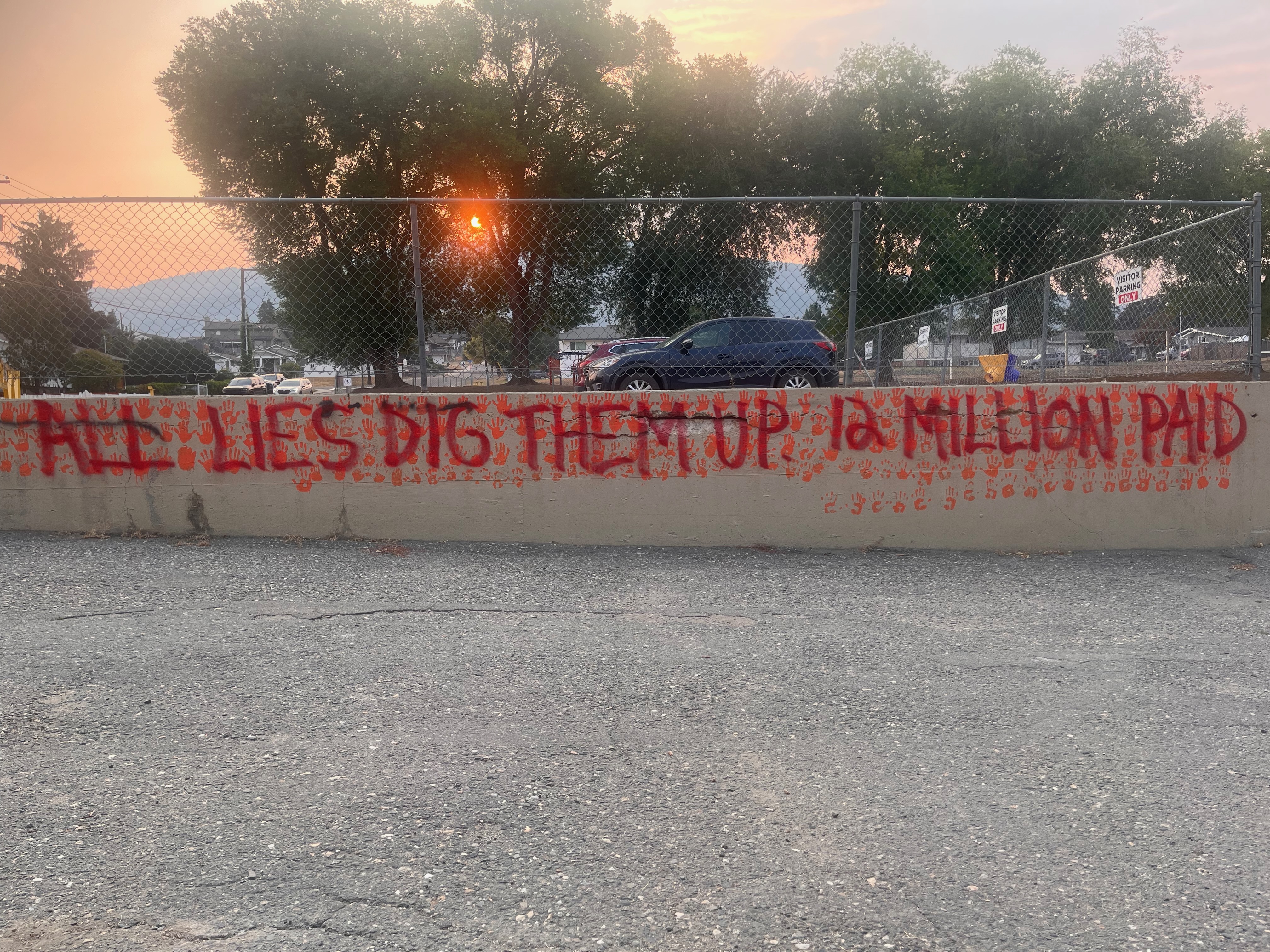
A mural at a Vernon elementary school honouring Canada’s residential school survivors became a target for racist graffiti this week, highlighting a mood change from armchair racists into physical action.
The racist words that appeared overnight on Aug. 19, were painted in large letters across a mural of hundreds of orange handprints on a wall at Vernon’s Silver Star Elementary.
“ALL LIES DIG THEM UP 12 MILLION PAID” the graffiti read in reference to the 2021 discovery of roughly 200 suspected bodies believed to be buried at the former Kamloops Indian Residential School.
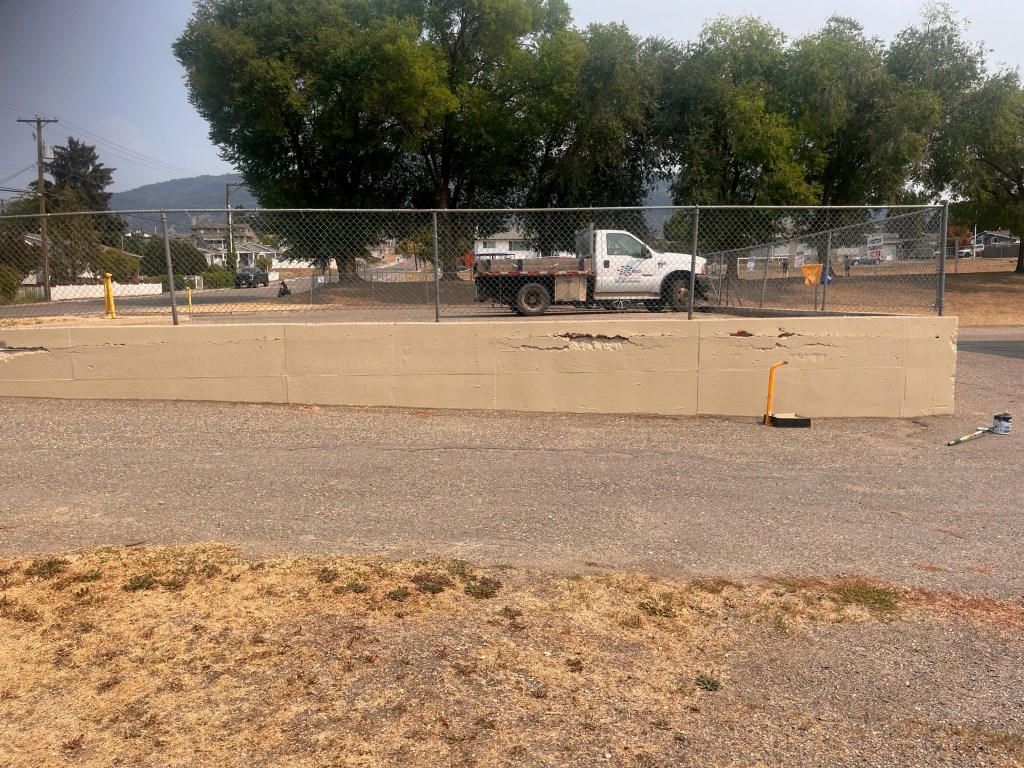
The school district was quick to remove the graffiti – and the mural underneath – but the message is an indicator of how emboldened some have become in spreading such messages.
“People in many different environments are becoming more comfortable sharing views that are… untrue and hurtful and racist,” UBC political science professor Stewart Prest told iNFOnews.ca. “This is a denial of history, and a denial of a traumatic history… that is part of Canada’s story.”
Prest said such attitudes have always been there to a certain extent, but in the last decade, and even over the past year, things have changed.
“Donald Trump in the United States and his willingness to… be openly racist, really emboldens other people to share their views similarly as well,” he said. Normalizing offensive racist language trickled all the way down to appear on the wall of an Okanagan elementary school.
When Tk’emlups te Secwepemc announced their findings in 2021, the band said the suspected graves may never be exhumed.
However, since the discovery, skeptics, often fuelled by right-wing publications, have claimed it’s a hoax to get federal funding.
This message has been pushed by BC One MLA Dallas Brodie, who on Aug. 20, incorrectly posted to social media that the story was “always meant” to get Canadians to drop their guards when it came to land claims.
The new BC Conservative leader Kerry-Lynne Findlay has challenged the idea of land claims and said she would repeal the Declaration on the Rights of Indigenous Peoples Act or DRIPA.
“When we have a significant number of public leaders from one side of the political divide that polarize (the) divide in our society… it becomes a lot easier for others to do the same thing,” Prest said.
According to University of Manitoba Indigenous studies professors Sean Carleton and Niigaanwewidam Sinclair, who recently published Truth Before Reconciliation: Confronting Residential School Denialism, pushing denial is a way of undermining public confidence in reconciliation.
Carleton and Sinclair said sowing the seeds of distrust and resentment can be used to develop political messaging to gain support and financial donations.
“This has created a situation where divisive and hateful political messaging has led to divisive and hateful actions, as people act on what has influenced them,” they said. “It poisons the political relationship between Indigenous peoples and settler Canadians whose past, present, and future are deeply interconnected and intertwined.”
In a recent essay penned by the Indigenous studies professors, the pair call out the Globe and Mail after a recent editorial cast doubt on the potential unmarked graves.
“The editorial is emblematic of the slow creep of residential school denialist rhetoric into mainstream discourse,” the essay stated.
Outside of the Kamloops residential school issue, the BC Supreme Court’s ruling Cowichan ruling that recognized Indigenous title has also fanned the flames.
“That seems to have been a real touchstone for people,” Prest said.
Polling firm Research Co. president Mario Canseco said views on Indigenous reconciliation changed in the months after the Cowichan decision.
“The drops are significant,” Canseco said. “It’s very rare to see something that was supported by 70-something per cent of BC residents suddenly dropping into the 50s.”
Canseco pointed out it’s still a majority of people that support reconciliation, but attitudes have changed.
“It certainly places the onus on the governments, particularly the federal and the BC government, to do something better to explain where this is going,” he said.
News from © iNFOnews.ca, . All rights reserved.
This material may not be published, broadcast, rewritten or redistributed.

This site is protected by reCAPTCHA and the Google Privacy Policy and Terms of Service apply.
Want to share your thoughts, add context, or connect with others in your community?
You must be logged in to post a comment.