Elevate your local knowledge
Sign up for the iNFOnews newsletter today!
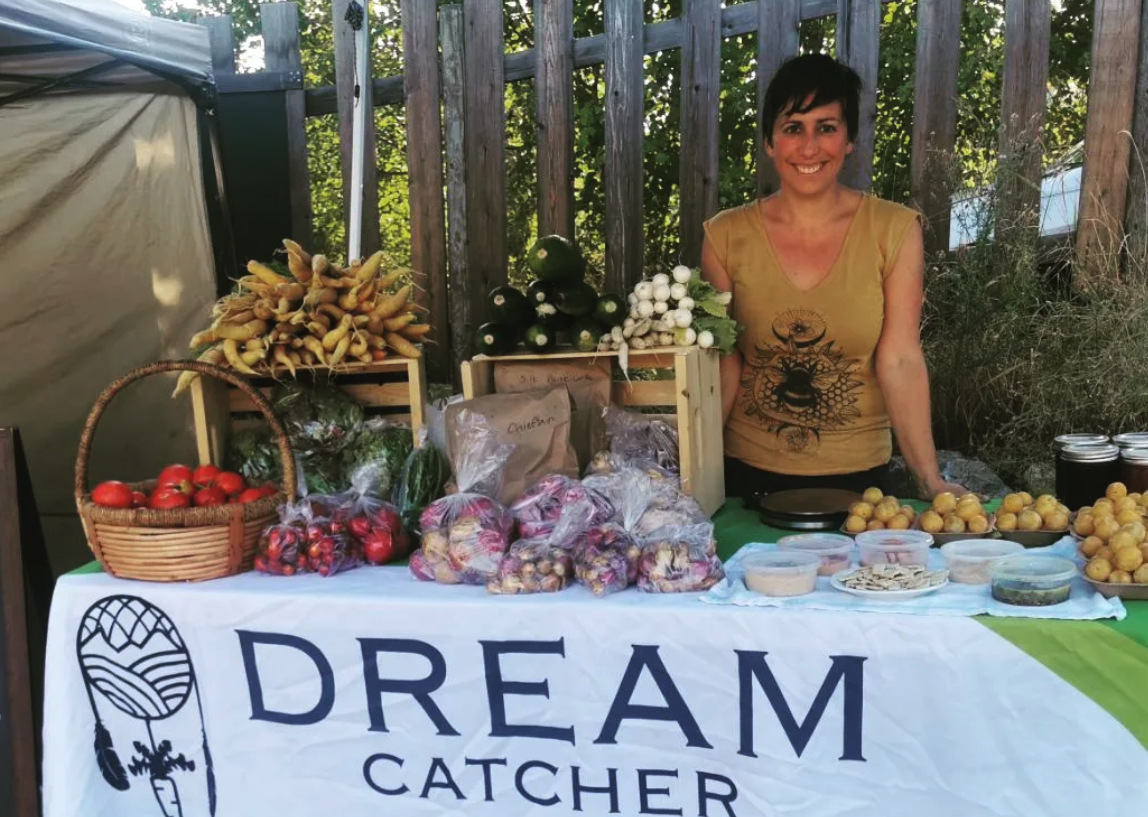
An Okanagan mushroom forager is perplexed at how poisonous mushrooms came to be sold at a Kootenay farmers market last month, saying the mushrooms look vastly different than the edible species they were labelled as.
Professional forager Scott Moran told iNFOnews.ca that the mushrooms sold look nothing like chanterelle mushrooms, and identifying them isn’t difficult.
“It’s just foolish,” Moran said. “It just makes no sense… you just don’t do that.”
The mushrooms were sold at the Harrop Community Hall by farm owner Naomi Legg, who identified them as chanterelle mushrooms.
However, the mushrooms turned out to be Paxillus involutus, also known as brown roll-rim or common roll-rim mushrooms, which can cause severe health outcomes if eaten.
It’s not clear how the mix-up was identified but the Interior Health Authority said the BC Drug and Poison Information Centre received a small number of calls related to the consumption of the mushrooms, and there were some reports of mild illness.
Legg, who owns Dreamcatcher Farm outside Nelson, has since taken to social media to apologize for her actions.
“It has shaken both me and many of you to the core and has eroded trust,” Legg posted to social media. “I want you to know that I am deeply sorry. I never would have knowingly try (sic) to harm you.”
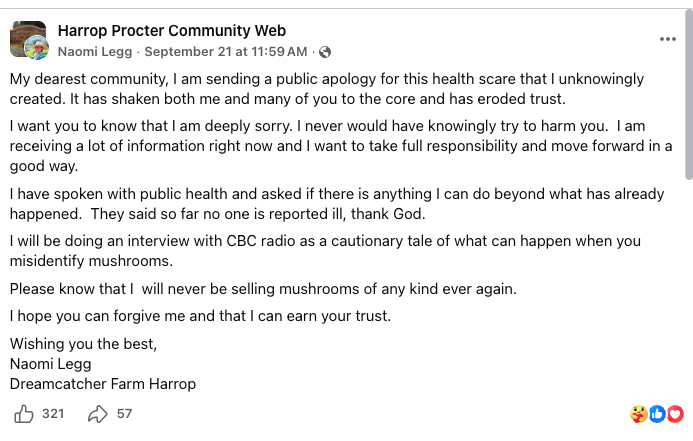
In an interview with CBC Radio, she said she found the mushrooms growing in her garden and thought they’d be a good addition to her market stall.
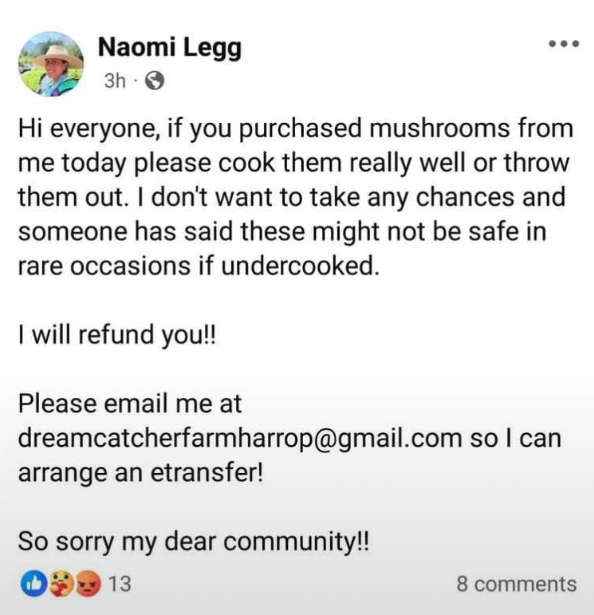
She has made numerous apologies for what happened, but in a since-deleted Facebook post she doesn’t appear to take the issue particularly seriously.
“Hi everyone, if you purchased mushrooms from me today please cook them really well or throw them out. I don’t want to take any chances and someone has said these might not be safe in rare occasions if undercooked,” she posted to Facebook, along with offering a refund.
In a text message, Legg told iNFOnews.ca she removed the post because she got better information.
While there are somewhere between 3,000 and 4,000 species of mushroom in the province, Moran said foragers only focus on a few varieties, and identification isn’t that difficult.
“I did it when I was a child,” Moran said. “(It’s) actually very easy.”
He said chanterelle mushrooms have ridges, not gills, which is one of the most identifying features of a mushroom. Moran reiterates it’s pretty easy to tell the difference.
“Just literally in one hour (with an expert) you could have it figured out,” he said.
Moran’s views are echoed by professional biologist and long-time amateur mushroom foraging guide Tyson Ehlers.
“I would never have thought somebody would be mistaking those two species,” Ehlers said. “I never would have expected that to get mistaken.
“There are things that look like chanterelles that are quite notorious. This one, it never occurred to me, would be mistaken for a chanterelle.”
Ehlers has been a foraging guide at the Sicamous Fungi Festival for more than 20 years and also guides at the Kootenay Mushroom Festival.
He said there’s a logical step to take when mushroom foraging.
“In identifying any wild mushroom to eat, one of the first thing you do is identify what… you shouldn’t eat,” he said.
The mushrooms sold by Legg have historically been considered to be edible mushrooms, Ehlers said. However, the mushroom was implicated in the poisoning of a German mycologist in the 1940s.
“He had been eating it with his family for years, and one year it killed him,” he said. “It causes a type of autoimmune reaction where it’s a cumulative buildup of the body’s response to this chemical… it doesn’t happen in everybody… but it can be fatal.”
According to the BC Drug and Poison Information Centre, on average there are about 200 mushroom poisonings each year.
From 2012 to August this year, there have been 2,784 reported mushroom poisoning cases. The vast majority, 85%, were unintentional exposures and more than half involved children under five years old. Nine percent of cases involved people who had intentionally eaten mushrooms. About 15% of people are referred to a health-care facility.
Fatalities are very rare, but in 2016 a child died from exposure to a death cap mushroom, the most poisonous mushroom in the world.
While many people might be scared of misidentifying mushrooms, Elhers said it’s not as complicated as people may think because the ones that you know you can eat are quite distinctive from others.
“There’s no substitute for going out into the forest (with) somebody experienced and knowledgeable, having them say, this is it, smell it, feel it, pick it, taste it, (it) always grows with these plants,” he said. “In this case, the wild chanterelles would never have grown in your garden.”
Moran, who’s been foraging professionally for about 15 years, is baffled by what happened.
“It’s just very strange that somebody would just go and pick some random mushroom and think they had a good one,” Moran said. “It doesn’t make sense.”
Legg was not immediately available for comment.
News from © iNFOnews.ca, . All rights reserved.
This material may not be published, broadcast, rewritten or redistributed.

This site is protected by reCAPTCHA and the Google Privacy Policy and Terms of Service apply.
Want to share your thoughts, add context, or connect with others in your community?
You must be logged in to post a comment.