Elevate your local knowledge
Sign up for the iNFOnews newsletter today!
EDMONTON — The decision to hold a live-fire training exercise at Canadian Forces Base Wainwright during a high-risk fire month will be part of the investigation into the fire that killed four soldiers and injured dozens.
Military officials said the grass fire broke out Saturday on a grenade range at the base southeast of Edmonton in a permanent danger area, which prevented firefighters from putting it out early on.
The fire was being monitored when, in the afternoon, a strong wind quickly shot flames over to an area where the soldiers were in attack training.
The base’s training-range standing orders document cautions that units firing between August and October should plan early morning shoots when fire risk is lower.
The document says the fire-hazard risk is “normally low enough to permit the firing of most ammunition natures” before about 10 a.m.
Maj.-Gen. Wade Rutland of the 1st Canadian Division told reporters in Edmonton on Thursday the decision to hold it later in the day will be part of the review, but cautioned against reading too much into the document’s recommendations.
“That’s a guideline and commanders on the ground have to assess multiple factors in order to decide whether or not to go ahead with shooting,” he said, including the weather, dryness and the type of munitions involved.
“What needs to be looked at is what were the factors on that day, as opposed to general range guidelines.”
Training resumed on the base, although it is not the same kind of training conducted on Saturday, and the entire battalion will redeploy in the coming days.
Rutland said the military knows it must review its safety regulations, but emphasized Saturday’s devastating fire was an anomaly.
“We’ll be reviewing things like our ammunition and our range and training safety standards. Concurrent and ongoing investigations will examine every aspect of what happened,” he said.
Three investigations into the accident are taking place — two led by the military and one civilian.
Military police are leading a police investigation, while a military-led board of inquiry will look into the broader circumstances and recommend how to prevent this from ever happening again. The province’s chief medical examiner will look into the fatalities.
Rutland had told a Sunday briefing that the investigation could take at least a month. But on Thursday, he said he had “underestimated the scope” of the upcoming review by the military’s board of inquiry.
He said that panel’s fact-finding investigation will take “as long as it takes to examine all facets of the situation.”
Officials said 27 injured soldiers remain in various hospitals, with 13 in critical condition. Twelve others have since been released.
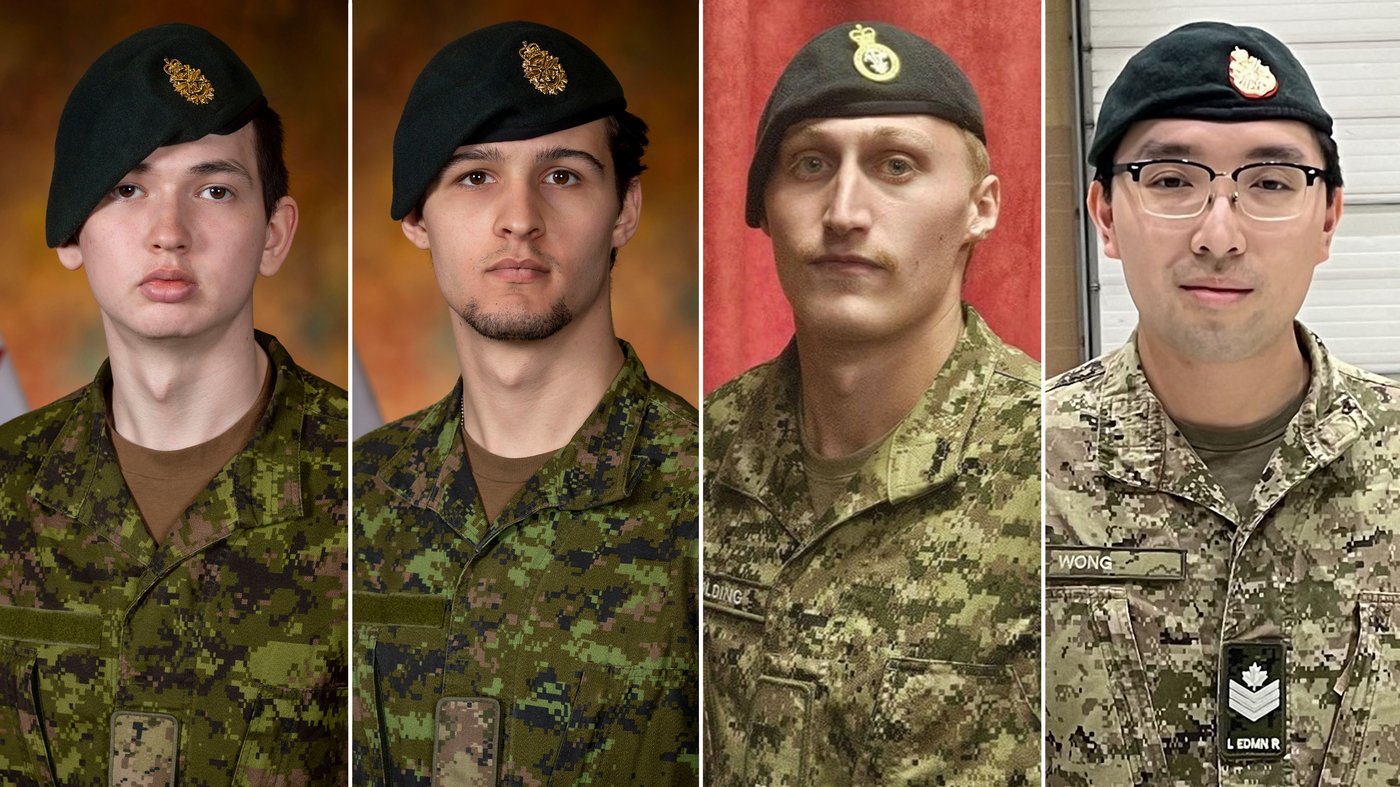
Those who died have been identified as: Pte. Shaun Farrell, 23, of Prince Albert, Sask.; Pte. Aidan Goulding, 23, of North Vancouver; and Pte. Hayden Lykkemark, 19, of Langley, B.C.; and Sgt. Morgan Wong, 26, of Edmonton.
The military helped transport 19 intensive care nurses and five operating room nurses from Toronto that specialize in burn treatment to assist.
Chief of the Defence Staff Gen. Jennie Carignan said she’s heartbroken by the tragedy that has devastated affected families and the wider military community. She promised the military reviews will take place with transparency.
“There are difficult questions about what happened,” she said. “I am acutely aware of our responsibility to establish the facts, share the findings and act on what we learn.”
Brig.-Gen. Vanessa Hanrahan, head of the military police, said 30 officers are on the ground investigating, but the information they can confirm right now is limited.
“The investigation has confirmed that the fire originated as a result of a training event that was taking place on the anti-grenade launcher range,” she said.
“Every other aspect of what happened, from the time that fire originated on that range to what we have today dealing with the tragic accident on a different range in that area, is still under investigation.”
There remains no indication natural gas infrastructure was a factor in the fire, she added.
Officials said the fire had spread at a rapid pace, bypassing fireguards and flying toward what’s called a pair’s range — where two soldiers work as a team to practise live-fire exercises.
Previously, officials had said the fire had leapt to the section attack range.
The fire continued to burn beyond the training base, but apparently did not deal any lasting damage to base infrastructure.
This report by The Canadian Press was first published Oct. 22, 2026.
— By Kyle Duggan in Ottawa, with files from Lisa Johnson in Edmonton
News from © The Canadian Press, . All rights reserved.
This material may not be published, broadcast, rewritten or redistributed.

This site is protected by reCAPTCHA and the Google Privacy Policy and Terms of Service apply.
Want to share your thoughts, add context, or connect with others in your community?
You must be logged in to post a comment.