


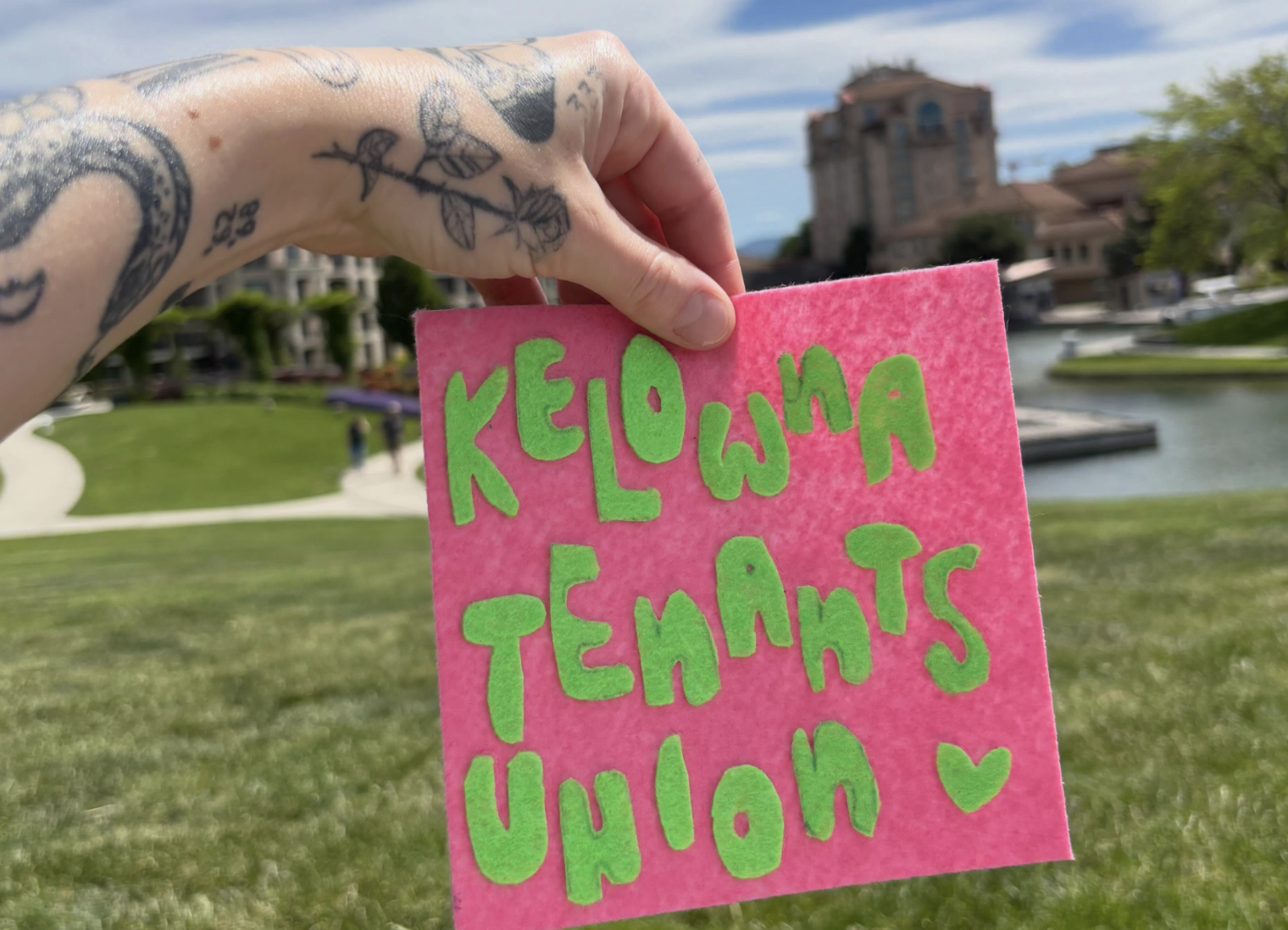
Kelowna tenants forming a union to protect renters’ rights

Tenants’ unions exist in major cities all across the country, and a group of renters in Kelowna have decided it’s time to have one as well.
The Kelowna Tenants Union is still in its infancy, but organizers have ambitions to make the city a better place for those who rent their homes. The goal is to organize for rent control, better living conditions and pool resources to help every tenant in Kelowna defend their rights.
“We’re kind of still in our doing the groundwork phase,” one of the union’s founders said.
iNFOnews.ca agreed to let the union’s spokesperson remain anonymous as they’re concerned about negative landlord reaction and future landlord bias against them.
“There is a big power imbalance,” they said. “We just want to make sure that we’re keeping folks in the union safe for now. I can’t foresee what’s going to happen in the future, even though tenant organizing is legal.”
Trevor McAleese is a candidate for Kelowna city council and he met with the Kelowna Tenants Union at one of their events recently. He’s a renter himself and said a tenants’ union could be a big help.
“It’s important that people who are renting, for one thing, understand what their rights are as tenants, but also have a body to turn to for resources and support,” McAleese said. “This would be more or less filling a gap that definitely exists.”
A tenant union, sometimes called a collective or an association, isn’t like a labour union. There are no collective bargaining rights for tenants in B.C.
Some things that tenant unions do is help people understand their rights, lobby for policy changes and help people navigate disputes through the Residential Tenancy Branch.
The Kelowna Tenants Union is trying to get people’s input to find out what would be most helpful for renters, as well as working to attract more members.
“What’s really important and something that’s really unique about tenant organizing is that it’s quite different in every city,” they said. “Trying to better understand what it is that folks, tenants, renters in this city specifically need.’”
The union is getting input from other organizations around the country like the Vancouver Tenants Union and The Montreal Autonomous Tenants’ Union.
“We were really inspired to get something similar going here,” they said. “We essentially saw a gap in Kelowna… it’s really awesome to look at them and see their successes. We can’t replicate, and that’s not the point of these conversations, it’s more so to learn what we can and then apply here within our context.”
Renters who want to join, or find out more, can go to a union event. Details are posted on the group’s social media. There isn’t a formal fee structure, it’s pay-what-you-can, but they said any money contributed to the union would go a long way.
“We’re not going to ask questions, pay what you can,” they said.
“If for whatever reason somebody can’t contribute financially we’re not going to exclude folks, but it’s really important to have that sense of accountability for becoming a member.”
Rent strikes make for viral headlines, but the Kelowna Tenants Union doesn’t see withholding rent as something that would work well here.
“A lot of tenant unions in larger cities organize in specific apartment buildings… so rent strikes are something that works really well in that situation,” they said. “In Kelowna, there’s unfortunately a lot of mixed apartment buildings where there’s a higher percentage of folks that actually own.”
The union organizer said one of the first issues it could help people deal with is the recent return of short-term rentals in the city.
“The interests of tourism are highly prioritized. Airbnb is like a massive parasitic kind of entity in this city,” they said. “There’s real consequences and it’s putting people into really tricky situations.”
The union said Kelowna could prioritize investment and tourism over homes for renters.
“The city is run by landlords. It is a city of developers. It is a city of the ruling elite class,” they said.
“Tenants over tourism. And I think that summarizes a lot of what we’re trying to advocate for.”
There are resources for renters to turn to right now.
B.C. has a Tenant Resource and Advisory Centre for renters who need some free legal or referral services and the CMHA’s Central Okanagan Rent Bank is a resource for people who need a bit of short-term help making their rent.
News from © iNFOnews.ca, . All rights reserved.
This material may not be published, broadcast, rewritten or redistributed.

Join the Conversation!
Want to share your thoughts, add context, or connect with others in your community?
You must be logged in to post a comment.







7 responses
I agree with both of the comments above. As a landlord I was advised not to rent to people on welfare. I have nothing against people on welfare, I did rent to a welfare recipient and found it next to impossible to get them out after they started letting a lot of people in to do their laundry on my shared machines, I’m talking garbage bags full every day. I let them move in with a small dog, after a couple of months there were 3 dogs and 2 cats that used the suite as their personal toilet. I rented to her and her daughter, soon there were 4 people living there. And I didn’t have the right to ask them to leave because she said that she had nowhere to go, meanwhile my house continued to be trashed. Finally I told her I’d pay her a months rent in cash and let her store her things in my garage until she found another place if she’d move out at the end of the month. Once all her things were in the garage I changed the locks and then had to spend $3,500 to repair the stench and the damage to the suite. And I’m a regular guy just trying to get ahead. Are all people on welfare like that, of course not. But unfortunately I wouldn’t rent to people on welfare after that; I feel for the good renters.
I understand why landlords switch to Airbnb, and unfortunately until landlords have more rights, I don’t see that changing.
So I agree with the writer’s statement, “There is a big power imbalance”, but all the power sits with the renter, not the landlord.
Again I agree. As a landlord we have to follow all the rules but if they are on welfare, welfare doesn’t let you keep the damage deposit or go after anyone for lost rent or damage
The power imbalance exists on the basis of wealth inequality. Renters are inherently at a disadvantage with one party OWNING and the other party paying the owner for a service. A service in which landlords sign up to take on. Such as repairs, maintenance etc. When you sign up to be a landlord you sign up for these responsibilities. Renters are paying for a SERVICE from a landlord, y’all should really start acting like it. The wealth disparity in BC is disproportionate, minimum wage in BC is $18.25/hour, before tax deductions that is $1460 per month in income. Tell me how you expect people working in the downtown core at minimum wage jobs and live down there where a cheap one-bedroom is around $1900. Landlords are asking us to go into debt to pay their mortgages.
Landlords need to have a registery
Where they can find info on past tenants who don’t pay rent,have been evicted,who destroy property.
That way the landlord decides who he is willing to rent to!
I agree 💯
I agree that there should be a landlord registry, for renters to warn one another of predatory landlords with poor practices.
As an ex landlord, there’s two sides to this. Residential tenancy provides more protection for tenants than landlords. My personal experience in collecting for unpaid rent and damage is next to impossible. All landlords are not well off with bags of money to cover mortgage payments when tenants don’t pay and repair damages. Bad tenants are why I got rid of my rental housing. Not all were bad but it’s the bad ones that make having rental housing unaffordable. If you want more rental housing that isn’t owned by big developers the law needs to make it easier for small landlords to collect rent and evict bad tenants